
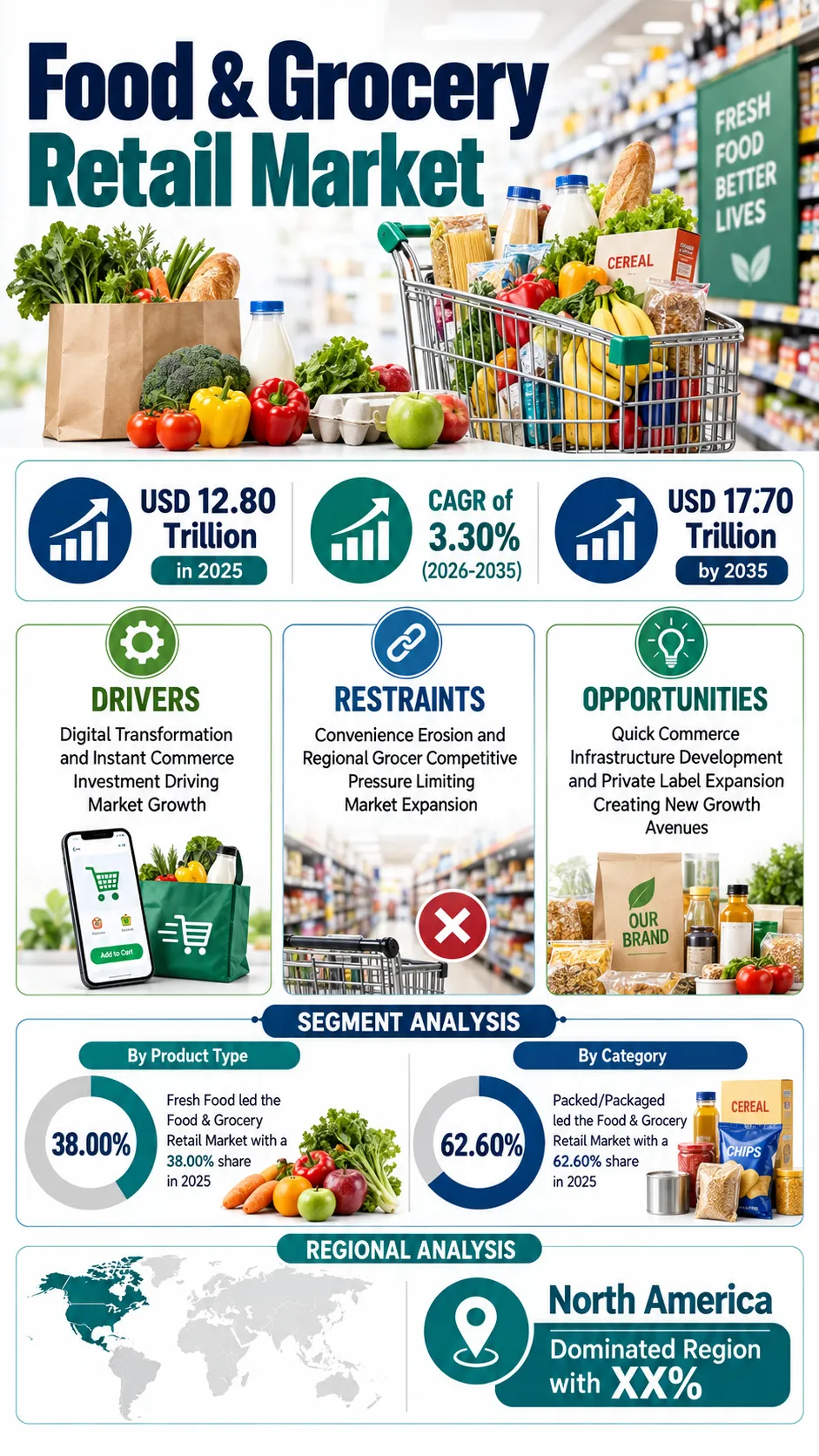
The global Food & Grocery Retail Market is set for steady expansion as retailers worldwide continue investing in instant commerce and digital transformation capability. "According to a recent study by SNS Insider, the global Food & Grocery Retail Market size valued at USD 12.80 trillion in 2025, is anticipated to grow to USD 17.70 trillion by 2035, registering a CAGR of 3.30% over the 2026-2035 forecast period."
There have been tremendous changes within grocery retail delivery technology over time due to which many retailers who aim at improving fulfillment speed can take advantage of this trend. This includes the need for more agile, instant commerce-ready systems that will provide consumers with the ability to receive groceries within minutes. This applies in situations where food and grocery retail spans supermarkets, hypermarkets, convenience stores, and online platforms.
Retailers are constantly working hard to ensure that their delivery systems perform better than before in order to meet various needs of convenience-seeking consumers worldwide.
To Get Detailed Insights on the Food & Grocery Retail Market – Request a Sample Report
Instant Commerce Retail Ecosystems Create New Demand
The food and grocery retail market has evolved from basic in-store shopping to more advanced quick commerce and mobile app-integrated use cases. The growing investment in 30-minute delivery infrastructure, private label brand development, and subscription-based delivery models for a variety of applications has required the development of more efficient and reliable retail systems.
New designs of grocery retail fulfillment can increase delivery speed, reduce operational friction, and allow for broader digital consumer engagement. This gives retailers the possibility to be more effective when serving customers and doing better market share capture.
Grocery retailers, quick commerce providers, and technology platforms are increasingly cooperating thanks to the growing interest in developing future solutions for instant grocery fulfillment.
Key Market Findings Highlight High-Growth Segments
The fresh food segment dominated all categories in the food and grocery retail market share with a market revenue share of 38.00% in 2025 due to sustained consumer demand for fresh produce, meat, dairy, and bakery items.
The fastest growing category is expected to be frozen food which will grow at a CAGR of 5.00% through 2035. This will be possible owing to the increasing convenience and food waste reduction benefits.
By category, packed and packaged products held the largest share of total market revenue of 62.60% in 2025 due to extended shelf stability. The unpacked and fresh segment will see the fastest growth in revenue generation at a CAGR of 4.20%.
Based on distribution channel, supermarkets and hypermarkets generated a share of 63.00% of market revenue in 2025 broad product assortment and established shopping habits. On the other hand, online distribution will be the segment recording the fastest revenue growth at a CAGR of 6.50%.
Distributive trends are changing as well. Traditional supermarket and hypermarket channels remain substantial, but online distribution will turn out to be the fastest-growing channel through 2035, on the back of 30-minute delivery services, quick commerce competition, and increased digital consumer engagement.
Speed, Convenience, and Digital Integration Gain Importance
In this regard, retailers have been looking at fulfillment systems that would make their delivery faster and require less operational friction and be more digitally integrated.
Innovation in 30-minute delivery infrastructure, mobile app engagement, and private label development has been making it possible for companies to come up with systems that can meet increasingly demanding consumer convenience expectations. In addition to that, increasing emphasis on quick commerce and subscription-based models is also making it possible for companies to find solutions that optimize customer retention.
Such trends are likely to become even more prominent in the future.
North America Emerges as the Largest Market Amid Rising Instant Commerce Investment
The North America region represented the largest regional market in 2025, owing to extensive supermarket and hypermarket infrastructure and a dense concentration of leading grocery retail giants. In addition, Asia Pacific is expected to be the fastest-growing market during the forecast period, propelled by rapid urbanization and applications across the region's fast-growing digital grocery infrastructure industries.
On the other hand, Europe represented a meaningful share of global market revenue in 2025, aided by a dense concentration of leading grocery retail chains and strong private label brand penetration.
Leading Companies Drive Innovation and Competition
The environment continues to stay very dynamic since players continue innovating on products and delivery technologies as well as forming partnerships in order to enhance their position in the industry.
Some of the major companies that operate in the global food and grocery retail market are Walmart Inc., Amazon.com, Inc., Costco Wholesale Corporation, Schwarz Group, Aldi Einkauf GmbH & Co. oHG, The Kroger Co., Carrefour S.A., Ahold Delhaize, Tesco PLC, Target Corporation, REWE Group, Seven & i Holdings Co., Ltd., AEON Co., Ltd., Albertsons Companies, Inc., EDEKA Zentrale Stiftung & Co. KG.
An SNS Insider Analyst Parry Kardani commented, "The rapid commercialization of instant commerce and quick delivery technology is creating unprecedented demand for high-performance grocery retail systems. Retailers that successfully combine delivery speed, digital engagement, private label differentiation, and advanced logistics capabilities will be best positioned to capitalize on emerging opportunities across supermarket, convenience, and online applications."
About the Author

Get in touch




