
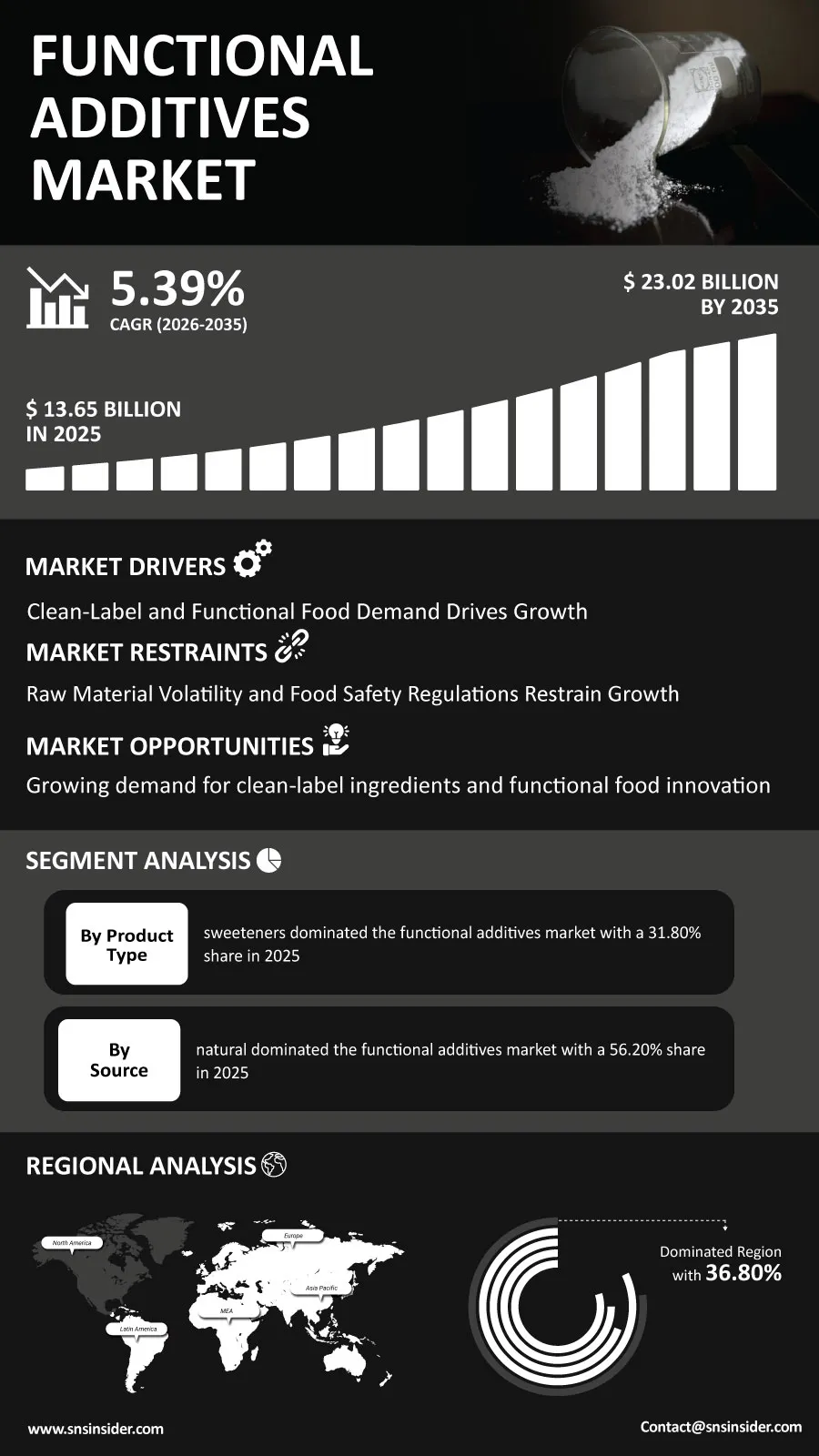
The Functional Additives Market around the world is poised to witness a period of sustained growth as food processors cater to changing eating habits, increased consumption of convenience foods, and higher standards of quality. “According to a recent study by SNS Insider, the global Functional Additives Market size valued at 13.65 Billion in 2025, is anticipated to grow to USD 23.02 Billion by 2035, registering a CAGR of 5.39% over the 2026–2035 forecast period.”
Demand will be driven by the requirements to enhance the quality and stability of packaged food items without losing out on taste, appearance, texture, and nutrition qualities. Food producers within sectors such as bakery products, dairy products, beverages, confectionery, meat products, and animal nutrition are increasingly using specialist ingredients for the benefit of formulation efficiency and usability.
To Get Detailed Insights on the Functional Additives Market – Request a Sample Report
Clean-Label Innovation Creates New Opportunities Across Food Manufacturing
Natural and authentic ingredients are becoming a very significant factor influencing the development of new products. There is an increasing tendency to look for preservatives of plant origin, natural dyes, alternative sweeteners, enzymes, emulsifiers, and other additives that could satisfy clean label requirements and provide satisfactory product performance.
Moreover, technology is widening the possibilities for applying functional additives. Innovations in fermentation technology, biotechnology, extraction technology, and formulation are providing opportunities for producers to create additives which will have better performance and more flexible applications. More sustainable sources and upcycling of raw materials are becoming popular among manufacturers who want to find solutions satisfying both consumers' and environmental requirements.
Examples of recent activities of the industry demonstrate such trend. For instance, Ingredion has been building capabilities to produce specialty ingredients by means of acquisitions and portfolio development in order to serve clean label, health-related, and functional foods applications.
Key Market Insights Highlight Evolving Ingredient Preferences
In terms of product type, sweeteners emerged as the leader with a market share of 31.80% in 2025 owing to widespread application in beverages, bakery products, dairy, confectionery, and processed foods. It is anticipated that food colorants would exhibit the fastest growth rate with a CAGR of 7.88% till 2035. Growing demand for colorful products and natural solutions for food coloring would drive the growth of this segment.
In terms of source, natural functional additives constituted 56.20% of the market in 2025, while synthetic additives would witness a CAGR of 5.80% during the forecast period. In terms of form, dry additives led the market with a share of 67.40%, whereas liquid additives would witness the fastest growth with a CAGR of 6.69%.
On the basis of application, bakery and confectionery comprised 28.10% of market revenue in 2025. Beverages is the fastest-growing segment with a CAGR of 7.37% till 2035 owing to the growing demand for fortified, low sugar, functional, and ready-to-drink products. In terms of function, preservation occupied the largest share of 30.40%, while coloring emerged as the fastest-growing function with a CAGR of 7.58%.
Processing Technology Accelerates Functional Ingredient Development
Food processing companies are turning to the use of high-level formulation techniques and automation in production processes in order to ensure quality and increase efficiency in production. Formulations are being produced that will help with the processing needs of the product as well as its storage quality, sensory characteristics, and nutrition profile.
In addition, with greater requirements concerning the safety of food products, the need for better ingredient traceability, formulation, and quality control is being encouraged. This is presenting new opportunities for organizations that can provide high-performance formulations.
Asia-Pacific Emerges as the Fastest-Growing Regional Market
North America held 36.80% of the total share of the Global Functional Additives Market in 2025, thereby holding the largest regional market position. The United States held 83.60% of the total share of the North American market owing to its large-scale food processing industry and the increasing preference for convenience products.
The Asia-Pacific region is anticipated to witness the fastest growth rate up to 2035 owing to urbanization, disposable income growth, packaged foods consumption growth, and investments in food processing. China held 41.80% of the total regional market share in 2025. Europe is still enjoying high demand for natural and functional ingredients whereas the Middle East & Africa and Latin America regions are showing potential through growing food processing capacity.
Industry Participants Strengthen Functional Ingredient Portfolios
Competition is still all about innovation in products, clean-label technologies, acquisition strategies, and new food applications. The top firms are developing natural and specialty ingredients for the purpose of meeting sugar reduction, preservation, texture improvement, coloring, fortification, and nutrition.
Key companies operating in the global Functional Additives Market include Cargill, Incorporated; BASF SE; DSM-Firmenich AG; Ingredion Incorporated; Kerry Group plc; Archer Daniels Midland Company (ADM); International Flavors & Fragrances Inc. (IFF); Givaudan SA; Tate & Lyle PLC; Corbion N.V.; Ajinomoto Co., Inc.; Roquette Frères; Sensient Technologies Corporation; Novonesis A/S; Kemin Industries, Inc.; Chr. Hansen Holding A/S; Jungbunzlauer Suisse AG; and Döhler GmbH.
An SNS Insider analyst Himanshu Sharma commented, “The growing convergence of clean-label expectations, convenience-food consumption, and functional nutrition is reshaping ingredient innovation. Companies that combine natural sourcing, advanced processing capabilities, and application-specific functionality will be better positioned to capture emerging opportunities across global food and beverage markets.”
About the Author

Get in touch




