
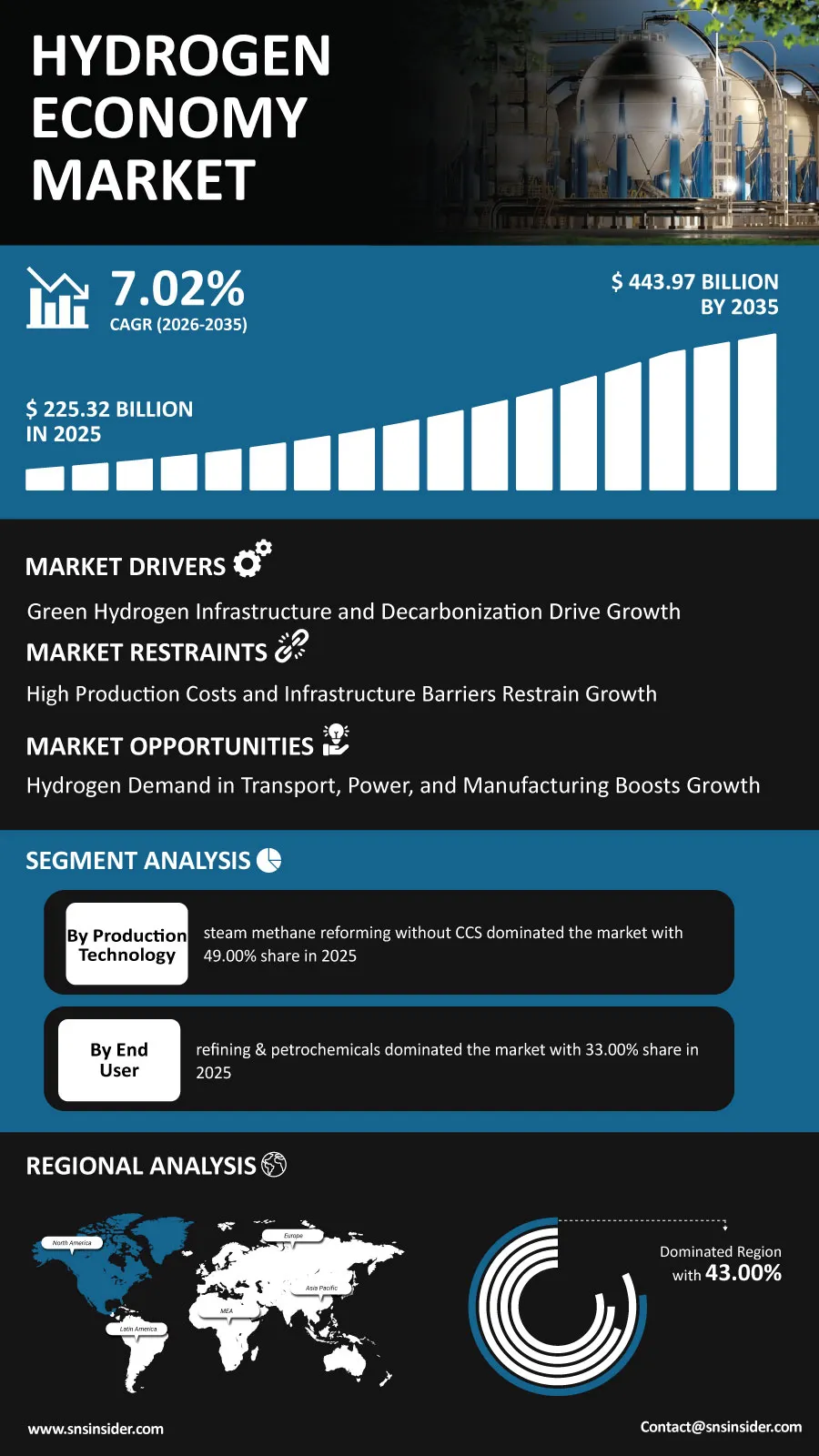
The global Hydrogen Economy Market is set to experience fast development due to increased investments in low carbon energy systems by both governments and industries. “According to a recent study by SNS Insider, the global Hydrogen Economy Market size valued at 225.32 Billion in 2025, is anticipated to grow to USD 443.97 Billion by 2035, registering a CAGR of 7.02% over the 2026–2035 forecast period.”
Hydrogen is assuming greater strategic significance in a wide range of applications such as refining, chemicals, fertilizer, steel, mobility, and power generation. The use of hydrogen is also going beyond the traditional raw material application due to its potential in energy firms for integrating renewable energy, storage purposes, and clean fuel system.
To Get Detailed Insights on the Hydrogen Economy Market – Request a Sample Report
Clean Energy Investments Create Significant Commercial Opportunities
Substantial investments in renewable hydrogen generation are opening new doors for electrolyzer makers, energy companies, industrial gas companies, utility companies, and infrastructure providers. The falling costs of renewable electricity, advancements in electrolyzers, and decarbonization efforts by governments are helping drive the commercial viability of hydrogen initiatives in leading economies.
Transportation is another area that is coming into focus for development, specifically heavy-duty transport like trucks and buses, railways, marine vessels, and others in which range and fast refueling would be an advantage. Hydrogen is also becoming popular in steel production, synthetic fuels, seasonal energy storage, and industries looking to replace fossil energy.
Key Market Insights Highlight Transition Toward Low-Carbon Hydrogen
In terms of hydrogen types, gray hydrogen was responsible for a 61.00% market share in 2025 owing to its well-established industrial infrastructure and high application rates in refining, ammonia production, methanol, and chemical industries. Green hydrogen, in turn, is estimated to show the fastest growing CAGR of 21.49% through 2035 owing to increased renewable energy generation, investments in electrolyzers, and increased decarbonization goals.
On the basis of production technologies, steam methane reforming without carbon capture and storage technology had a 49.00% share in 2025 due to its advanced infrastructure and widespread use in industry. Electrolysis is estimated to demonstrate the fastest growth rate with a 20.13% CAGR through 2035 due to increased electrification of hydrogen production from renewables.
By end users, refining and petrochemicals were responsible for 33.00% of market share in 2025 due to hydrogen being an important component in several refinery and chemical applications. On the other hand, transportation and mobility is estimated to have the fastest growing CAGR of 13.18% through 2035.
Digitalization and Electrolyzer Innovation Transform Hydrogen Production
Technology advancement is transforming economics and performance of hydrogen production processes. Technology companies are investing in development of proton exchange membrane electrolyzers, alkaline electrolyzers, and solid oxide electrolyzers by incorporating green energy into automated production systems.
Increasingly, artificial intelligence, predictive maintenance, digital twins, cloud monitoring, and real-time analysis technologies are being incorporated into hydrogen plants. These technologies could help plant operators detect problems with their equipment earlier, reduce energy usage, and enhance production scheduling at the increasingly complex hydrogen plants.
Regional Markets Reflect Diverse Hydrogen Development Strategies
North America was the leading regional segment with a market share of 43.00% in 2025, owing to high consumption of industrial hydrogen, presence of well-established refining and petrochemical industry, support from government initiatives on clean energy and hydrogen infrastructure. In North America, the U.S. contributed 92.00% of total market revenue in 2025, with high demand from refining, chemicals, fertilizers, industrial manufacturing, and new clean hydrogen projects.
Asia Pacific is expected to become the fastest growing regional market with a CAGR of 7.50% up to 2035. Key countries including China, Japan, South Korea, India, and Australia are making progress in electrolyzer production, hydrogen mobility, green ammonia, renewable hydrogen, and export-led projects. Europe is reinforcing its position through renewable hydrogen policies, industrial decarbonization, hydrogen valleys, and international hydrogen infrastructure.
Industry Leaders Expand Hydrogen Technology and Infrastructure
Hydrogen Economy Market competition is becoming more oriented towards efficiency of production, electrolysis techniques, storage methods, fuel cell technology, optimization, and hydrogen infrastructure. Big players are engaging in collaborations, projects, improvements in technology, and low-carbon production to benefit from opportunities brought by energy transition worldwide.
Key companies operating in the global Hydrogen Economy Market include Air Liquide, Linde plc, Air Products and Chemicals, Inc., Plug Power Inc., Nel ASA, Cummins Inc., Bloom Energy Corporation, Ballard Power Systems Inc., ITM Power plc, Siemens Energy AG, thyssenkrupp nucera AG & Co. KGaA, Shell plc, TotalEnergies SE, bp plc, Mitsubishi Power, Kawasaki Heavy Industries, Ltd., Chart Industries, Inc., Fortescue Ltd., Hexagon Purus ASA, and ENGIE SA.
An SNS Insider analyst Himanshu Sharma commented, “Hydrogen is moving from a conventional industrial feedstock toward a broader energy and decarbonization platform. Continued investment in electrolyzers, renewable power integration, storage, mobility infrastructure, and intelligent plant operations will be critical to reducing costs and accelerating commercial adoption across hard-to-abate industries.”
About the Author

Get in touch




