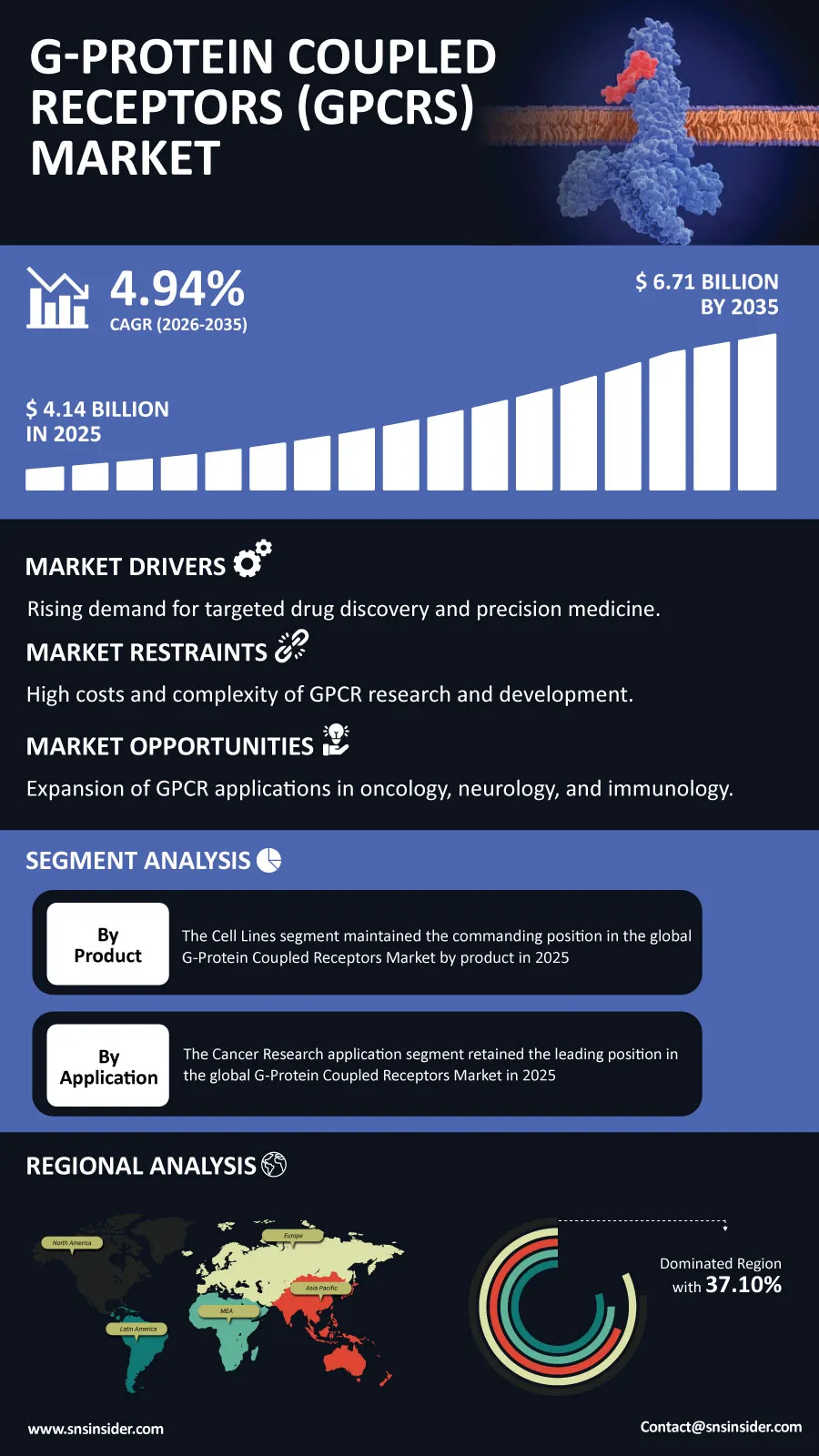
The global G-Protein Coupled Receptors (GPCRs) Market is projected to witness sustained growth as pharmaceutical companies, biotechnology firms, and research institutions continue to expand investments in next-generation drug discovery platforms. “According to a recent study by SNS Insider, the global G-Protein Coupled Receptors (GPCRs) Market size valued at USD 4.14 Billion in 2025, is anticipated to grow to USD 6.71 Billion by 2035, registering a CAGR of 4.94% over the 2026–2035 forecast period.”
With the rising demand for precision medicine, structural biology advancements, and fast-paced developments in drug discovery computing technology, the field of GPCR research is being revolutionized. As one of the most researched target families in developing therapeutic drugs, GPCRs remain highly relevant for the development of treatments against diseases ranging from cancer to neurological and cardiovascular illnesses.
Healthcare innovators are increasingly combining artificial intelligence, advanced molecular biology, and high-throughput screening technologies to accelerate therapeutic discovery while improving the efficiency of early-stage drug development.
To Get Detailed Insights on the G-Protein Coupled Receptors (GPCRs) Market – Request a Sample Report
Artificial Intelligence and Structural Biology Accelerate Drug Discovery
The recent breakthroughs in computational biology have led to an improved approach to the research of GPCRs by making it possible to quickly find potential candidates for drug development. The use of artificial intelligence, machine learning, and new technologies in structural analysis is facilitating a deeper understanding of the processes in receptors and better treatment design for difficult targets.
The increased popularity of new imaging and computational technologies is also contributing to the discovery of very selective drug candidates that can increase efficiency while decreasing the impact on other biological processes. It is hoped that such discoveries will be beneficial for further pharmaceutical research.
Increasing collaboration between biotechnology companies, academic institutions, and global pharmaceutical organizations is further accelerating innovation throughout the GPCR ecosystem.
Key Market Findings Highlight Future Growth Opportunities
Among product categories, cell lines accounted for approximately 46.1% of global market revenue in 2025, reflecting their critical role in receptor characterization, assay development, and pharmaceutical research workflows.
Meanwhile, detection kits are projected to register the fastest growth throughout the forecast period, supported by increasing demand for standardized, ready-to-use assay solutions that improve laboratory productivity and testing efficiency.
From an assay perspective, cAMP functional assays represented approximately 28% of total market revenue in 2025, maintaining their importance across receptor signaling studies and drug screening applications. At the same time, calcium functional assays are expected to experience the strongest growth through 2035, driven by expanding research into neurological disorders, oncology, and cardiovascular diseases.
Application trends continue to evolve rapidly. Cancer research accounted for approximately 31.2% of market revenue in 2025, underscoring the growing importance of GPCR biology in oncology drug development. However, central nervous system (CNS) research is expected to emerge as the fastest-growing application area, supported by increasing investments in therapies targeting neurological and psychiatric disorders.
By end user, pharmaceutical and biotechnology companies held approximately 52.1% of total market revenue in 2025, while contract research organizations (CROs) are anticipated to record the fastest growth, reflecting increasing outsourcing of specialized drug discovery and screening services.
Strategic Collaborations Continue to Drive Innovation
GPCR market is experiencing rising partnership activity between the pharmaceutical and the biotechnology sector, with an objective of hastening development cycles by broadening R&D efforts.
It is through strategic alliances, licensing deals, and technology partnerships that firms can leverage their knowledge in molecular biology, drug-designing technology, structural biology, and sophisticated screening techniques. The collaborations will not only help to fast track the development process but will also improve the probability of developing new GPCR-based treatments reaching the clinic.
Industry attention on orphan receptors, precision medicine, and new therapeutic approaches is opening up promising business prospects for the future.
Regional Markets Continue to Expand
North America constituted around 37.10% of the worldwide market revenue share in 2025, owing to superior pharmaceutical research abilities, biotechnology infrastructure, and huge investments made in innovations in life sciences. The region also benefits from superior academic research, funding and technology in drug discovery.
Asia Pacific is expected to grow as the fastest regional market, with a CAGR of around 6.12% between 2025 and 2035. Development of biotechnology ecosystem, pharmaceutical R&D investments, improvement in research infrastructure, and governmental initiatives have been making way for huge growth potential in multiple countries in this region.
Leading Companies Strengthen Research and Development Capabilities
Competition within the GPCR market remains highly dynamic as industry participants continue investing in innovative technologies, strategic collaborations, and expanded research capabilities to accelerate therapeutic discovery.
Key companies operating in the global G-Protein Coupled Receptors (GPCRs) Market include Thermo Fisher Scientific, Merck KGaA, Revvity, Promega Corporation, Eurofins Scientific, QIAGEN, Bio-Rad Laboratories, GenScript Biotech, Novo Nordisk, and AstraZeneca.
An SNS Insider analyst Parry Kardani commented, "Scientific advances in artificial intelligence, receptor biology, and precision drug discovery are opening new possibilities for GPCR-targeted therapeutics. Continued collaboration between pharmaceutical innovators, biotechnology companies, and academic researchers is expected to drive the next generation of medicines across multiple therapeutic areas."
About the Author

Get in touch