
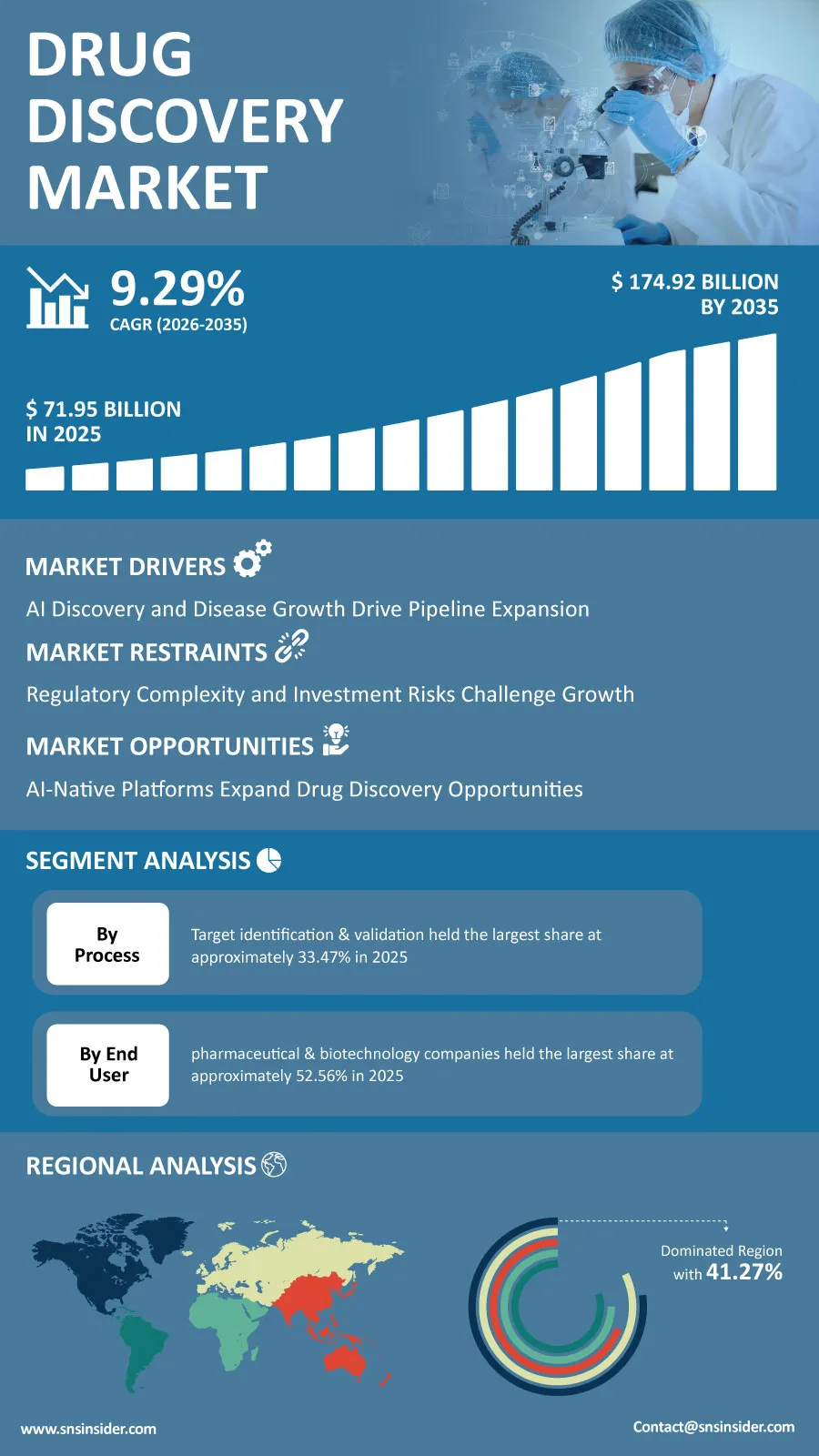
The global Drug Discovery Market is entering a transformative decade as pharmaceutical companies accelerate research programs to address complex diseases through advanced technologies and collaborative innovation. "According to a recent study by SNS Insider, the global Drug Discovery Market size valued at USD 71.95 billion in 2025, is anticipated to grow to USD 174.92 billion by 2035, registering a CAGR of 9.29% over the 2026–2035 forecast period." Increasing adoption of artificial intelligence, genomics, automation, and precision medicine is enabling researchers to shorten development timelines while improving the quality of early-stage therapeutic candidates.
Investments are being made by healthcare institutions, biotech companies, and drug manufacturers in new age discovery platforms that help in the improvement of target validation, molecule design, and biological data analysis. Due to increasing focus on chronic illnesses, orphan disease treatments, and personalized medicine approaches globally, there is an increasing need for more efficient discovery technologies.
To Get Detailed Insights on the Drug Discovery Market – Request a Sample Report
Advanced Digital Technologies Accelerate Drug Innovation
Discovery of drugs is moving away from traditional lab methods by embracing computational biology, machine learning, and high-performance analytics. AI-driven molecular modeling, genome engineering, and multi-omics studies are helping researchers discover potential targets at an accelerated rate and with unprecedented precision.
Meanwhile, collaborations among drug manufacturers, biotech companies, academia, and contract research organizations are creating more opportunities to access scientific expertise. Such collaboration is ensuring that organizations become more efficient in carrying out research activities while minimizing the cost of development in the highly competitive world of pharmaceuticals.
Key Market Findings Highlight High-Growth Segments
By process, target identification & validation accounted for approximately 33.47% of market revenue in 2025, supported by growing investments in genomics and precision medicine research. Candidate validation is projected to register the fastest growth, expanding at a CAGR of 10.45% through 2035.
Among technologies, high-throughput screening maintained the leading position with approximately 41.29% revenue share in 2025 owing to its ability to rapidly evaluate large compound libraries. Bioinformatics is expected to emerge as the fastest-growing technology segment, recording a CAGR of 11.22% during the forecast period.
By drug type, small molecules represented approximately 59.41% of global revenue in 2025 due to their established development pathways and broad therapeutic applications. Meanwhile, biologics are anticipated to deliver the strongest growth at a CAGR of 10.88%, supported by increasing research into advanced therapies.
Based on end users, pharmaceutical and biotechnology companies captured approximately 52.56% of market revenue in 2025. Contract Research Organizations (CROs) are forecast to experience the fastest expansion, growing at a 10.13% CAGR as outsourcing continues to gain momentum worldwide.
AI, Precision Medicine, and Outsourcing Transform Discovery Strategies
Artificial intelligence has increasingly become a crucial element of pharmaceutical development due to its applications for molecular optimization, prediction, and target identification. Together with improvements in the fields of structural biology, CRISPR techniques, and biomarker-oriented research, these technologies have made early-stage drug development more rational.
The increasing dependence on specialized CROs is also changing the dynamics of the industry. Pharmaceutical firms are turning towards outsourcing of discovery processes for enhanced business agility, cost savings in terms of infrastructure, and access to expertise in fields such as computational biology and medicinal chemistry.
Regional Markets Maintain Strong Research Momentum
North America was the largest regional market, with around 41.27% share of total revenue. In North America, the U.S. held around 83% of North America's revenue and also led in pharmaceutical innovation globally. The U.S. Drug Discovery Market was estimated at around USD 24.53 billion in 2025 and is anticipated to grow up to around USD 62.14 billion by 2035, growing at a CAGR of 9.74%.
The fastest regional growth will be seen in Asia Pacific, with around 9.82% growth in terms of CAGR through 2035, owing to expanding pharmaceutical research infrastructure and biotechnology investments. In 2025, China contributed around 45% of Asia Pacific revenue, while India continues to improve its position in being a prominent destination for research outsourcing globally.
In Europe, Germany made up for about 30% of revenue in the region due to a well-established pharmaceutical research environment. For emerging regions, Brazil holds about 38% of the Latin America revenue, while Israel holds around 22% of the Middle East and Africa market revenue.
Leading Companies Expand Research Capabilities
Competition within the global drug discovery market continues to intensify as leading organizations invest in AI-enabled research platforms, biologics development, precision medicine, and strategic collaborations. Major companies operating in the market include Eli Lilly, Johnson & Johnson, AbbVie, Merck & Co., Roche, Pfizer, AstraZeneca, Novartis, Bayer, GlaxoSmithKline (GSK), Amgen, Sanofi, Bristol Myers Squibb, Abbott Laboratories, Gilead Sciences, Regeneron Pharmaceuticals, Vertex Pharmaceuticals, Eisai Co., Ltd., Takeda Pharmaceutical Company, and Biogen.
An SNS Insider analyst Parry Kardani commented, "The future of drug discovery will be defined by the successful integration of artificial intelligence, advanced biological research, and collaborative innovation. Organizations that combine computational capabilities with scientific expertise will be best positioned to accelerate therapeutic development and address the growing global demand for more effective medicines.
About the Author

Get in touch




