
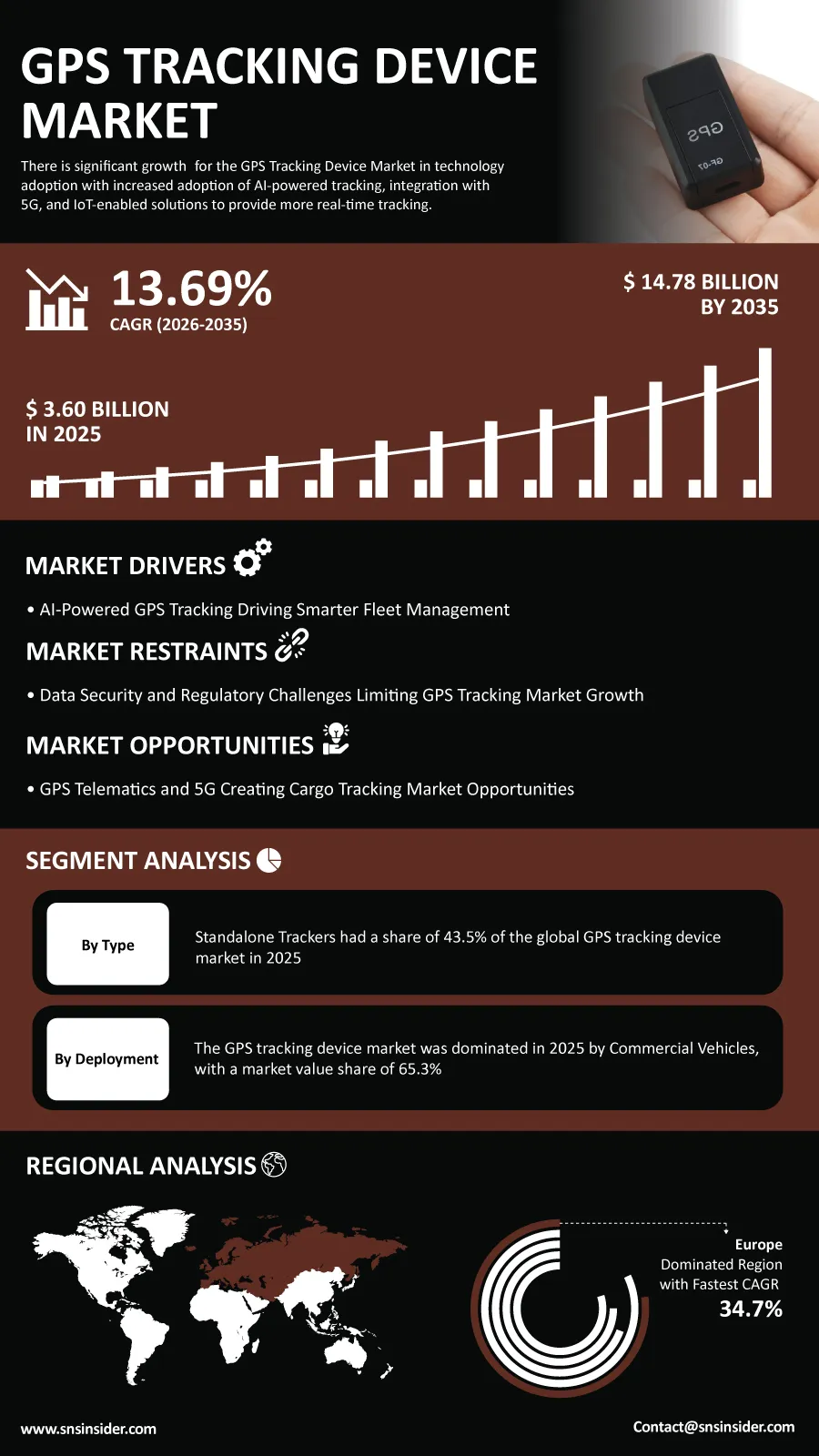
The global GPS Tracking Device Market is entering a strong growth phase as businesses and consumers increasingly prioritize real-time visibility, asset security, and connected mobility. According to a recent study by SNS Insider, the global GPS Tracking Device Market size valued at USD 3.60 billion in 2025, is anticipated to grow to USD 14.78 billion by 2035, registering a CAGR of 13.69% over the 2026–2035 forecast period.
Due to the growth in logistics network, online shopping deliveries, transportation, and vehicle ecosystem connections, there is a growing need for sophisticated tracking technologies. Companies have been relying on GPS to track their vehicles to maximize route planning and control operations.
Simultaneously, artificial intelligence, IoT connectivity, cloud technology, and cellular networks have led to the evolution of GPS tracker from location monitoring device to an intelligent telematics device that can provide predictive analysis and other features.
To Get Detailed Insights on the GPS Tracking Device Market – Request a Sample Report
Connected Fleet Management Creates New Growth Opportunities
Transportation firms, construction companies, logistic services, and delivery businesses are utilizing GPS technology to enhance efficiency and lower their cost of operations. The ability to track vehicles will allow the firm to see the routes being followed, how much time drivers are spending on the road, fuel usage, and asset management.
The growth in international trade has also created more demand for GPS cargo and container tracking services. Logistics companies are looking to gain better visibility of their shipments through the complex supply chain, while the Internet of Things technology offers an opportunity to monitor location, environment, and possible security threats.
Increased digitalization in emerging economies will drive more opportunities in the future as companies and government authorities implement fleet tracking for selected commercial and transportation activities.
Key Market Insights Highlight Shifting Demand Patterns
By type, standalone trackers were expected to account for 43.5% of global market revenue in 2025, supported by widespread use in vehicle, fleet, and personal asset monitoring. Advanced trackers are projected to record the fastest growth through 2035 as businesses increasingly seek AI-enabled analytics, IoT integration, cloud connectivity, predictive maintenance, and sophisticated geofencing capabilities.
Based on deployment, commercial vehicles were anticipated to dominate with a 65.3% market share in 2025. Growing adoption across trucking, logistics, public transportation, ride-hailing, and delivery fleets is supporting demand for solutions that improve route efficiency and regulatory compliance. Cargo and containers are expected to be the fastest-growing deployment segment as international trade and supply chain digitalization increase the need for continuous shipment visibility.
By industry, transportation and logistics held 41.4% of market revenue in 2025. The segment continues to benefit from rising e-commerce activity, last-mile delivery requirements, and demand for better fleet utilization. Metals and mining are projected to achieve the fastest growth through 2035 as operators deploy GPS technologies for remote equipment monitoring, worker safety, and management of heavy machinery in challenging environments.
AI and IoT Integration Strengthen Tracking Capabilities
GPS and artificial intelligence, IoT, 5G, cloud services, among other technologies, are converging to bring new possibilities in fleet and asset management. Current GPS devices are capable of offering more than just location details, offering automated notifications, predictions, routing capabilities, and device monitoring.
The long-lasting batteries are becoming increasingly valuable in cases of cargo tracking and remote assets, but the wired device is still needed for vehicles. The rechargeable tracker is becoming increasingly popular in the situation where there is an option for the regular maintenance and charging of the equipment.
However, concerns surrounding location-data privacy, cybersecurity, regulatory compliance, and signal reliability remain important considerations. Manufacturers are therefore focusing on secure data transmission and more resilient connectivity to improve the reliability of tracking systems.
Europe Leads with 34.7% Revenue Share While Asia Pacific Accelerates Transportation Digitalization
Europe is set to have a revenue market share of 34.7% in the global market by 2025 because of the existing logistics infrastructures, wide acceptance of telematics, and regulatory mandates on commercial transportations. Europe's well-established market for fleet management is motivating investors to invest in GPS-based monitoring systems.
The Asia Pacific region is anticipated to grow at the fastest rate up to 2035 because of the urbanization in the region, e-commerce activities, transport sector modernization, and digital adaptation. This region has vast potential because of increased demand for GPS tracking services in China, India, Japan, and Southeast Asia.
There is already an advanced level of telematics adoption and increased demand for commercial fleet management, asset monitoring, and vehicle tracking in North America. On the other hand, Latin America and the Middle East & Africa will gain momentum because of the need for vehicle security and logistics efficiency among other factors.
Industry Participants Focus on Intelligent Tracking Innovation
The competitive landscape remains dynamic as companies develop increasingly connected and data-driven tracking solutions. Industry participants are focusing on improving device durability, expanding cellular connectivity, integrating AI-powered analytics, and creating platforms capable of supporting diverse fleet and asset management requirements.
Key companies operating in the global GPS Tracking Device Market include Teltonika Telematics, Navtelecom, Queclink Wireless Solutions, Jimi IoT, Ruptela, Suntech International, GLONASSsoft, Sensata INSIGHTS, FleetGuide, ERM Electronic Systems, Garmin Ltd., TomTom International B.V., Trimble Inc., Geotab Inc., CalAmp Corp., Verizon Connect, Sierra Wireless, Teletrac Navman, MiX Telematics, and Zebra Technologies.
An SNS Insider analyst Sushant Kadam commented, “The growing need for real-time operational visibility, fleet efficiency, asset security, and connected mobility is creating a strong foundation for GPS tracking technology. Providers that combine reliable positioning with AI analytics, IoT connectivity, and secure cloud-based platforms will be well positioned to capture emerging opportunities across transportation, logistics, mining, and commercial asset management.”
About the Author

Get in touch




