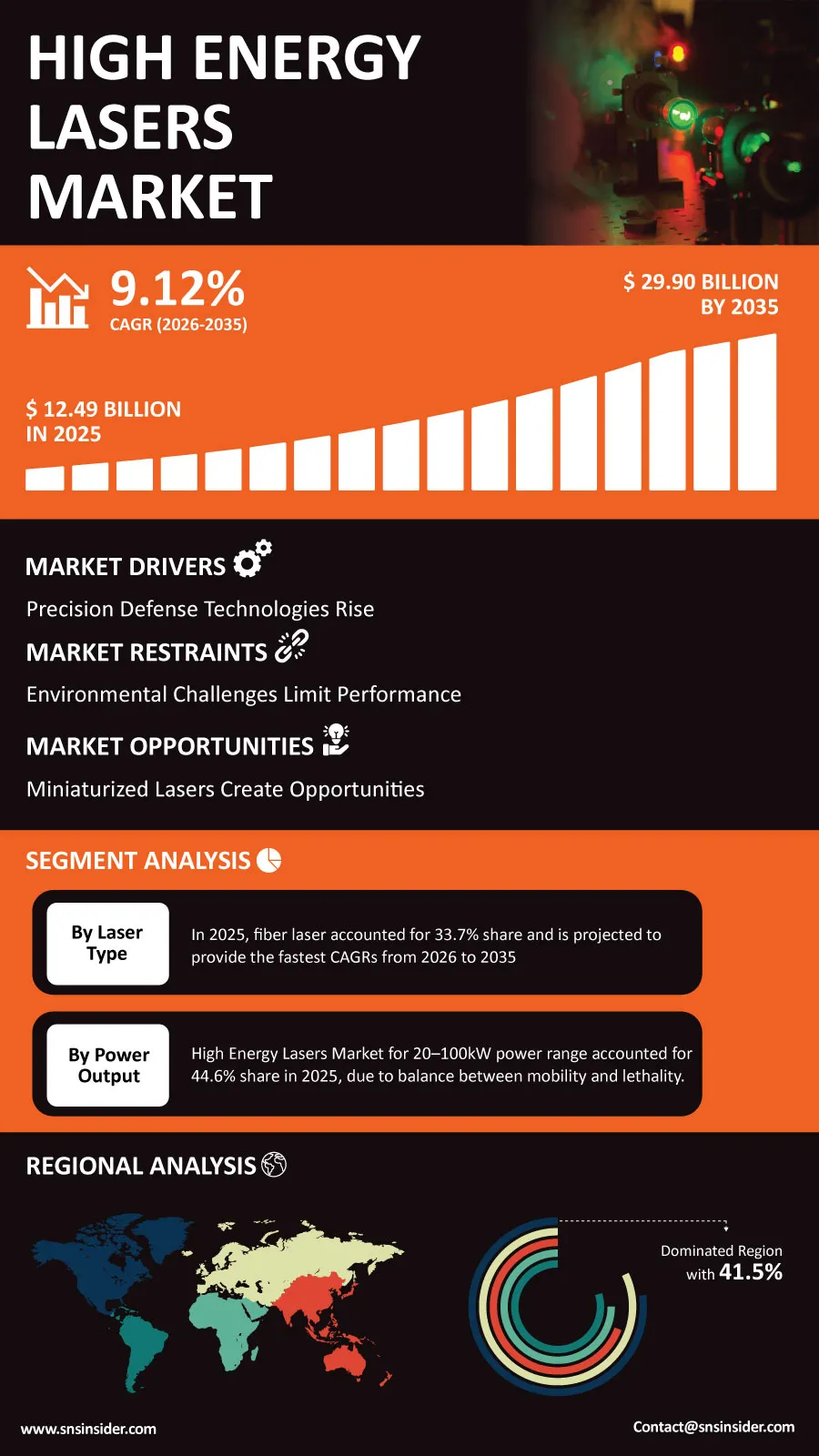
The global High Energy Lasers Market is entering a period of accelerated development as defense agencies seek advanced systems capable of addressing emerging aerial and missile threats with greater precision and operational efficiency. According to a recent study by SNS Insider, the global High Energy Laser (HEL) Market size valued at USD 12.49 billion in 2025, is anticipated to grow to USD 29.90 billion by 2035, registering a CAGR of 9.12% over the 2026–2035 forecast period.
The increasing use of unmanned aircraft systems, the evolving nature of missile threats, and increased tensions among countries have resulted in military institutions looking into directed energy technology solutions. High energy laser systems provide fast response times, precise target acquisition, and reduced costs per engagement, making them very useful for future defense systems.
Advances in beam control, thermal control, power generation, and system miniaturization have also increased the number of platforms that can support high energy laser systems. More development efforts are being made to take these programs from laboratory demonstrations to field tests and operations.
To Get Detailed Insights on the High Energy Laser (HEL) Market – Request a Sample Report
Defense Modernization and Counter-UAV Requirements Create New Growth Opportunities
The widespread use of UAVs for military and security purposes has generated high demand for scalable counter-drone solutions. High Energy Lasers are an excellent additional defensive measure for dealing with drones and other air-based threats, especially when conventional defenses are more expensive per shot or have limited ammunition.
The military and defense agencies are also exploring the use of HEL for integration with various platforms including armored vehicles, navy ships, fixed structures, and unmanned platforms. Research efforts backed by the government along with cooperation among defense companies and militaries are fueling technological innovation and aiding in moving these laser systems to practical implementations.
The compact nature of these lasers coupled with modular power systems is opening up new opportunities for portable applications.
Key Market Insights Highlight Shifting Demand Patterns
By laser type, fiber lasers accounted for 33.7% of market revenue in 2025 and are projected to remain the fastest-growing laser category through 2035. Their compact architecture, high electrical efficiency, beam quality, and scalability make them suitable for integration across ground, naval, and unmanned defense platforms.
Based on application, Directed Energy Weapons held the largest share at 47.4% in 2025, supported by increasing interest in counter-drone and air defense missions. Research and Development is expected to record the fastest growth as governments and defense companies continue advancing beam control, power management, cooling, and system integration technologies.
In terms of power output, the 20–100 kW category held around 44.6% of market revenue in 2025, reflecting its suitability for tactical counter-UAV and short- to medium-range defense missions. Systems exceeding 100 kW are projected to experience the fastest growth through 2035 as development progresses toward applications involving cruise missiles, large drone swarms, and other high-value threats.
By platform, land-based systems dominated with 43.4% of market revenue in 2025 due to their deployment across mobile combat vehicles, fixed defense installations, and border security applications. Naval platforms are anticipated to register the fastest growth as technological advances enable higher-power laser systems to be integrated with surface vessels for maritime defense and aerial threat interception.
Beam Control and Thermal Management Remain Critical Priorities
High-energy laser systems rely heavily on maintaining beam quality and handling large amounts of heat during long-term usage. Unfavorable weather patterns, turbulence in the atmosphere, dust, fog, and rain may influence the propagation and effectiveness of engagement by lasers, thereby supporting further investments in beam control and heat management technologies.
Development of energy sources that are smaller in size is another area that is gaining prominence with defense organizations looking for ways to install HEL weapons on platforms such as unmanned and mobile ones. This would make the use of such a weapon system more versatile in its application.
North America Leads with More Than 41.5% Revenue Share While Asia Pacific Accelerates Defense Modernization
North America is predicted to generate more than 41.5% of the global market revenue by 2025, owing to high defense spending, large-scale government-supported research initiatives, and early development of directed energy devices on land, naval, and aerial vehicles. North America is led by the U.S., which continues to dominate owing to its ongoing military development efforts and presence of large players in the field.
The Asia Pacific is expected to grow at the fastest rate until 2035, owing to military modernization, high security threats, increase in defense budgets, and investment in counter UAV and missile defense technologies. In this region, China is anticipated to continue as a dominant market, owing to heavy investments in research on directed energy devices.
Industry Participants Focus on Next-Generation Laser Capabilities
The competitive landscape remains highly innovation-driven as defense contractors invest in scalable power systems, advanced beam control, thermal management, and platform integration. Companies are increasingly pursuing field testing and modular architectures designed to transition high energy laser technologies from experimental programs into operational defense applications.
Key companies operating in the global High Energy Laser (HEL) Market include Lockheed Martin Corporation, Northrop Grumman Corporation, Raytheon Technologies Corporation, Boeing Defense, Space & Security, L3Harris Technologies Inc., BAE Systems plc, Rheinmetall AG, Leonardo S.p.A., MBDA, Thales Group, Elbit Systems Ltd., Hanwha Aerospace Co. Ltd., CACI International Inc., General Atomics, Directed Energy Solutions Inc., EOS Defense Systems, BlueHalo, QinetiQ Group plc, Israel Aerospace Industries Ltd., and Textron Systems Corporation.
An SNS Insider analyst Sushant Kadam commented, “The convergence of growing counter-UAV requirements, defense modernization, and advances in power and beam-control technologies is accelerating the transition of high energy lasers toward operational use. Companies capable of delivering compact, reliable, and scalable systems will be well positioned to capture emerging opportunities across land, naval, and airborne defense applications.”
About the Author

Get in touch