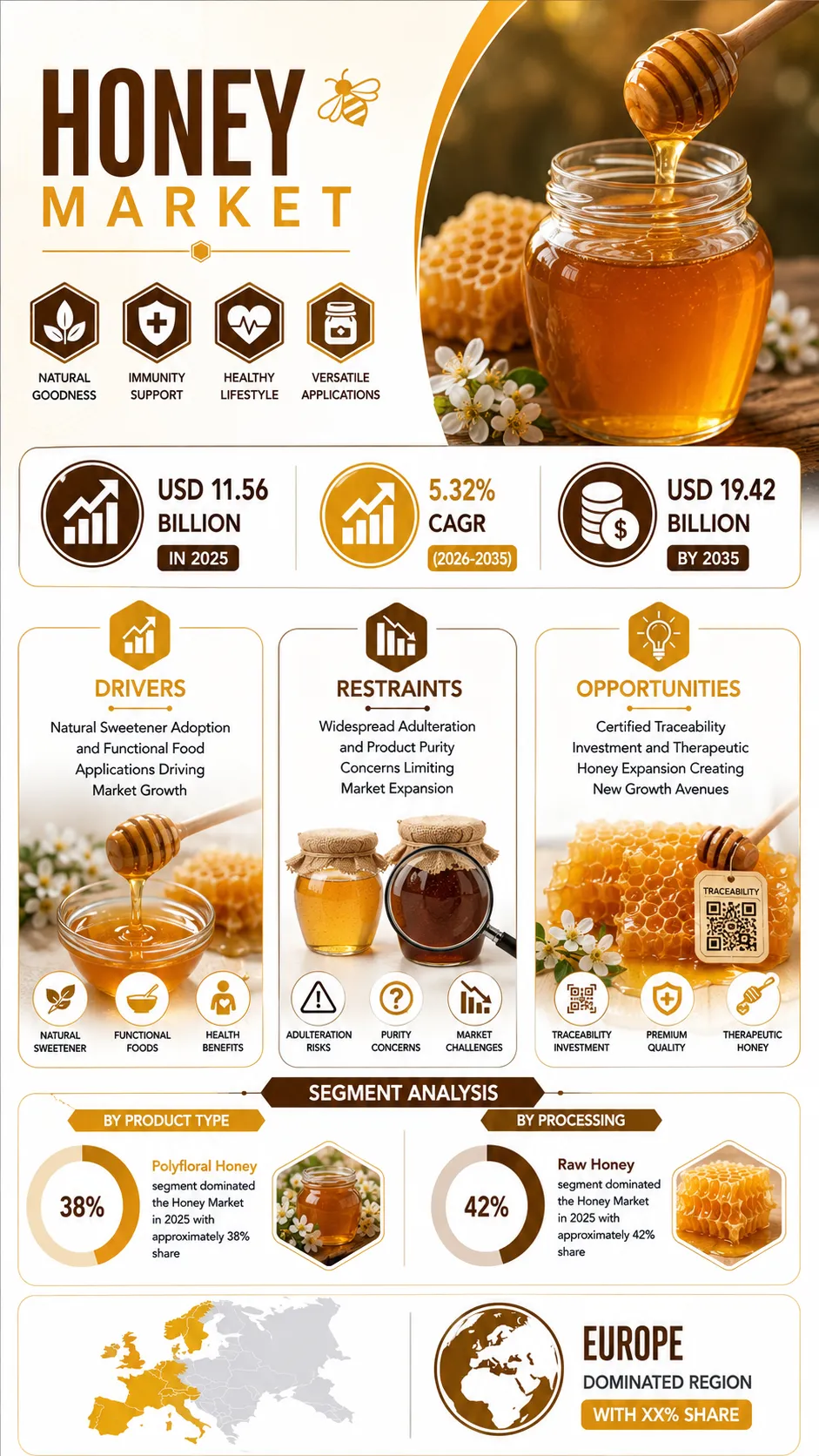
The global Honey Market is set for steady expansion as consumers worldwide continue seeking natural, functional sweetener alternatives. "According to a recent study by SNS Insider, the global Honey Market size valued at USD 11.56 billion in 2025, is anticipated to grow to USD 19.42 billion by 2035, registering a CAGR of 5.32% over the 2026-2035 forecast period."
There have been tremendous changes within honey production and quality assurance over time due to which many brands who aim at improving traceability can take advantage of this trend. This includes the need for more certified, purity-verified products that will provide consumers with the ability to trust honey authenticity claims. This applies in situations where honey is used across food and beverage, cosmetics, and pharmaceutical applications.
Producers are constantly working hard to ensure that their honey products perform better than before in order to meet various needs of health-conscious consumers worldwide.
To Get Detailed Insights on the Honey Market – Request a Sample Report
Certified Traceable Sweetener Ecosystems Create New Demand
The honey market has evolved from basic conventional processing to more advanced organic and certified traceable use cases. The growing investment in purity testing technology, organic beekeeping practices, and premium packaging for a variety of applications has required the development of more efficient and reliable production systems.
New designs of honey production and certification systems can increase purity verification, reduce adulteration risk, and allow for broader consumer trust. This gives producers the possibility to be more effective when reaching health-conscious consumers and doing better brand differentiation.
Honey producers, certification bodies, and food safety regulators are increasingly cooperating thanks to the growing interest in developing future solutions for verified, trustworthy honey products.
Key Market Findings Highlight High-Growth Segments
The polyfloral honey category held a prominent position in the Honey Market, contributing nearly 38% to the overall market revenue in 2025, on account of its wide availability, varied floral sources, and wide consumer acceptability. The monofloral honey category is projected to witness the fastest growth, fueled by the rising consumer inclination towards premium varieties of honey.
Based on the process, the raw honey category held the dominant share of the overall market revenue, contributing nearly 42% to the total market revenue in 2025, attributed to the rising consumer inclination towards minimally processed and natural products. The creamed honey category is projected to witness the fastest growth in the coming years.
The polyfloral honey segment was positioned well within the Honey Market with an almost 38% share of total market revenue in 2025 due to its high availability and acceptance among consumers. The monofloral honey segment is expected to have the highest growth rate driven by the increasing consumer preference for high-quality honeys.
By the process, the raw honey segment was the dominant segment with almost 42% share of total market revenue in 2025 due to increased consumer preference for minimally processed honey. The creamed honey segment is expected to have the highest growth rate in future years.
Distributive patterns are also changing. In 2025, 43% of the revenues were made in supermarkets/hypermarkets due to a variety of products and high accessibility to consumers. E-commerce is considered to have the highest growth rate among other distribution channels owing to increased presence on the internet and purchasing convenience.
Purity, Traceability, and Functional Positioning Gain Importance
In this regard, producers have been looking at honey products that would make their offerings more verifiably pure and require less adulteration risk and be more functionally differentiated.
Innovation in purity testing, certified traceability programs, and organic beekeeping practices has been making it possible for companies to come up with products that can meet increasingly demanding consumer trust expectations. In addition to that, increasing emphasis on therapeutic and functional food positioning is also making it possible for companies to find solutions that optimize consumer confidence.
Such trends are likely to become even more prominent in the future.
Europe Emerges as the Largest Market Amid Rising Health Consciousness
The Europe region represented the largest regional market in 2025, owing to strong consumer demand for nutritious food products and rising awareness of healthy lifestyle benefits. In addition, Asia Pacific is expected to be the fastest-growing market during the forecast period, propelled by increasing use of honey as a sugar substitute and applications across the region's fast-growing health and wellness industries.
On the other hand, North America represented a significant share of global market revenue in 2025, aided by increasing penetration of independent retail giants boosting product visibility.
Leading Companies Drive Innovation and Competition
The environment continues to stay very dynamic since players continue innovating on products and quality assurance as well as forming partnerships in order to enhance their position in the industry.
Some of the major companies that operate in the global honey market are Dabur India Ltd., Capilano Honey Ltd. (Hive + Wellness), Comvita Ltd., Barkman Honey LLC, Dutch Gold Honey, Inc., Bee Maid Honey Ltd., Sioux Honey Association Co-op, Nature Nate’s Honey Co., Rowse Honey Ltd. (Valeo Foods), Billy Bee Honey Products (McCormick & Company), Langnese Honig GmbH & Co. KG.
An SNS Insider Analyst Santosh Bhul commented, "The rapid emphasis on certified traceability and purity verification is creating unprecedented demand for high-quality, trustworthy honey products. Producers that successfully combine verified sourcing, functional positioning, therapeutic credibility, and advanced quality assurance capabilities will be best positioned to capitalize on emerging opportunities across food, cosmetics, and pharmaceutical applications."
About the Author

Get in touch