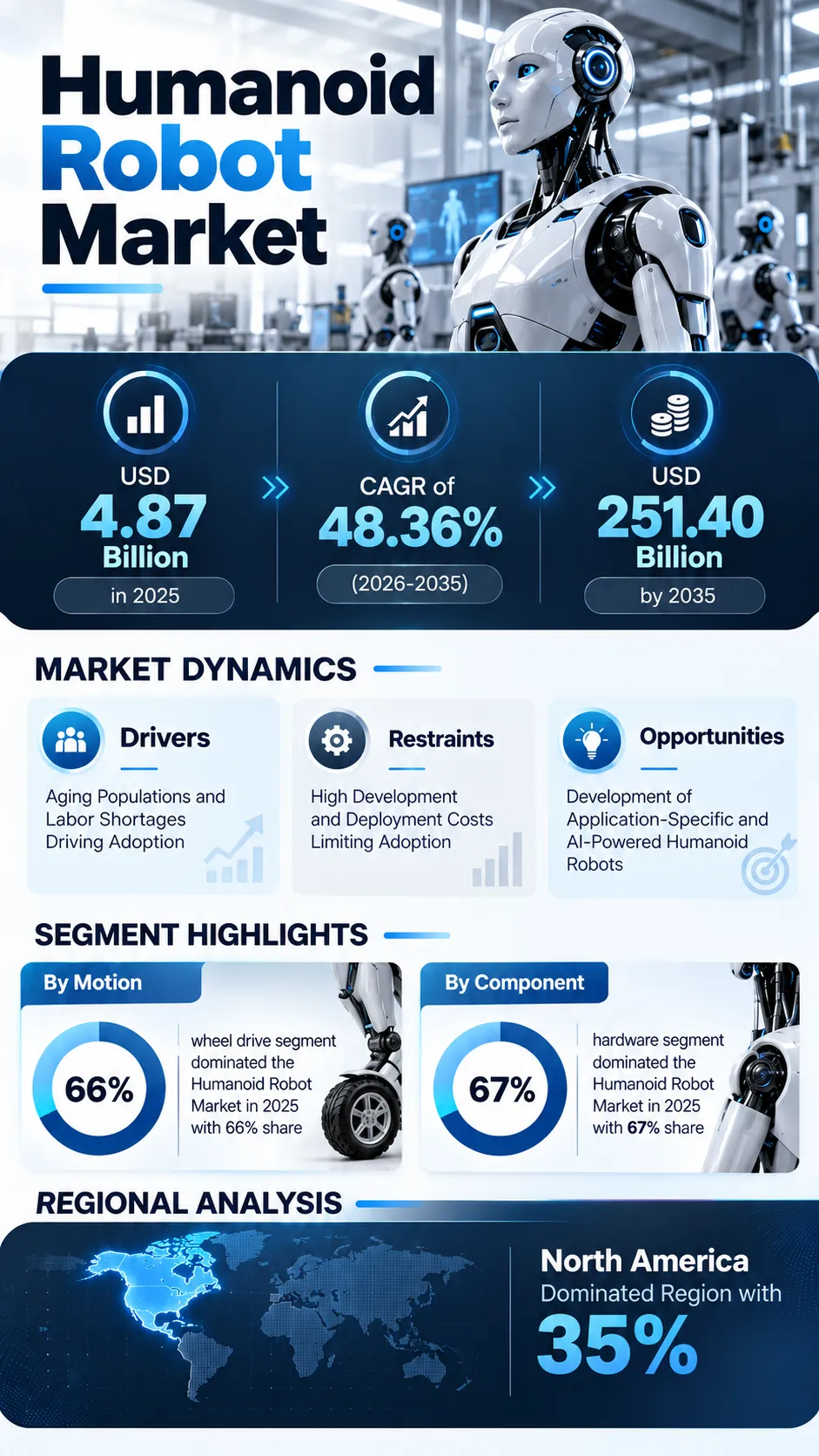
The global Humanoid Robot Market is poised for transformative growth as advances in artificial intelligence and robotics expand the role of human-shaped machines across industrial and service environments. “According to a recent study by SNS Insider, the global Humanoid Robot Market size valued at USD 4.87 billion in 2025, is anticipated to grow to USD 251.40 billion by 2035, registering a CAGR of 48.36% over the 2026–2035 forecast period.”
Firms involved in manufacturing, logistics, healthcare, and technology are beginning to investigate the application of humanoid robots to alleviate labor shortages, automate routine processes, and increase efficiency. Advancements in machine sensing, autonomous movement, and robotic dexterity have made it possible for these machines to perform more tasks than before.
Increased investment from technology firms, robotics companies, and research institutes has hastened their deployment. There are over 45,000 humanoid robots installed in 2025, making way for manufacturers who want to implement automated solutions.
To Get Detailed Insights on the Humanoid Robot Market – Request a Sample Report
AI Advancements and Workforce Challenges Create New Growth Opportunities
As the demand for flexibility in automation continues to grow, companies are beginning to explore robots that can be used in environments designed for humans. As opposed to traditional industrial machinery, which is constructed for carrying out certain functions, humanoid robots are being designed to carry out a variety of functions such as manipulating objects, moving materials, inspecting and interacting with humans.
There have been developments in light actuators, sophisticated sensors, batteries and computer programs that use artificial intelligence in controlling the robots. However, cost, safety validation and reliability remain significant factors.
Key Market Insights Highlight Shifting Demand Patterns
By motion, wheel-driven humanoid robots accounted for 66% of market revenue in 2025, due to their stability, energy efficiency, and appropriateness for use in warehouses and manufacturing plants. Bipedal robots will be the most rapidly growing type of robots from 2025 to 2035 due to their ability to navigate stairs and uneven terrain.
By component, hardware held around 67% of market revenue in 2025, due to the high cost of actuators, processors, sensors, batteries, and mechanical components. The software segment is expected to experience rapid growth owing to the significance of AI models, computer vision, motion planning, and natural language processing.
Based on application, industrial deployments contributed around 43% of market revenue in 2025 due to the requirement of automation for manufacturing, inspection, and material handling. The household segment is expected to show the highest growth since efforts are being made to develop robots that can help in household chores.
By end use, personal assistance and caregiving segment held 35% of market revenue in 2025, showing increasing focus on the development of technology that can assist aging individuals and those needing help with their routine tasks. The search and rescue area is seen as having the highest growth potential due to emergency services looking into robotic solutions for dangerous missions.
Industrial Automation Accelerates Commercial Deployment
Manufacturing and logistics continue to be significant testing grounds for humanoid robots due to the highly structured working conditions where firms can evaluate performance, safety, and efficiency before making broader deployments. Robots that can transport materials, work with components, and assist with repetitive processes might assist firms in overcoming existing shortages of manpower.
Healthcare, hospitality, and homes are other areas of application, though adoption will require affordable pricing, consistent performance, and good interactions with humans. Improvements in AI training and robot controls will likely extend the types of commercially viable applications.
North America Captures 35% Humanoid Robot Market Share as Asia Pacific Accelerates at 49.65% CAGR
The Humanoid Robot Market in North America captured the largest market share of 35% in 2025 owing to significant investments made in AI, robotics R&D, industrial automation, and health care applications. North America continues to be a key region with technology firms and R&D companies working on commercial and experimental humanoid robots.
Asia-Pacific would experience the fastest growth rate of 49.65% CAGR during 2026-2035. This growth would be attributed to manufacturing capabilities of China, assistive robotics interests of Japan, and automation investments in the region. It is also noted that government policies and demand for intelligent systems would further aid the region's dominance in the forecast period.
Industry Participants Focus on Intelligent Robotics Innovation
There is growing competition as robot makers build ever-smarter and better-performing robot platforms, advance autonomy, and form business relationships. Areas of focus involve increasing dexterity, cutting costs, boosting safety measures, and designing AI algorithms that would allow robots to deal with new tasks.
Key companies operating in the global Humanoid Robot Market include Boston Dynamics, Honda Robotics, SoftBank Robotics, UBTECH Robotics, Agility Robotics, Tesla, Toyota Research Institute, Hanson Robotics, PAL Robotics, RoboKind, Kawada Robotics, Samsung Electronics, ABB, Shadow Robot Company, Festo, Hyundai Robotics, iRobot, Boston Micro Fabrication, Rethink Robotics, and Mitsubishi Electric.
An SNS Insider analyst Sushant Kadam commented, “Rapid advances in artificial intelligence, rising labor constraints, and growing demand for adaptable automation are creating substantial opportunities for humanoid robotics. Companies that combine reliable hardware with intelligent software, practical applications, and cost-effective deployment models will be better positioned to translate technological progress into sustainable commercial growth.”
About the Author

Get in touch