
Hyperpigmentation Treatment Market is gaining strong traction worldwide due to the rising demand for professional hyperpigmentation treatment by customers due to their need for skin tone correction, acne discoloration, and pigmentation issues related to aging. The derma clinics, aesthetics clinics, and skin care companies are adding more treatment options in response to this evolving demand.
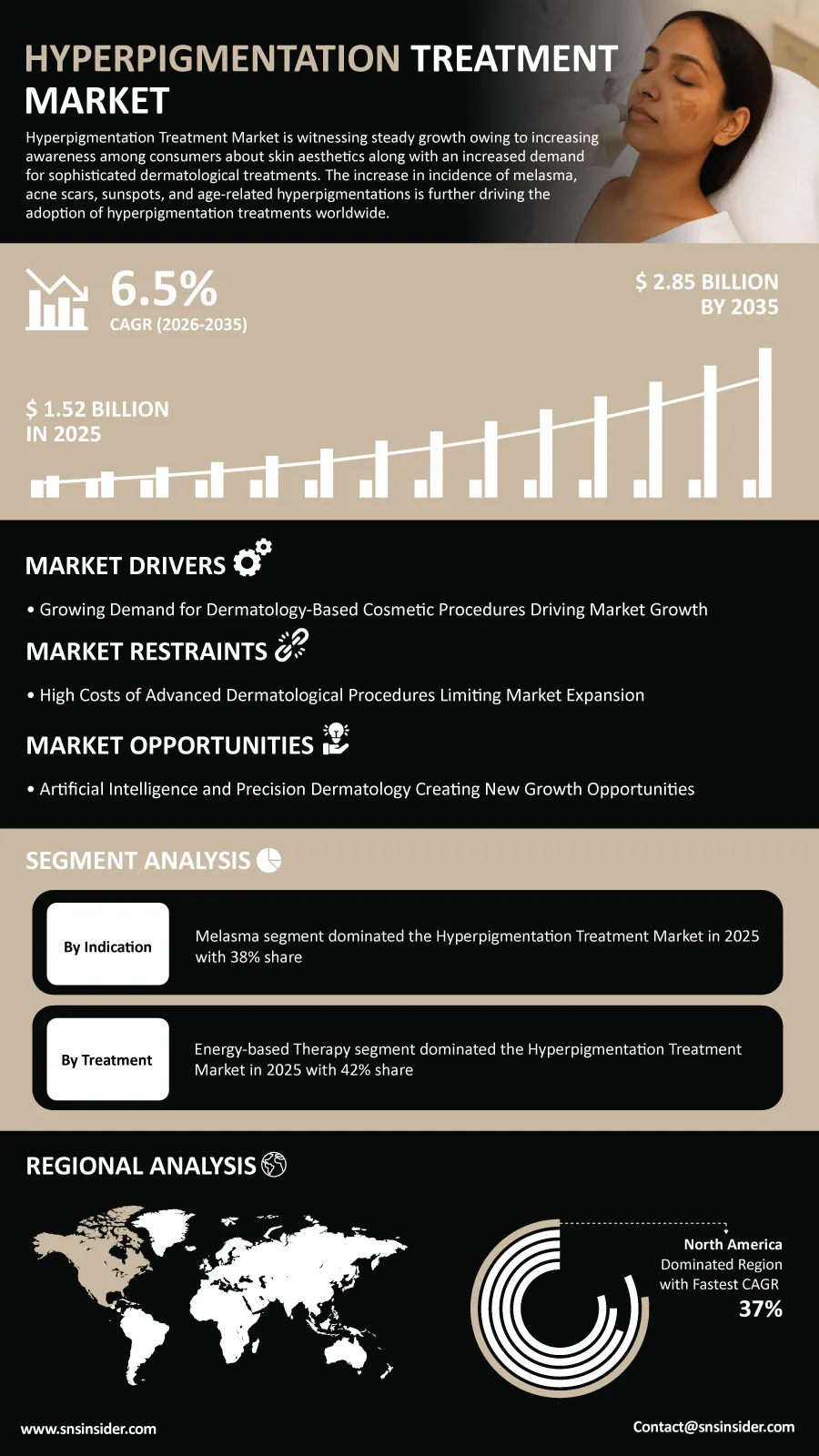
According to a recent study by SNS Insider, the global Hyperpigmentation Treatment Market size valued at USD 1.52 billion in 2025, is anticipated to grow to USD 2.85 billion by 2035, registering a CAGR of 6.5% over the 2026–2035 forecast period. Rising awareness of skin health, broader access to cosmetic dermatology services, and continuous innovation in energy-based treatment technologies are supporting sustained market expansion.
The market is being helped by the rising consumer demand for medical grade skin care and dermatological customization. Rising consultations for melasma, sun-related hyper-pigmentation and post-acne scarring are driving health professionals to use combination treatment therapies involving laser treatments, chemical peels, microneedling and prescribed treatments.
To Get Detailed Insights on the Hyaluronic Acid Market – Request a Sample Report
Dermatology Innovation Creates New Commercial Opportunities
Skin analysis technology, along with artificial intelligence and personalized care products, is revolutionizing treatment planning within the field of aesthetic dermatology. Digital imaging and personalized treatment plans are becoming more and more common in clinics in order to achieve optimal results while minimizing post-procedure complications.
There is also an increasing tendency towards collaboration in the skin care sector between pharmaceutical firms, skin care manufacturers, and dermatologists. This trend is facilitating the production of professional products for maintaining skin pigmentation.
Market Segments Reveal Changing Patient Preferences
By indication, melasma accounted for approximately 38% of global revenue in 2025, reflecting its high prevalence and recurrent treatment needs. Post-inflammatory hyperpigmentation (PIH) is projected to emerge as the fastest-growing indication as acne, eczema, and other inflammatory skin conditions become more common.
Based on treatment type, energy-based therapy represented around 42% of market revenue in 2025, supported by strong clinical adoption of laser and light-based procedures for deeper pigmentation disorders. Microneedling is expected to register the fastest growth through 2035 due to its lower invasiveness, affordability, and compatibility with multiple skin types.
In terms of skin tone, Fitzpatrick skin types III and IV accounted for approximately 41% of global revenue in 2025. Demand among Fitzpatrick skin types V and VI is anticipated to expand rapidly as safer treatment protocols and specialized technologies become more widely available.
By end use, dermatology clinics generated roughly 46% of market revenue in 2025, while aesthetic centers are forecast to experience the fastest growth as consumers increasingly seek quick, cosmetic-focused procedures.
Consumer Awareness and Social Media Continue to Influence Demand
Social media, beauty bloggers, and improved dermatology education have been making people aware of the importance of seeking treatment early for their pigmentation issues. More awareness of before and after effects of treatments and more acceptance of cosmetic procedures have contributed toward the increase in patient numbers.
On the other hand, there are problems regarding affordability. State-of-the-art laser technology, multiple sessions required for treatment, and high-end skincare products continue to be costly, especially in developing countries that do not have insurance for cosmetic surgeries.
Regional Markets Show Diverse Growth Patterns
In 2025, North America emerged as the key player in the global market accounting for 37% of the total revenue due to developed infrastructure of dermatology, high expenditure power of consumers for aesthetic skin care products, and adoption of energy-based treatments. In the North American region, the United States is expected to contribute nearly 90.7% to the North American market revenue. The US Hyperpigmentation Treatment Market had a value of USD 0.55 billion in 2025 and is projected to reach USD 0.93 billion by 2035, growing at a 5.5% CAGR.
In terms of regional growth, Asia-Pacific is anticipated to exhibit the highest CAGR through 2035 because of high disposable income levels, rapid urbanization, and higher awareness regarding beauty among consumers in China, India, South Korea, and Japan.
In Europe, the United Kingdom generated roughly 22.4% of the region’s revenue, whereas in Latin America, Brazil generated roughly 48.3% of the region’s revenue, and the UAE accounted for about 14.6% of Middle East & Africa's revenue.
Leading Companies Intensify Product Innovation
C The competition in the hyperpigmentation treatments industry is highly innovation-based, clinical effectiveness based, and branded based. Innovation in the market includes the launch of the SkinMedica Even & Correct Collection by AbbVie (Allergan Aesthetics) in 2023, the introduction of the molecule Melasyl by L’Oréal Groupe for pigmentation in 2024, and the innovation efforts of Galderma S.A. from 2025 to 2026.
Major companies operating in the global market include L’Oréal Groupe, Galderma S.A., Beiersdorf AG, Johnson & Johnson, Procter & Gamble, Unilever, Shiseido Company Limited, AbbVie (Allergan Aesthetics), Bayer AG, Obagi Medical Products, SkinCeuticals, La Roche-Posay, Pierre Fabre Dermo-Cosmetique, Candela Medical, Lumenis, Vivier Pharma, Paula’s Choice, ISDIN, Bausch Health, and Allergan Aesthetics.
An SNS Insider analyst Parry Kardani commented, "The hyperpigmentation treatment market is shifting toward precision dermatology, where individualized treatment plans, advanced laser systems, and clinically validated skincare formulations are becoming the primary growth drivers. Companies that successfully combine technology, safety, and personalized care are expected to strengthen their competitive position over the next decade.
About the Author

Get in touch




