
Aesthetics Market Report Scope & Overview:
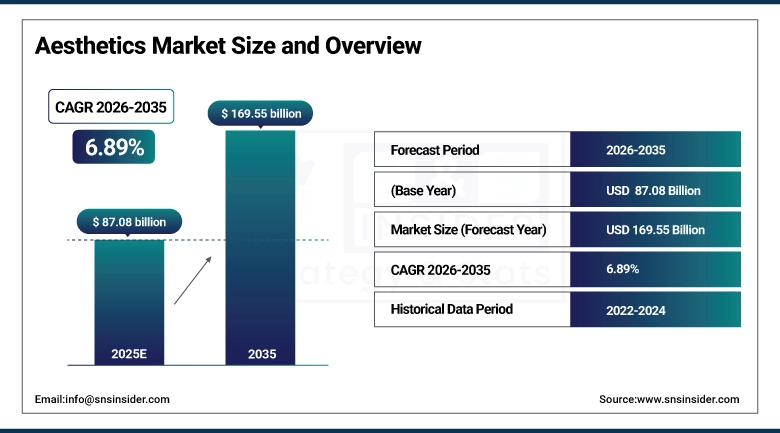
The Aesthetics market was valued at USD 87.08 Billion in 2025 and is expected to reach USD 169.55 Billion by 2035, growing at a CAGR of 6.89% from 2026–2035.
The global aesthetics market is at a pivotal moment of broad-based expansion driven by the convergence of demographic trends, social and cultural forces, and technological innovation that are collectively expanding the appeal and accessibility of cosmetic procedures far beyond the affluent older female demographic that historically defined the aesthetic medicine patient population. The progressive normalization of aesthetic enhancement as a mainstream wellness and self-care investment rather than a stigmatized vanity pursuit, accelerated by social media culture’s emphasis on personal appearance and the visible adoption of aesthetic procedures by celebrities, influencers, and public figures who openly discuss their treatments, is lowering psychological barriers to consideration across younger demographics, male populations, and emerging market consumer segments that represent the most significant incremental demand sources for the market’s next growth phase.
The extraordinary commercial performance of GLP-1 receptor agonists including semaglutide and tirzepatide for weight loss is creating a closely watched adjacent market opportunity for aesthetic medicine as the millions of patients achieving significant weight reduction through GLP-1 therapy are subsequently seeking body contouring, skin tightening, and facial volumisation treatments to address the aesthetic consequences of rapid weight loss, representing a structurally new patient acquisition channel that is generating incremental aesthetic procedure demand across body contouring, injectable, and skin treatment categories simultaneously.
Market Size and Forecast
-
Market Size in 2026E: USD 93.08 Billion
-
Market Size by 2035: USD 169.55 Billion
-
CAGR: 6.89% from 2026 to 2035
-
Fastest Growing Region: Asia Pacific
-
Largest Region: North America
Aesthetics Market Trends
-
Accelerating adoption of combination aesthetic treatment protocols that integrate multiple modalities including neuromodulators, dermal fillers, energy-based skin resurfacing, and biostimulator injections within individualized treatment plans that achieve comprehensive facial rejuvenation and body contouring outcomes superior to single-treatment approaches, driving higher per-patient treatment spend, increased treatment frequency, and growing practitioner investment in multi-modality device and product portfolios.
-
Rising male aesthetic procedure adoption across botulinum toxin treatments, non-surgical body contouring, hair restoration, and skin quality improvement categories, driven by the progressive cultural normalization of male grooming and appearance investment that social media, professional appearance pressure, and changing masculinity norms are collectively enabling, creating a demographic expansion opportunity that major aesthetic brands are addressing through male-specific marketing campaigns, practitioner training programmes, and product positioning strategies.
-
Growing preventive aesthetics movement among Millennial and Generation Z consumers who are initiating neuromodulator and skincare treatments earlier in adulthood to delay the appearance of ageing rather than treating established lines and volume loss after they develop, shifting the industry’s patient acquisition age profile downward, increasing lifetime patient value through earlier relationship establishment, and creating demand for lighter treatment protocols and natural-result positioning that differs from the heavier correction demands of the traditional older patient base.
-
Rapid expansion of medical spa networks as the primary access point for aesthetic procedures among the growing mainstream consumer segment that prioritizes convenience, affordability, and professional environment quality over the clinical formality of physician office or hospital-based treatment settings, with medical spa operator consolidation through regional and national group expansion creating new distribution channel dynamics that are shifting procedural volume away from independent practitioner practices toward managed multi-location aesthetic service platforms.
-
Increasing adoption of advanced energy-based body contouring and skin quality treatment devices including high-intensity focused ultrasound, radiofrequency microneedling, cryolipolysis, and electromagnetic muscle stimulation platforms that deliver measurable fat reduction, muscle toning, and skin tightening outcomes through non-invasive or minimally invasive treatment protocols, expanding the aesthetic treatment menu available to patients who are not candidates for or interested in surgical alternatives.
The U.S. Aesthetics Market Outlook
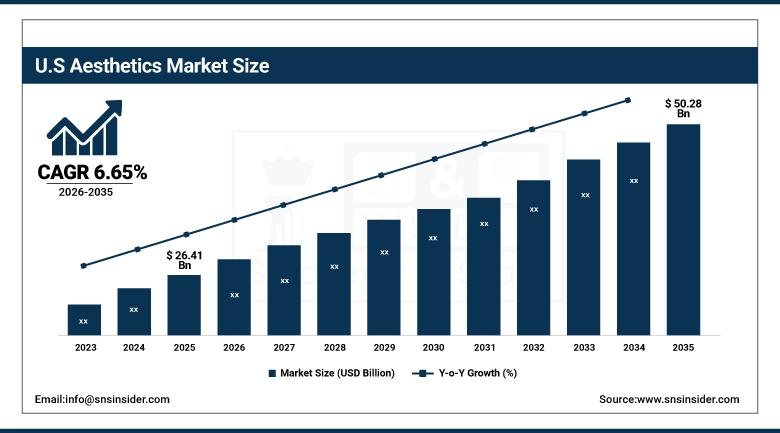
The U.S. Aesthetics Market was valued at approximately USD 26.41 Billion in 2025 and is expected to reach approximately USD 50.28 Billion by 2035, growing at a CAGR of 6.65%.
The United States aesthetic medicine market is defined by the extraordinary density and sophistication of its practitioner community, which encompasses over 15,000 board-certified dermatologists, plastic surgeons, and aesthetic physicians with specialist aesthetic procedure training alongside the rapidly growing medical spa sector that now accounts for an estimated 30 to 40 percent of total injectable procedure volume as non-physician practitioners including nurse practitioners, physician assistants, and registered nurses deliver botulinum toxin and dermal filler treatments under appropriate medical supervision in consumer-accessible settings that serve the mainstream aesthetic market at accessible price points.
The rapid growth of aesthetic practice management software platforms, patient financing solutions including CareCredit and Alle’s financing programme, and aesthetic treatment subscription models that bundle monthly or quarterly treatment packages at fixed monthly cost are collectively reducing the financial barrier to regular aesthetic procedure participation, effectively converting what was historically episodic high-spend aesthetic treatment purchasing into recurring consumer expenditure patterns that sustain more predictable practice revenues and build stronger patient loyalty than traditional one-off treatment booking models.
Aesthetics Market Segment Analysis
-
By Procedure, Non-Surgical Procedures led the Aesthetics Market with approximately 58.40% revenue share in 2025; Surgical Procedures is the fastest-growing segment at a CAGR of approximately 9.40%.
-
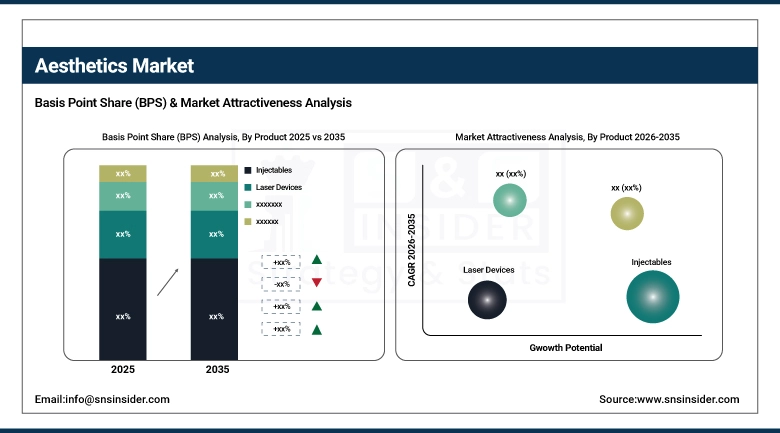
By Product, Injectables led the Aesthetics Market with approximately 40.06% revenue share in 2025; Body Contouring Devices is the fastest-growing product segment at a CAGR of approximately 8.50%.
-
By Application, Facial Aesthetics led the Aesthetics Market with approximately 50.64% revenue share in 2025; Body Aesthetics is the fastest-growing application at a CAGR of approximately 7.90%.
By Procedure, Non-Surgical Procedures dominate, Surgical grows fastest
Non-Surgical Procedures retained the dominant position with approximately 58.40% of the Aesthetics Market in 2025, a dominance rooted in the fundamental patient preference advantages of minimal downtime, lower procedural risk, no general anesthesia requirement, reversible outcomes in the case of hyaluronic acid fillers, and progressively improving result quality that collectively make non-surgical treatments the preferred aesthetic intervention across the majority of the global patient population for the most commonly sought aesthetic outcomes.
Surgical Procedures is the fastest-growing segment at a CAGR of approximately 9.40% through 2035, propelled by the combination of an ageing population in high-income markets whose aesthetic correction needs increasingly exceed what non-surgical procedures can address, growing medical tourism enabling patients to access high-quality surgical procedures in Thailand, Mexico, Turkey, and South Korea at price points 40 to 70% below domestic market equivalents, and the continuous improvement of surgical anesthesia safety, minimally invasive technique development, and post-operative care protocols that are reducing surgical procedure risk profiles and recovery durations toward levels that are increasingly acceptable to patient populations previously deterred by surgical complexity.
By Product, Injectables dominate products, Body Contouring Devices grow fastest
Injectables retained the dominant product position with approximately 40.06% of the Aesthetics Market in 2025, anchored by the global procedure volumes of botulinum toxin wrinkle reduction treatments and hyaluronic acid dermal filler volumisation and contouring procedures that together constitute the two most widely performed aesthetic treatments in the world across virtually every national market where aesthetic medicine is practiced commercially.
Body Contouring Devices is the fastest-growing product segment at a CAGR of approximately 8.50% through 2035, propelled by the structural demand tailwind created by the GLP-1 weight loss patient cohort seeking non-surgical body sculpting options to complement their pharmacological weight management, the continuous device innovation cycle delivering new energy modalities and combined treatment platforms with improving efficacy and patient comfort profiles, and the growing consumer acceptance of non-surgical body contouring as a standard aesthetic wellness investment comparable to personal training and nutrition management rather than an exceptional medical intervention.
Regional Analysis
|
Region |
Major Country |
Share within Region, 2025 (%) |
|---|---|---|
|
North America |
United States |
87.4% |
|
Europe |
Germany |
22.3% |
|
Asia Pacific |
China |
61.7% |
|
Middle East & Africa |
Saudi Arabia |
38.4% |
|
Latin America |
Brazil |
44.2% |
North America Aesthetics Market Insights
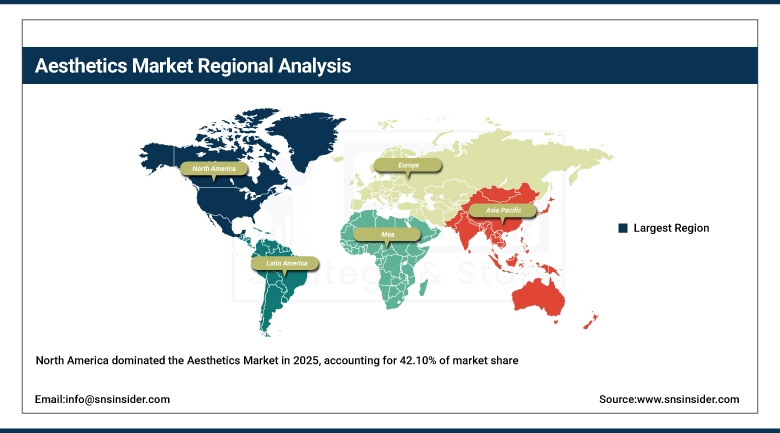
North America dominated the global Aesthetics Market in 2025, with the United States accounting for approximately 87.4% of North American revenues and approximately 42.10% of the global market share, driven by the world’s highest per-capita aesthetic procedure utilisation, the most commercially sophisticated aesthetic medicine practitioner and practice ecosystem, the highest concentration of aesthetic product and device innovation, and the most progressive consumer culture around cosmetic enhancement normalization that collectively create the deepest and most commercially dynamic aesthetic market globally. The U.S. market benefits from the world’s most extensive aesthetic practitioner training infrastructure supported by AbbVie’s expanded Allergan Medical Institute network, Galderma’s Restylane training academies, and multiple independent aesthetic medicine education organizations that collectively maintain the high practitioner skill base across injectable technique, combination treatment protocol design, and patient consultation that supports premium aesthetic procedure pricing and patient outcome quality.
Europe Aesthetics Market Insights
Europe is the world’s second-largest aesthetics market and a region where aesthetic medicine regulation, practitioner qualification standards, and product approval frameworks vary significantly across national markets in ways that shape commercial dynamics differently from the relatively standardized U.S. regulatory environment. Germany accounts for approximately 22.3% of European aesthetics revenues as the region’s largest national market, with a sophisticated medical aesthetics practice community and a consumer base whose approach to aesthetic enhancement tends toward the natural, understated results that reflect German aesthetic culture’s preference for subtle rejuvenation over dramatic cosmetic transformation, creating a market environment that favors high-quality natural-look product formulations and conservative treatment protocols.
Asia Pacific Aesthetics Market Insights
Asia Pacific is the fastest-growing regional aesthetics market, driven by South Korea’s extraordinary position as the global epicenter of advanced aesthetic medicine innovation and the world’s highest per-capita aesthetic procedure penetration rate, the explosive growth of medical aesthetics across Chinese urban centers where rising disposable income and beauty culture investment among young professional demographics are driving first-time aesthetic treatment adoption at remarkable scale, and the aesthetic treatment demand growth across Japan, Thailand, Singapore, and Australia from sophisticated consumer bases with well-established premium beauty spending habits. China accounts for approximately 61.7% of Asia Pacific aesthetics revenues and represents the most strategically important growth market in global aesthetics, as the combination of approximately 400 million urban middle-class consumers with growing disposable income and appearance investment motivation, a rapidly expanding aesthetic clinic network, and a government regulatory framework that is progressively clarifying the boundaries of permitted aesthetic practice creates a commercial opportunity whose scale and growth trajectory no other single national market can match across the 2026 to 2035 forecast period.
Latin America and MEA Aesthetics Market Insights
Latin America and the Middle East and Africa are growing aesthetics markets where cultural attitudes favoring physical appearance investment, rising middle-class purchasing power, expanding medical spa and aesthetic clinic infrastructure, and growing medical tourism flows are creating sustained aesthetic procedure demand growth across consumer segments that were previously limited in access to professional aesthetic services. Brazil accounts for approximately 44.2% of Latin American aesthetics revenues and holds a distinctive position as both a major aesthetic treatment consumption market reflecting Brazil’s globally renowned cultural emphasis on personal appearance and physical fitness and one of the world’s leading aesthetic medical tourism destinations where internationally recognized plastic surgeons and aesthetic physicians attract patients from North America, Europe, and neighboring Latin American countries for high-quality procedures at prices that compare favorably with developed market equivalents.
Market Dynamics
Growth Drivers: Demographic ageing expanding the established aesthetic patient population, younger generation preventive aesthetics adoption broadening the addressable market, and GLP-1 weight loss patient cohort creating structurally new body contouring and facial volumisation demand
The primary structural growth drivers for the Aesthetics Market are the demographic inevitability of expanding elderly and middle-aged populations in high-income markets whose aesthetic correction needs and purchasing power for aesthetic investment will grow simultaneously across the forecast period, combined with the extraordinary cultural shift toward preventive aesthetics among younger consumer demographics who are entering aesthetic treatment relationships earlier in adulthood and extending their lifetime aesthetic procedure engagement into a decades-long consumer journey that generates far greater cumulative market value than the episodic treatment patterns of earlier patient cohorts. The GLP-1 weight loss revolution represents a structurally new and additive demand driver that was not incorporated into pre-2024 aesthetic market forecasts, as the millions of patients globally achieving significant pharmacological weight loss are creating incremental demand for body contouring, loose skin treatment, facial volumisation, and rejuvenation procedures that address the distinctive aesthetic consequences of rapid weight loss in a patient population that did not previously exist at commercial scale in the aesthetic medicine market. Social media’s ongoing role as the primary driver of aesthetic awareness, procedure consideration, and practice selection continues to expand the aesthetic market’s geographic and demographic reach by making procedure information, before-and-after results, and practitioner expertise visible to consumer populations who would never have encountered aesthetic medicine through traditional medical referral pathways.
Restraints: Regulatory variation across markets limiting treatment accessibility, biosimilar neuromodulator competition compressing injectable product margins, and practitioner shortage in emerging markets constraining aesthetic procedure capacity expansion
A significant restraint on the Aesthetics Market is the regulatory fragmentation across national markets that creates compliance complexity for aesthetic product and device manufacturers seeking multi-market commercial launches, as the varying clinical evidence requirements, approval timelines, and post-market surveillance obligations across the FDA, European CE marking, Japanese PMDA, and Chinese NMPA regulatory frameworks require parallel multi-jurisdiction regulatory investment programmes that extend the time and capital cost of new product commercialization beyond what any single national market approval would require. The biosimilar and competing branded neuromodulator market expansion, with multiple botulinum toxin type A products now competing across the U.S. and European markets, is creating intensifying price competition in the world’s largest injectable product category that is compressing the premium pricing that established brands including Botox and Dysport have historically commanded, requiring manufacturers to invest in expanded clinical evidence, extended indication approvals, and enhanced patient and practitioner engagement programmes to sustain brand loyalty against increasingly capable lower-priced alternatives.
Opportunities: Male aesthetics market development, emerging market aesthetic medicine infrastructure expansion, and AI-powered treatment planning tools improving outcome predictability and patient conversion
The male aesthetics market development opportunity represents one of the highest-growth demographic expansion vectors in the global aesthetics industry, as the cultural barriers to male cosmetic treatment that historically suppressed male procedure adoption are demonstrably lowering across age cohorts in response to social media influence, professional appearance investment normalization, and the marketing efforts of major aesthetic brands including AbbVie’s Allergan Aesthetics, which launched dedicated male-focused Botox and Juvederm campaigns in 2025, creating commercial momentum that is converting cultural acceptance into procedure volume across botulinum toxin, filler, and non-surgical body contouring categories where male-specific treatment protocols and aesthetic outcomes are becoming progressively more defined and clinically refined. AI-powered skin analysis, facial aesthetic simulation, and treatment outcome prediction tools represent a significant commercial opportunity to improve patient conversion rates and treatment satisfaction by enabling practitioners to show prospective patients realistic visualizations of their likely aesthetic outcomes before committing to treatment, addressing the uncertainty and anxiety that prevents many consideration-stage patients from proceeding with treatment and differentiating the practices that deploy these tools with a consultative capability that purely product-focused competitors cannot match.
Recent Developments:
-
2025: Allergan Aesthetics (AbbVie) opened three new state-of-the-art Allergan Medical Institute training centers in Irvine, California, Atlanta, Georgia, and Austin, Texas, expanding its U.S. practitioner training infrastructure to support the growing aesthetics provider workforce and strengthen brand loyalty among the next generation of injectors and aesthetic medicine practitioners across dermatology, plastic surgery, and medical spa settings.
-
2025: Galderma expanded its Restylane filler portfolio with new product formulations incorporating advanced NASHA and OBT technologies designed to deliver improved longevity, lift capacity, and natural facial integration across lip enhancement, cheek contouring, and tear trough treatment applications in response to growing patient demand for premium long-lasting filler results.
-
2025: Revance Therapeutics continued the commercial rollout of Daxxify (daxibotulinumtoxinA-lanm) across U.S. aesthetic practices, marketing the product’s approximately six-month duration advantage over standard three-month neuromodulators to patients seeking reduced treatment frequency, and building practitioner adoption through clinical education programmes demonstrating optimal Daxxify injection technique for facial wrinkle reduction indications.
-
2025: InMode expanded its body contouring and facial treatment device portfolio with new radiofrequency and combination energy modality platforms targeting the growing non-surgical body reshaping market, including devices designed specifically to address the skin laxity and body composition changes experienced by the growing GLP-1 medication weight loss patient population seeking post-weight-loss aesthetic correction.
-
2025: Perfect Corp. expanded its AI-powered aesthetic simulation platform with new capabilities enabling aesthetic clinics to provide patients with realistic AI-generated visualizations of expected injectable treatment outcomes during consultation, integrating with practice management systems to improve patient consultation quality, treatment plan approval rates, and overall patient experience at adopting aesthetic practices globally.
Aesthetics Market Key Players
-
AbbVie Inc. (Allergan Aesthetics)
-
Galderma S.A.
-
Merz Pharmaceuticals GmbH
-
Revance Therapeutics, Inc.
-
InMode Ltd.
-
Sientra, Inc.
-
Hologic, Inc. (Cynosure)
-
Cutera, Inc.
-
BTL Industries
-
Venus Concept
-
Solta Medical (Bausch Health)
-
Sciton, Inc.
-
Apyx Medical Corporation
-
Sinclair Pharma
-
Medytox Inc.
-
Hugel Inc.
-
IBSA Institut Biochimique SA
-
Teoxane SA
-
Prollenium Medical Technologies
-
Evolus Inc.
Aesthetics Market Report Scope:
| Report Attributes | Details |
|---|---|
| Market Size in 2025 | USD 87.08 Billion |
| Market Size by 2035 | USD 169.55 Billion |
| CAGR | CAGR of 6.89% From 2026 to 2035 |
| Base Year | 2025 |
| Forecast Period | 2026-2035 |
| Historical Data | 2022-2024 |
| Report Scope & Coverage | Market Size, Segments Analysis, Competitive Landscape, Regional Analysis, DROC & SWOT Analysis, Forecast Outlook |
| Key Segments | • By Procedure (Non-Surgical Procedures, Surgical Procedures) • By Product (Injectables, Body Contouring Devices, Facial Aesthetic Devices, Implants, Others) • By Application (Facial Aesthetics, Body Aesthetics, Skin Aesthetics, Hair Aesthetics) • By End User (Dermatology Clinics, Hospitals & Clinics, Beauty Clinics, Others) |
| Regional Analysis/Coverage | North America (US, Canada), Europe (Germany, UK, France, Italy, Spain, Russia, Poland, Rest of Europe), Asia Pacific (China, India, Japan, South Korea, Australia, ASEAN Countries, Rest of Asia Pacific), Middle East & Africa (UAE, Saudi Arabia, Qatar, South Africa, Rest of Middle East & Africa), Latin America (Brazil, Argentina, Mexico, Colombia, Rest of Latin America). |
| Company Profiles | AbbVie Inc. (Allergan Aesthetics), Galderma S.A., Merz Pharmaceuticals GmbH, Revance Therapeutics, Inc., InMode Ltd., Sientra, Inc., Hologic, Inc. (Cynosure), Cutera, Inc., BTL Industries, Venus Concept, Solta Medical (Bausch Health), Sciton, Inc., Apyx Medical Corporation, Sinclair Pharma, Medytox Inc., Hugel Inc., IBSA Institut Biochimique SA, Teoxane SA, Prollenium Medical Technologies, and Evolus Inc. |
Frequently Asked Questions
North America dominated the Aesthetics Market in 2025, with the United States as the leading national market within the region.
Non-Surgical Procedures dominated with approximately 58.40% revenue share in 2025.
The convergence of ageing population demographics expanding the established aesthetic patient base, younger generation preventive aesthetics adoption broadening the addressable market, the GLP-1 weight loss patient cohort creating new body contouring and facial volumisation demand, and the continuous innovation cycle in injectable formulations and energy-based device technologies delivering improving non-surgical treatment outcomes that are expanding the range of aesthetic corrections achievable without surgical intervention.
The Aesthetics Market was valued at USD 87.08 Billion in 2025.
The Aesthetics Market is expected to grow at a CAGR of 6.89% from 2026 to 2035.
