
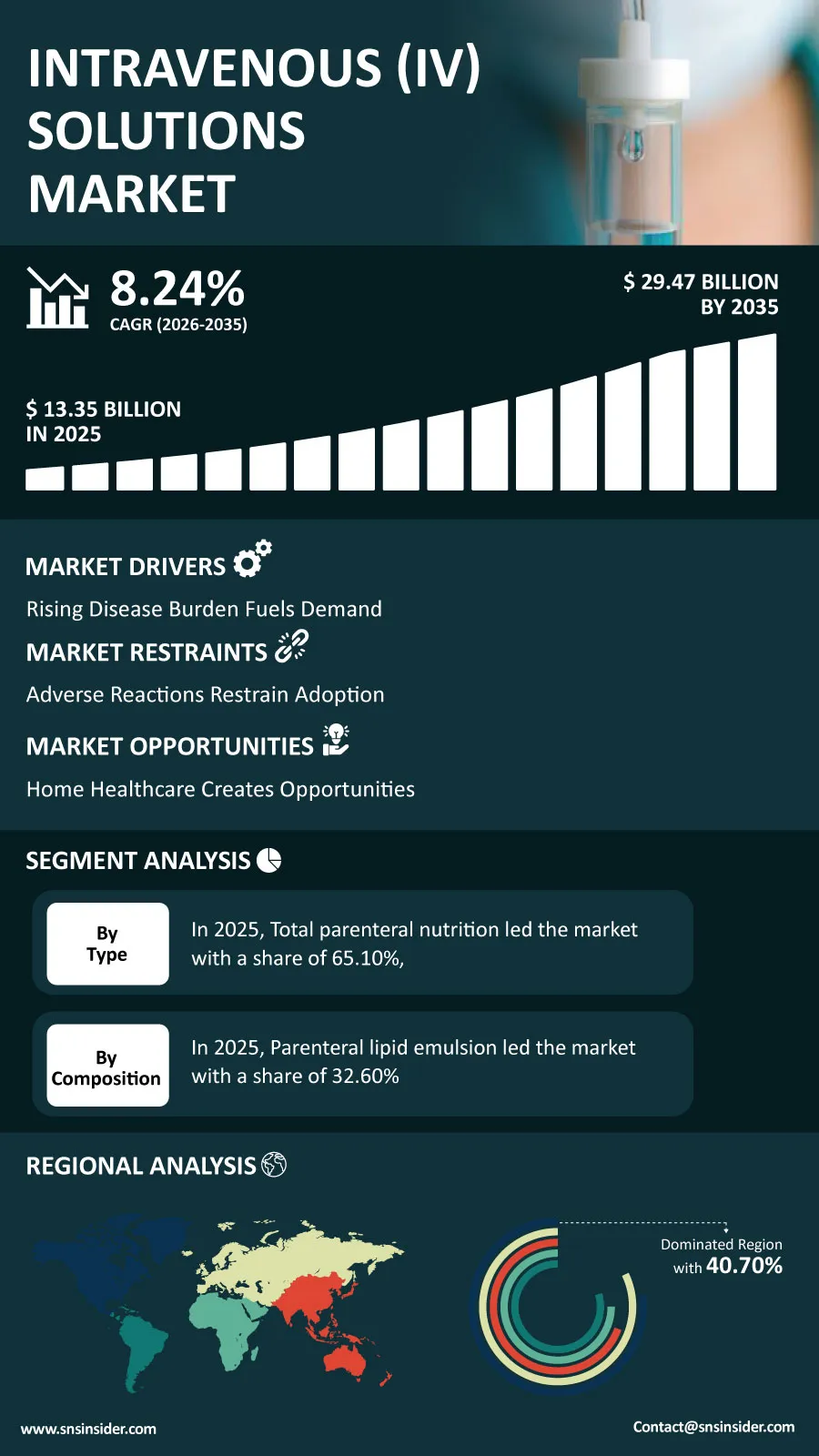
The global Intravenous Solutions Market is witnessing sustained momentum as healthcare systems expand critical care capacity and prioritize advanced nutritional support, fluid management, and patient recovery solutions. “According to a recent study by SNS Insider, the global Intravenous Solutions Market size valued at USD 13.35 billion in 2025, is anticipated to grow to USD 29.47 billion by 2035, registering a CAGR of 8.24% over the 2026–2035 forecast period.”
Healthcare practitioners are turning more frequently to IV therapy for treating patients who need immediate rehydration, nutrition, electrolyte balancing, and administration of medications. The increasing trends in hospitalizations, surgeries, and cases of chronic diseases will drive the demand over the long term. However, advances in IV system technology and the availability of pre-packaged formulas contribute to making healthcare organizations operate more efficiently.
To Get Detailed Insights on the Intravenous Solutions Market – Request a Sample Report
Growing Healthcare Needs Expand IV Therapy Applications
Modern healthcare delivery is becoming increasingly dependent on intravenous therapies across emergency medicine, oncology, intensive care, nephrology, and post-operative recovery. Demand is also accelerating as aging populations require more frequent hospitalization and long-term nutritional support.
The shift toward outpatient care has encouraged manufacturers to develop portable infusion technologies and convenient solution formats that support treatment beyond hospitals. Home-based infusion services are becoming an increasingly important part of patient care, reducing hospital stays while improving treatment accessibility for individuals requiring ongoing therapy.
Key Market Findings Highlight Strong Segment Performance
The total parenteral nutrition segment accounted for 65.10% of market revenue in 2025, supported by its extensive use for patients requiring comprehensive nutritional supplementation. Meanwhile, peripheral parenteral nutrition is projected to record the fastest expansion through 2035, advancing at a CAGR of 8.90%.
Among product compositions, parenteral lipid emulsion represented the largest share at 32.60% in 2025 because of its essential role in complete nutritional formulations. Single-dose amino acids are anticipated to deliver the strongest future growth with a 9.20% CAGR, reflecting rising demand for personalized nutritional therapy.
Based on application, nutritional support generated 55.60% of total revenue in 2025, driven by increasing cases of chronic disease, malnutrition, and surgical recovery. Fluid and electrolyte balance is expected to emerge as the fastest-growing application, registering a CAGR of 8.70% during the forecast period.
Hospitals and clinics remained the leading end users, contributing 70.20% of market revenue in 2025 owing to high patient volumes and established infusion infrastructure. However, home care settings are forecast to experience the fastest growth with a 9.50% CAGR, reflecting increasing patient preference for receiving treatment outside conventional healthcare facilities.
Innovation and Home Healthcare Shape Future Demand
There has been increased investment in technologies aimed at improving safety, ease of administration, and minimizing preparation time for health care providers. Ready to administer IV preparations, automated compounding technologies, and intelligent infusion technologies are becoming increasingly prevalent among healthcare organizations.
Increased patient preference for home IV administration also means opportunities in portable equipment and monitoring, and easy to use administration kits. Market projections suggest that more than 60% of patients prefer to take their IV therapy from home in order to avoid visits to hospitals and thus healthcare costs. In addition, there has been an increased use of IVs in hospitals with annual growth rates of 6-7%.
Regional Markets Continue Their Expansion
The market share in North America in 2025 was 40.70%, owing to its advanced healthcare systems, increased usage of advanced infusion technology, and high demands for nutritional therapy and critical care. The U.S., on its part, is one of the leading countries within North America, which is attributed to its market value of USD 3.91 billion in 2025 and forecasted growth to reach USD 8.39 billion in 2035 at a 7.93% CAGR.
Among the regions, the Asia Pacific region is estimated to witness the fastest growth rate in terms of CAGR, which is 9.46% throughout the period 2025 – 2035. This is due to the rising investments in the health sector, improved infrastructure in the hospitals, and increased awareness of advanced infusion technology in China, India, and other healthcare market leaders.
Europe is also maintaining its strength owing to investments in the advanced medical technology and well-developed healthcare systems, whereas Latin America and the Middle East & Africa have been continuously developing their health sector through modernization initiatives.
Leading Companies Strengthen Competitive Position
Competition within the market remains focused on product innovation, patient safety, manufacturing expansion, and advanced infusion technologies. Companies continue introducing next-generation infusion systems, safer formulations, and environmentally responsible packaging while expanding their global distribution networks.
Major companies operating in the global Intravenous (IV) Solutions Market include Baxter International Inc., B. Braun Melsungen AG, Fresenius Kabi AG, Grifols S.A., ICU Medical Inc., Otsuka Pharmaceutical Co. Ltd., Ajinomoto Co. Inc., Terumo Corporation, Pfizer Inc., Hospira Inc., Daiichi Sankyo Company Limited, Hikma Pharmaceuticals PLC, Cardinal Health Inc., Abbott Laboratories, Novartis AG, Medline Industries Inc., Chongqing Huapont Pharm Co. Ltd., Shanghai Fuxing Pharmaceutical Co. Ltd., Taisho Pharmaceutical Co. Ltd., and CJ Healthcare Corporation.
An SNS Insider analyst Parry Kardani commented, "The future of intravenous therapy will be shaped by innovations that improve safety, convenience, and accessibility. Organizations investing in advanced infusion technologies, home healthcare solutions, and patient-centric delivery systems will be well positioned to meet growing global demand as healthcare increasingly moves beyond traditional hospital settings.
About the Author

Get in touch




