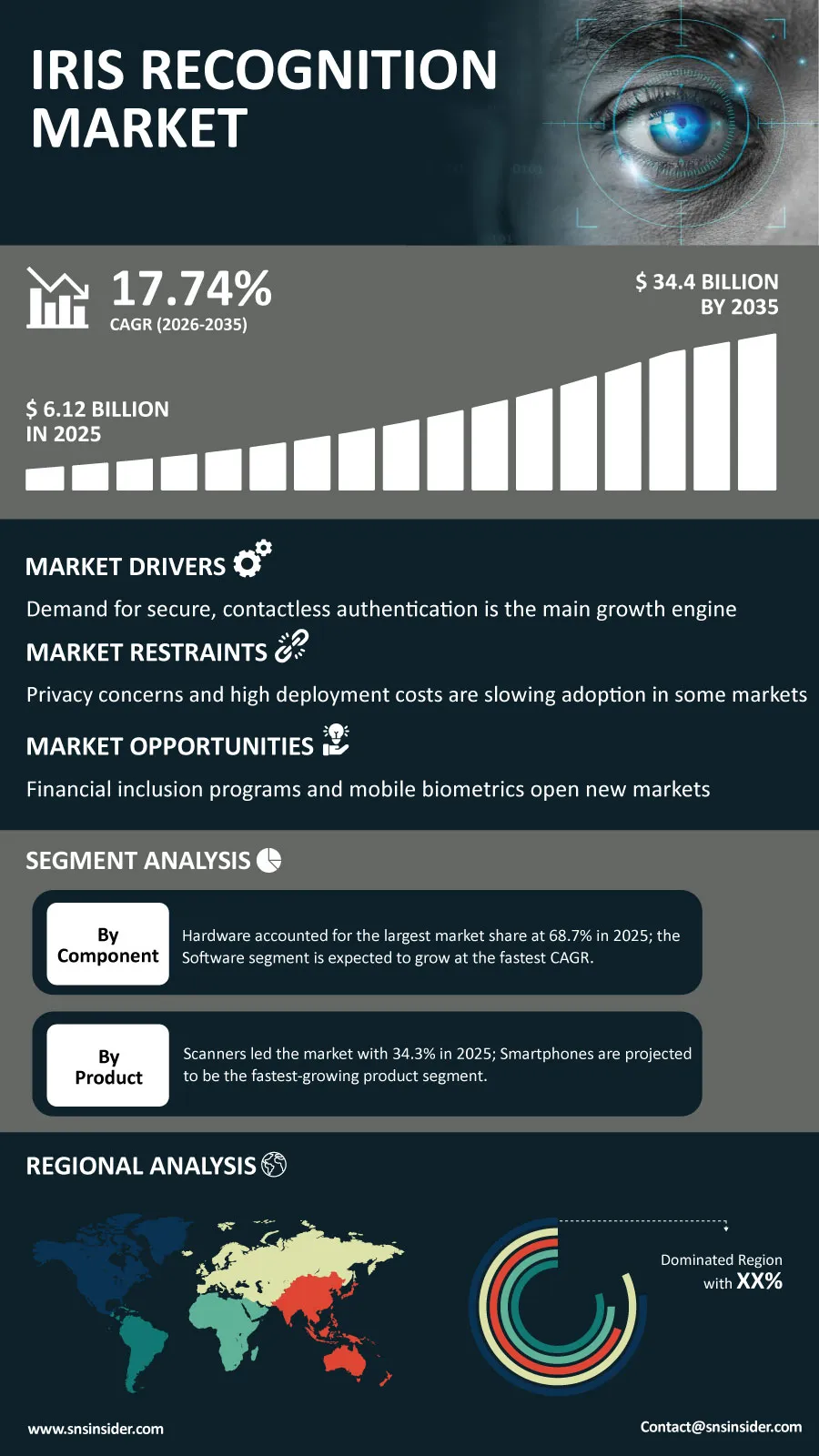
The global Iris Recognition Market is entering a high-growth phase as governments, enterprises, and technology providers accelerate the shift toward secure, contactless identity verification. According to a recent study by SNS Insider, the global Iris Recognition Market size valued at USD 6.12 billion in 2025, is anticipated to grow to USD 34.4 billion by 2035, registering a CAGR of 17.74% over the 2026–2035 forecast period.
The increased complexity of identity theft and cyber-attacks is leading to organizations moving toward improved forms of authentication that go beyond traditional methods such as passwords, PINs, and access cards. The iris is a biometric feature that provides a unique identifier while ensuring fast, contactless identification in critical environments including airports, governmental sites, financial establishments, healthcare facilities, and data systems.
Additionally, improvements in technologies such as artificial intelligence and image processing, among others, have made it easier for recognition to be accomplished under difficult environmental conditions. Moreover, growth in digital identity initiatives and application of biometric solutions in consumer devices have raised awareness.
To Get Detailed Insights on the Iris Recognition Market – Request a Sample Report
Digital Identity Expansion Creates New Growth Opportunities
As there is a move toward trusted digital identities globally, iris recognition systems have a chance of experiencing significant growth. Many governments are working on border control, national identification, and passport programs, whereas companies aim to enhance their security through authentication techniques.
One of the fields that will benefit from the use of biometrics technologies includes the healthcare industry, where many hospitals and healthcare organizations are looking to use biometric systems to prevent identity confusion and ensure access to medical data.
Moreover, financial companies are trying to implement iris recognition for the verification process and future payment solutions. Iris recognition technology is merging with facial recognition and other biometric techniques. Multi-modal technologies may be useful for high-security applications due to their advantages.
Key Market Insights Highlight Shifting Demand Patterns
By component, hardware is expected to account for 68.7% of global market revenue in 2025, reflecting continued demand for specialized scanners, imaging devices, and biometric capture systems. However, software is projected to record the fastest growth as artificial intelligence and cloud-based biometric platforms improve matching capabilities and simplify deployment.
Based on product, standalone scanners are anticipated to lead with a 34.3% market share in 2025, supported by widespread use in government facilities, border checkpoints, financial institutions, and other controlled environments. Smartphone-based solutions are expected to emerge as the fastest-growing product category as mobile devices increasingly become platforms for secure identity authentication.
By application, identity management and access control are forecast to dominate with a 57.3% revenue share in 2025. The e-payment segment is expected to witness the fastest growth as financial institutions and technology providers explore convenient, cardless authentication methods for digital transactions.
Based on end use, government is projected to hold the largest share at 39.6% in 2025, driven by national identity initiatives, border security, law enforcement, and defense applications. Healthcare and BFSI are emerging as high-growth sectors as organizations seek stronger identity verification and improved protection against fraud.
Contactless Authentication and AI Innovation Reshape Adoption
The rising preference for touchless security measures has been helping in the greater adoption of iris recognition technology in various settings. Artificial intelligence-based technologies are allowing for quicker and more reliable image processing and matching. New-age sensors have helped in making it usable in different lighting conditions.
The inclusion of biometrics in connected technologies has opened up new uses for this recognition technology. From secure building access to transportation systems and other digital services, iris recognition has been emerging as an important aspect of identification systems.
U.S. Biometric Industry Expands at an 18.72% CAGR, Reaching USD 9.3 Billion by 2035
The North American region is poised to be one of the prominent regional markets owing to the presence of extensive government policies, advanced cybersecurity framework, and high enterprise adoption in the United States. The U.S. market was worth USD 1.67 billion in 2025 and is estimated to grow up to USD 9.3 billion in 2035, witnessing a CAGR of 18.72%.
The Asia Pacific region is set to emerge as a prominent region for growth owing to large-scale deployments of digital identity programs, rapid technology adoption, and investments in security infrastructure for public sector. Significant contribution from China, India, Japan, and South Korea has been made through various applications such as government, transport, finance, and public security.
Industry Participants Focus on Multimodal Biometric Innovation
The competitive landscape is evolving as technology providers invest in artificial intelligence, liveness detection, multimodal authentication, compact biometric devices, and cloud-based identity platforms. Companies are increasingly focused on improving accuracy, reducing false matches, and integrating iris recognition into broader digital identity ecosystems.
Key companies operating in the global Iris Recognition Market include IriTech, Inc., IrisGuard Ltd., Iris ID, Inc., Princeton Identity Inc., CMITech Company Ltd., Aware, Inc., BioEnable Technologies, Recogtech B.V., SRI International, Thales Group, NEC Corporation, Innovatrics, Daon Inc., Precise Biometrics, and HID Global.
An SNS Insider analyst Sushant Kadam commented, “The rapid expansion of digital identity initiatives and the growing need for highly secure, contactless authentication are creating substantial opportunities for iris recognition technology. Providers that combine AI-driven accuracy, privacy-focused data protection, and seamless integration across government, healthcare, financial, and consumer applications will be well positioned to capture the market's long-term growth.”
About the Author

Get in touch