
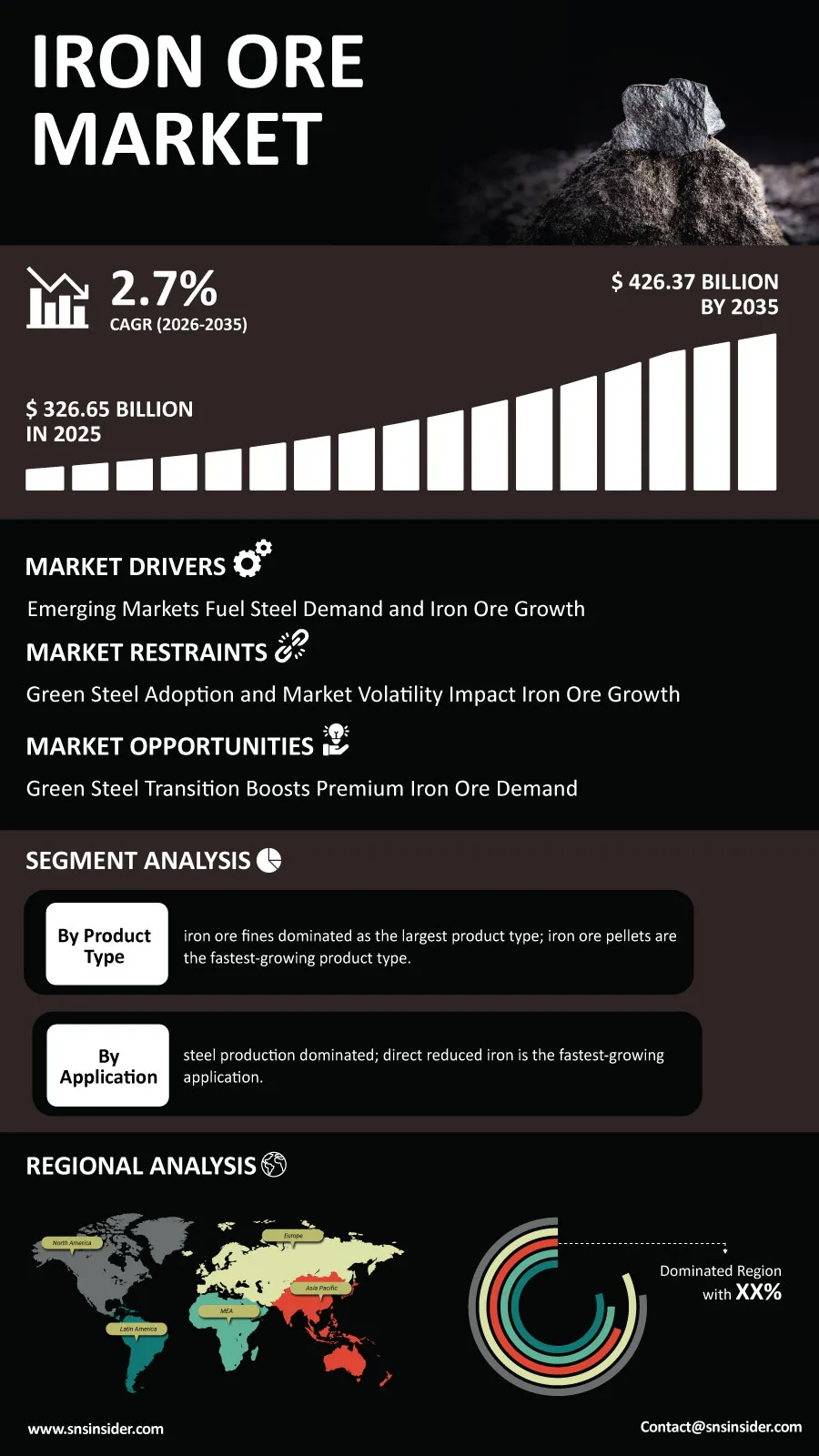
The world’s Iron Ore market is forecasted to remain steady in terms of its growth rate as governments increase infrastructure spending while iron ore producers move towards green production technology. “According to a recent study by SNS Insider, the global Iron Ore Market size valued at USD 326.65 Billion in 2025, is anticipated to grow to USD 426.37 Billion by 2035, registering a CAGR of 2.7% over the 2026–2035 forecast period.”
Iron ore remains to be the leading source of material used in steel production across the globe, with applications in sectors like construction, transportation, machinery, green energy, and industrial equipment. As countries with established economies record steady utilization of steel, new emerging countries are making significant investments in developing urban areas, transport systems, and industries, creating a sustainable demand for iron ore products. On the other hand, producers of steel are opting for high-quality ores to boost efficiency and decarbonization efforts.
To Get Detailed Insights on the Iron Ore Market – Request a Sample Report
Green Steel Investments Create New Opportunities for Premium Iron Ore
The global move towards carbon-efficient steel production processes is affecting the demand for iron ore in different ways. Ore suppliers are making greater capital investment in their efforts to upgrade beneficiation and pelletization processes to be able to provide iron ore concentrates that have better quality to be used in DRI plants and EAF steel production. This type of production requires higher iron ore quality and purity than the traditional blast furnace steel production.
Moreover, the use of advanced technologies such as automation, artificial intelligence, remote drilling, and automated haulage is being applied by miners to increase the efficiency of production processes as well as to reduce expenses and the negative effect on the environment.
Key Market Insights Reflect Changing Steel Production Requirements
Iron Ore Fines dominated by product type in 2025 owing to their extensive usage for making blast furnace steel around the world coupled with their abundant availability at large mining sites. The fastest growing segment is forecasted to be Iron Ore Pellets in the coming years because of increasing demands for high-quality input materials needed in hydrogen and natural gas-based direct reduction techniques.
With respect to the grading system, High-Grade Iron Ore emerged as a dominant market leader, driven by rising industrial preferences for high-efficiency and low-emissions of the furnace. Medium grade iron ore is still producing a considerable volume of output, especially in the conventional steelmaking operations.
In terms of applications, Steel Production dominated global consumption, taking up the lion’s share in terms of iron ore usage in the industrial sector. In contrast, Direct Reduced Iron (DRI) is forecasted to register the fastest growth driven by investments in clean technologies by steelmakers. By end-users, the dominating one was the Construction segment, whereas automotive and transport applications were growing owing to vehicle production and modernization of infrastructure.
Digital Mining Technologies Improve Efficiency Across Global Operations
Innovation in technology has been making an impact in mining companies through smart management of resources and automation. There has been the use of artificial intelligence in ore grade prediction, predictive maintenance of equipment, and mine planning in order to help mining firms to recover maximum resources without downtimes.
Mining companies are also working on increasing beneficiation capability in order to enhance ore quality and cope with the increased need for high-grade products. This, together with the efforts in logistics and lower emission transportation, is helping the steel industry meet its environmental goals.
Asia Pacific Leads Global Demand While Emerging Regions Expand Supply
The Asia Pacific region is still the largest and fastest-growing regional market due to the dominance of China as the largest producer of steel in the world as well as the dominance of Australia as a leading exporter of iron ore. The ongoing rapid industrialization in India and Southeast Asia drives steel demand in these regions as well.
North America enjoys stability of domestic steel production and infrastructural investments of the government to promote steel manufacturing. The continent of Europe is witnessing rising demand for high-quality iron ore due to a shift by steel producers towards hydrogen-based technologies. In the meantime, Latin America and Africa enjoy rising prominence through their mining investments, Brazil being one of the largest exporters of steel worldwide, along with large mining investments in Africa.
Industry Participants Expand Capacity and Sustainable Mining Initiatives
The dynamic environment keeps changing in light of the efforts being undertaken by the leading players in the mining sector towards the production of high-grade ores, digitalization in mining, automation, and green mining. The investments in beneficiation plant, pellets, logistics, and renewable energy are helping the producers build reliable supply chains for the low carbon manufacturing of steel.
Key companies operating in the global Iron Ore Market include Vale SA, BHP Group Ltd., Rio Tinto plc, Fortescue Metals Group Ltd., Anglo American plc, ArcelorMittal SA, Cleveland-Cliffs Inc., Kumba Iron Ore Ltd. (Anglo American), Ansteel Group Corporation Ltd., HBIS Group Co. Ltd., Metalloinvest Management LLC, LKAB (Luossavaara-Kiirunavaara AB), Iron Ore Company of Canada, Evraz plc, Severstal PJSC, Ferrexpo plc, NMDC Ltd., Champion Iron Ltd., Labrador Iron Ore Royalty Corporation, and Mount Gibson Iron Ltd.
An SNS Insider analyst Himanshu Sharma commented, "The global iron ore industry is entering a new phase where product quality, operational efficiency, and sustainability will become increasingly important competitive differentiators. Companies investing in premium-grade ore production, advanced mining technologies, and low-carbon supply chains are expected to benefit as steelmakers accelerate their transition toward cleaner and more efficient manufacturing processes."
About the Author

Get in touch




