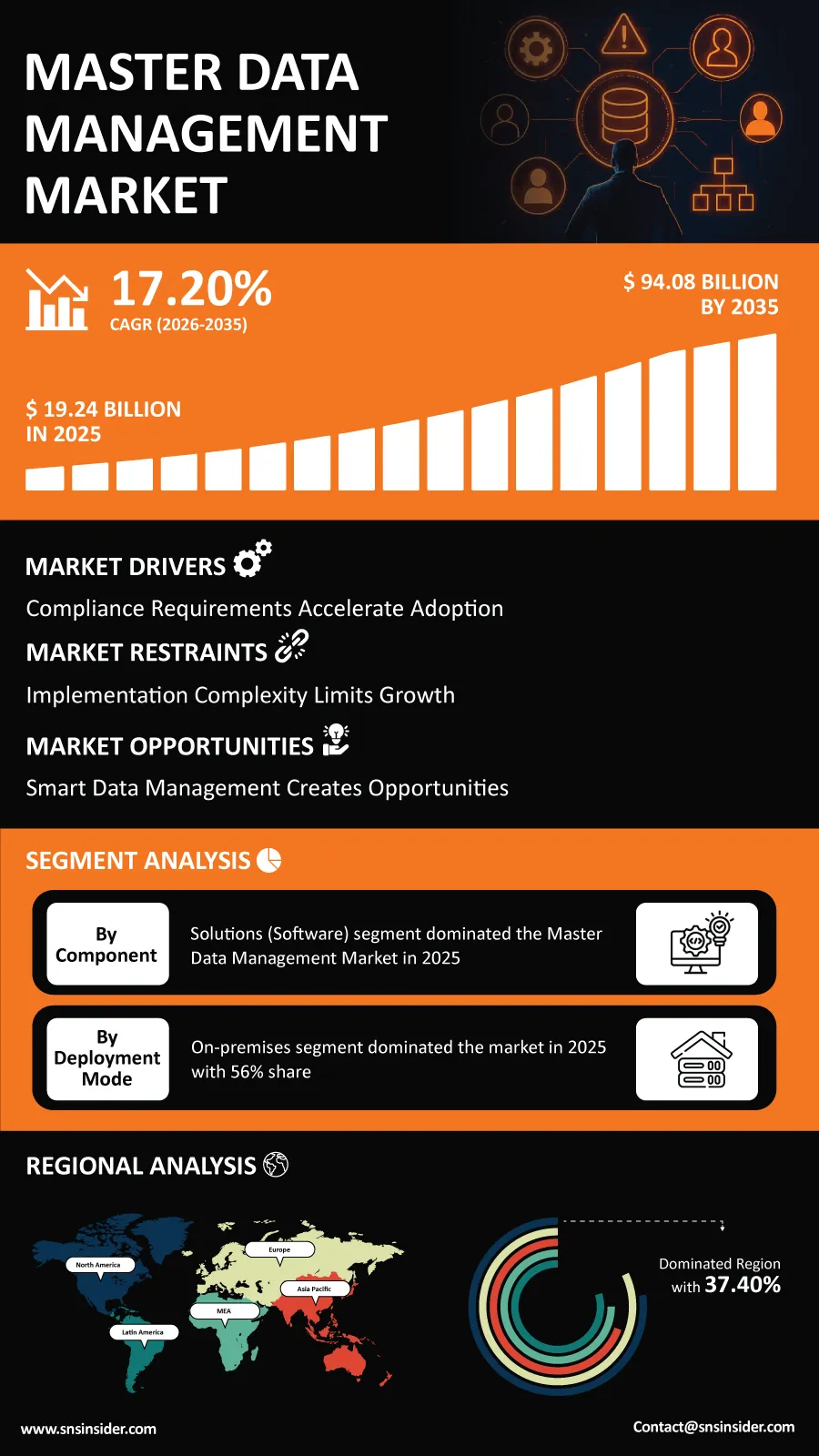
The global Master Data Management (MDM) Market will grow tremendously as enterprises are strengthening data governance strategies to boost operational efficiency, regulatory compliance and digital transformation initiatives. “According to a recent study by SNS Insider, the global Master Data Management Market size valued at USD 19.24 billion in 2025, is anticipated to grow to USD 94.08 billion by 2035, registering a CAGR of 17.20% over the 2026–2035 forecast period.”
In today’s world, where organizations produce an enormous amount of enterprise data, having one single source of truth is of paramount importance. From financial services to telecoms, manufacturing companies, retailers, and the healthcare sector, all are investing in master data management tools to overcome data discrepancies, boost business intelligence and enterprise decision making.
The widespread adoption of cloud computing technologies, AI, and advanced analytics is further fueling the need for master data management systems. Organizations have started requiring real-time synchronization of data related to customers, suppliers, products, and financial processes in digital environments.
To Get Detailed Insights on the Master Data Management Market – Request a Sample Report
Enterprise AI Adoption and Data Governance Investments Create Long-Term Growth Opportunities
As AI initiatives across the globe are growing more reliant on high-quality and reliable data assets, organizations are radically expanding investments in enterprise data platforms. We spent years designing better MDM platforms that help enterprises build a single unified data foundation for organizations to enhance automation, predictive analytics, and AI-driven decision making while lowering operational risks associated with duplicate or inaccurate information.
This will also enable a new breed of cloud-native deployment models — ones that can reimagine enterprise data management with higher scalability and rapid time to market integrated into existing business applications. Organizations are revitalizing their legacy infrastructure to build connected data ecosystems with the ability to scale across business units, bolstering their digital transformation strategies.
At the same time, growing regulatory scrutiny around data privacy, financial reporting, health information and consumer protection consistently drives demand for solid MDM governance. Investment in improved data quality or simplifying compliance processes is a trend organizations are now focusing on, perhaps with the ultimate goal of gaining confidence in enterprise-wide business information.
Key Market Insights Highlight Shifting Demand Patterns
By component, solutions are projected to hold more than 68% of global market revenue in 2025 driven by increasing enterprise needs for data governance, data quality management and integrated master data platforms. By 2035, the services segment is projected to grow at the highest CAGR due to growing need for consulting, implementation, migration and managed services among organizations supporting complex MDM deployments.
Based on deployment model, the market has been segmented onto on-premise and cloud-based solutions; where, by 2025 on-premise solutions are expected to reach up to 56% of an entire market revenue, owing to demands posed by enterprises for greater control over security and regulatory compliance across sensitive business environments. Cloud deployment is expected to register the highest growth during the forecast period, as organizations pursue cloud transformation processes and look for cost-effective yet scalable data management platforms.
Based on data domain, in 2025, customer master data represented around one-third market share due to organizations continuously focusing on accurate information about customers to benefits from personalization, regulatory compliance, fraud prevention and engagement with customers across the omnichannel. Data ranging from product master data — which is projected by our analysis to grow most quickly through 2035 as enterprises tackle the overlays of rising levels of complexities in their product portfolios across global digital commerce channels.
The BFSI segment accounted for around 28% of market revenue in 2025 among end users, owing to strict regulatory compliance policies and growing reliance on accountable enterprise data. The fastest growth of the segment is reserved due to expansion around the globe, through government initiatives aimed at electronic health records and inter-operation, in addition to data-driven clinical decision-making.
AI-Driven Data Management Technologies Accelerate Industry Transformation
Master data management (MDM) platforms are quickly evolving with improved adoption of AI, machine learning, automated data stewardship and real-time data synchronization capabilities. Such technologies empower organizations to enhance entity matching, automate data quality monitoring, and create trusted organization-wide master records around 60 times faster with improved accuracy.
In addition, technology providers are also introducing cloud-native architectures, API-driven integration capabilities along with advanced analytics features enabled to simplify deployment and support hybrid and multi-cloud enterprise environments. These advancements give organizations the capability to create cognitive data ecosystems that enhance operational effectiveness and streamline digital business transformation.
North America Held More Than 37.40% of the Master Data Management Market Share in 2025; Asia Pacific Projected to Register the Fastest CAGR Through 2035
Due to mature enterprise software ecosystem, AI adoption & compliance standards across the financial services sector, healthcare and technology sectors; North America is expected to remain as one of the prominent regions for revenue generation contributing more than 37.40% of total market revenue in 2025. United States has the sales and will keep to lead within local call for identical strategy software program module investments.
Asia Pacific is likely to witness fastest growth during the period 2025 - 2035 due to rapid increase in digitalization and enterprise cloud adoption across China, India, Japan and Southeast Asia. There are great opportunities for master data management solution providers across the region due to rapidly expanding digital economies, increasing enterprise data volumes and rising investments in artificial intelligence.
Europe too continues to be a key driver for global market growth, aided by strong data governance regulations, wider cloud adoption and increased need for regulated enterprise data management frameworks in manufacturing, financial services and healthcare.
Industry Participants Focus on AI-Powered Data Governance and Cloud Innovation
Continuous shift in competition with top technology providers such as AWS, Google and Microsoft spend heavily on AI, cloud-native architectures, automated data governance & integration features. Strategic partnerships, platform modernization, and persistent product innovation enable vendors to offer scalable master data management solutions to address more complex enterprise data environments.
Key companies operating in the global Master Data Management Market include Informatica, IBM, SAP SE, Oracle Corporation, TIBCO Software Inc., Talend S.A., Stibo Systems, Profisee Group, Inc., Reltio Inc., Ataccama Corporation, SAS Institute Inc., Teradata Corporation, Magnitude Software, Inc., EnterWorks (Winshuttle, LLC), Riversand Technologies, Inc. (Syndigo), Contentserv Group AG, Semarchy, Cloudera, Inc., Microsoft, and Qlik.
An SNS Insider analyst Sakshi Kale commented, “The accelerating adoption of artificial intelligence, cloud-native enterprise platforms, and data-driven business strategies is significantly increasing the importance of trusted master data across organizations. Companies investing in intelligent data governance, automated stewardship, and scalable MDM platforms will be well positioned to support future digital transformation and enterprise AI initiatives.”
About the Author

Get in touch