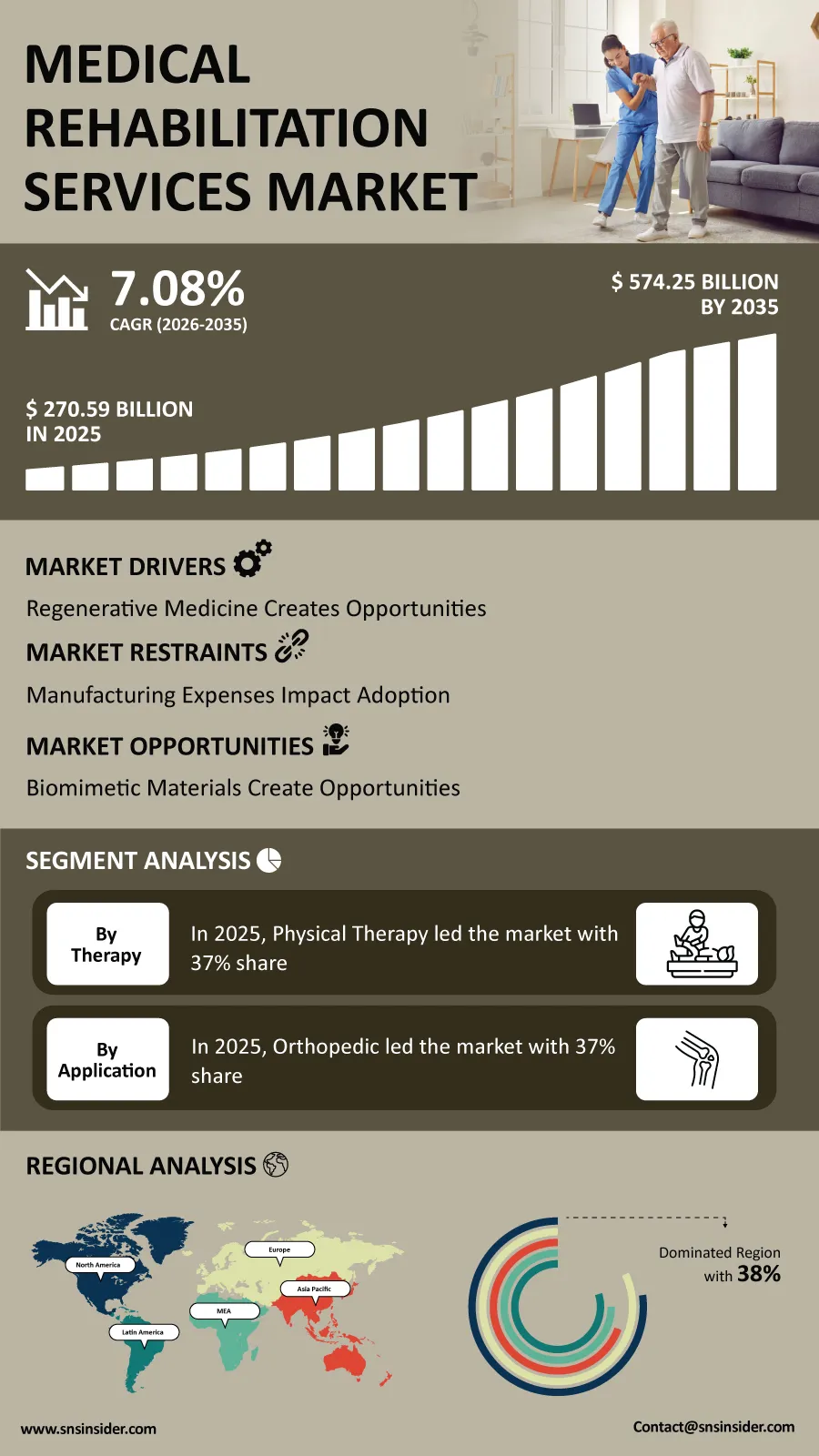
The global Medical Rehabilitation Services Market is expected to witness substantial expansion over the coming decade as healthcare systems increasingly prioritize long-term recovery, functional independence, and patient-centered care. “According to a recent study by SNS Insider, the global Medical Rehabilitation Services Market size valued at USD 270.59 billion in 2025, is anticipated to grow to USD 574.25 billion by 2035, registering a CAGR of 7.08% over the 2026–2035 forecast period.”
Rehabilitation facilities are being developed around the world in response to an increased demand for the services related to recovery after surgery, injury, neurological problems, heart conditions, and aging effects. The advancements in service delivery models, along with the expansion of access to specific therapy services, are contributing to the continued growth of the market.
At the same time, the sector is currently experiencing significant changes through the implementation of digital solutions, multidisciplinary treatment options, and personalized care plans.
To Get Detailed Insights on the Medical Rehabilitation Services Market – Request a Sample Report
Technology-Driven Rehabilitation Continues to Reshape Patient Care
The rapid development in health technology has brought about changes in how rehabilitative services are provided in hospitals, clinics, and even at home. The increase in use of robotic therapy, virtual rehabilitation systems, tele-rehabilitation, wearables, and artificial intelligence will allow healthcare practitioners to provide more personal and quantifiable rehabilitation programs.
There is an increase in use of hybrid care methods that incorporate in-person therapy and digital rehabilitation technologies, making health care services more accessible and allowing patients to engage continually outside traditional clinics.
The continued investment by healthcare providers in health technology for providing rehabilitation will lead to benefits in the health industry through increased treatment efficacy, patient engagement, and improved recovery.
Key Market Findings Highlight Emerging Opportunities
Among therapy categories, physical therapy accounted for 37% of global market revenue in 2025, maintaining its position as the largest rehabilitation service due to broad utilization across multiple clinical conditions.
Meanwhile, cognitive therapy is expected to emerge as the fastest-growing therapy segment through 2035, supported by increasing demand for rehabilitation programs addressing neurological disorders, cognitive impairment, and post-stroke recovery.
From an application perspective, orthopedic rehabilitation represented 37% of total market revenue in 2025, reflecting continued demand for recovery services associated with musculoskeletal disorders, joint replacement procedures, and mobility restoration. At the same time, sports-related injury rehabilitation is projected to record the fastest growth during the forecast period, driven by increasing sports participation and greater emphasis on performance-focused recovery.
By treatment setting, outpatient rehabilitation services accounted for 54% of market revenue in 2025, supported by greater convenience, lower treatment costs, and expanding availability of community-based rehabilitation programs. However, inpatient rehabilitation is anticipated to experience the fastest growth through 2035, reflecting increasing demand for comprehensive care among patients requiring intensive recovery programs.
Across end users, hospitals and clinics represented 31% of total market revenue in 2025, while specialized rehabilitation centers are expected to witness the strongest growth as healthcare systems continue expanding dedicated rehabilitation facilities and long-term recovery services.
Growing Focus on Functional Recovery Supports Market Expansion
Healthcare systems are increasingly recognizing rehabilitation as an essential component of comprehensive patient care. The emphasis is shifting beyond disease treatment toward restoring mobility, improving independence, and enhancing overall quality of life for patients recovering from complex medical conditions.
Greater collaboration among physicians, rehabilitation specialists, therapists, and care coordinators is enabling more integrated treatment approaches that support individualized recovery goals across diverse patient populations.
Increasing public awareness regarding the benefits of early rehabilitation and long-term therapy programs is also contributing to higher utilization of rehabilitation services worldwide.
Regional Markets Continue to Present Significant Growth Opportunities
North America was responsible for about 38% share of global market revenue in 2025 due to the presence of well-developed healthcare infrastructure, availability of various rehabilitation centers, good reimbursement scenario, and increased adoption of technologically driven therapy solutions.
The Asia Pacific region on the other hand is expected to register the highest regional market growth rate with a CAGR of about 9.04% until 2035. Growing healthcare spending, developing rehabilitation infrastructure, awareness regarding recovery services, and increasing elderly population demographics are driving growth in the region.
Leading Organizations Continue Expanding Rehabilitation Capabilities
The competitive landscape continues to evolve as healthcare providers strengthen rehabilitation networks through facility expansion, technology investments, strategic partnerships, and patient-centered service models.
Key organizations operating in the global medical rehabilitation services market include Select Medical Holdings, Encompass Health Corporation, Kindred Rehabilitation Services, U.S. Physical Therapy, Shirley Ryan AbilityLab, Nuffield Health, ATI Physical Therapy, Athletico Physical Therapy, Bupa, and MindMaze.
An SNS Insider analyst Parry Kardani commented, "Medical rehabilitation is becoming an increasingly important pillar of modern healthcare as providers focus on restoring long-term functional independence rather than simply treating disease. Continued investments in digital rehabilitation, multidisciplinary care, and personalized therapy programs are expected to create significant opportunities for healthcare organizations over the next decade."
About the Author

Get in touch