
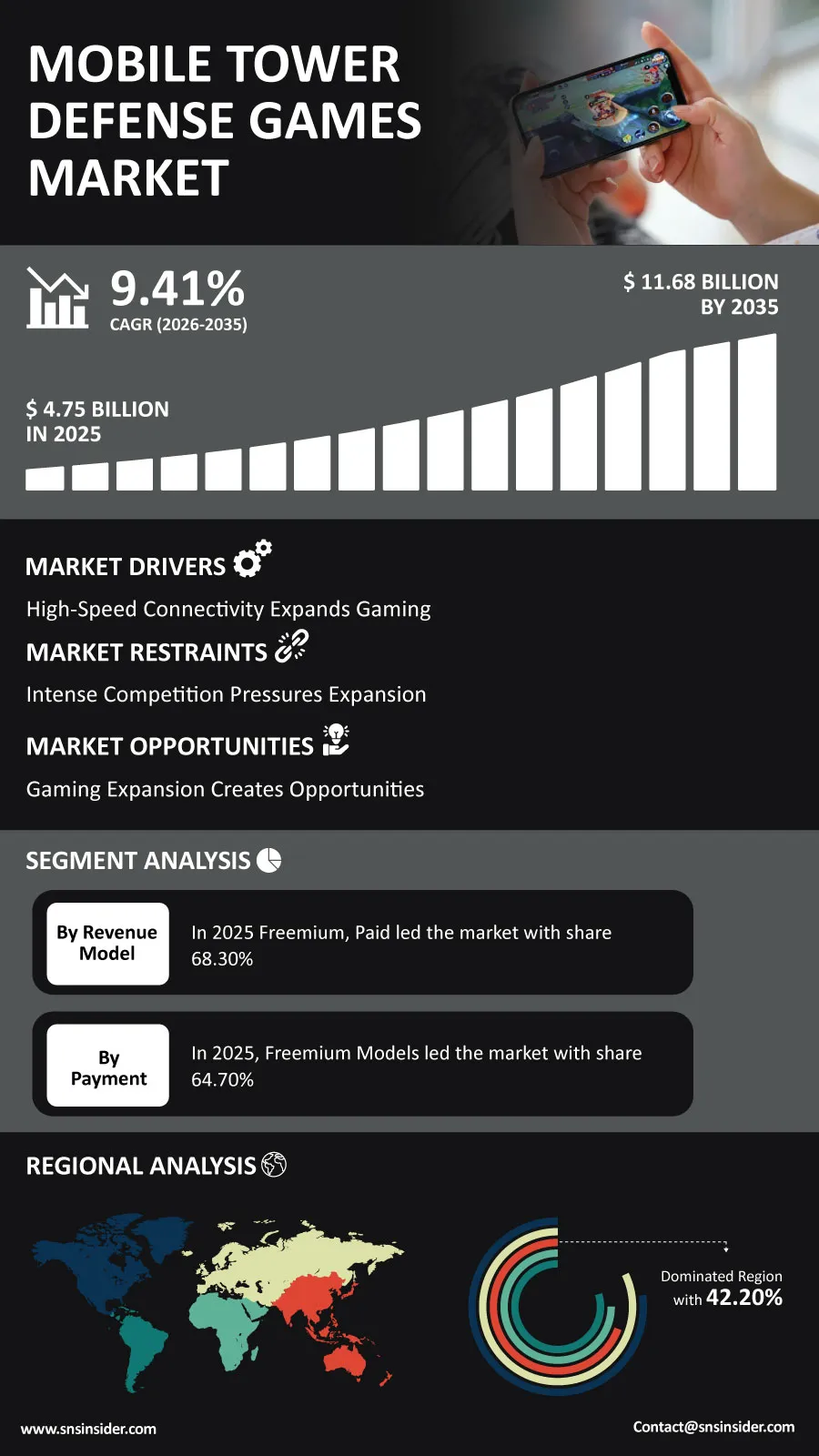
The global Mobile Tower Defense Games Market is poised for strong expansion as mobile gaming continues to attract a broader audience through strategic gameplay, social interaction, and continuous content innovation. “According to a recent study by SNS Insider, the Mobile Tower Defense Games Market size valued at USD 4.75 billion in 2025, is anticipated to grow to USD 11.68 billion by 2035, registering a CAGR of 9.41% over the 2026–2035 forecast period.”
Cost-effective smartphones and fast internet connection have transformed the worldwide gaming industry. Gamers are more interested in strategy games that provide depth and an innovative player experience, pushing the game developers to create more immersive games with advanced gameplay features and live service offerings.
Additionally, the industry benefits from improvements in mobile CPUs, cloud sync, online gaming experiences, and the latest releases in mobile technology. Game developers continue to improve their ability to engage players through seasonal events, leaderboards, customized rewards, and social features that add new dimensions to traditional gaming experience.
To Get Detailed Insights on the Mobile Tower Defense Games Market – Request a Sample Report
Expanding Digital Gaming Ecosystems Create New Growth Opportunities
The swift digital transformation happening in upcoming markets is creating conditions favorable for publishers of mobile games. The growing number of smartphones in use, developing ability to carry out online payments, and improved access to the internet open up opportunities for developers to reach their audiences, thus driving higher monetization results.
Cross-platform compatibility is one of the top competitive advantages in today’s gaming industry, as players demand a seamless experience across various mobile devices including smartphones and tablets. In line with it, advancements in cloud gaming, augmented reality experiences, and localized content are bringing about new monetization opportunities and keeping the interest of gamers high.
Key Market Insights Highlight Evolving Consumer Preferences
Based on game type, Single Player games accounted for 58.60% of global revenue in 2025 owing to their strong appeal among users seeking story-driven strategic gameplay. The Multiplayer segment is anticipated to record the fastest expansion through 2035 as cooperative missions, competitive gameplay, and online communities continue attracting larger audiences.
By platform, Android represented 62.40% of market revenue in 2025 due to its extensive global smartphone installed base. Meanwhile, iOS is expected to witness the fastest growth during the forecast period, supported by premium device adoption and stronger consumer spending on digital gaming content.
In terms of revenue model, Freemium/Paid games captured 68.30% of market revenue in 2025 because of their ability to attract large player communities while generating recurring income through premium features. In-App Purchases are projected to deliver the fastest growth as players increasingly invest in cosmetic upgrades, virtual currencies, and gameplay enhancements.
Live-Service Innovation and Advanced Technologies Transform Mobile Gaming
The competition in the industry is changing since more game creators shift to the live-service mode focusing on regular game updates, temporary events, new characters, and seasonal material. This method allows attracting players’ attention and improving monetization in the long run.
Novel technologies such as artificial intelligence are used when improving game balance systems, matchmaking, and individual recommendations for users. In addition, modern technologies used for graphics engines, cloud systems, and real-time multiplayer systems help improve the quality of mobile games.
Asia Pacific Held 42.20% of the Mobile Tower Defense Games Market Share in 2025; North America Projected to Register the Fastest CAGR Through 2035
Asia Pacific comprises 42.20% of global revenue in this sector by 2025 with its large gaming population, increasing penetration of smartphones, availability of internet, and dominant mobile-first entertainment culture, especially in countries such as China, India, Japan, and other Southeast Asian countries that drive user acquisition with rapid adoption of new digital technologies and rising consumption of mobile entertainment products.
North America is set to emerge as a region with the most rapid growth rates until 2035 along with premium ownership of mobile phones, improved mobile networks, and growing levels of participation in multiplayer games as the basis for market expansion. Increasing investments in digital gaming ecosystems and growing spending on in-game items strengthen growth in North America.
Europe keeps progressing steadily as a region with sustained demand for strategic games, while Latin America and Middle Asia emerge as an appealing region due to the increasing number of gaming facilitation technologies.
Industry Participants Focus on Player Engagement and Content Innovation
Leading companies are investing heavily in game development, multiplayer ecosystems, artificial intelligence, cloud technologies, and player engagement strategies to strengthen market competitiveness. Regular content updates, localization initiatives, strategic partnerships, and advanced monetization models remain central to long-term growth strategies across the industry.
Key companies operating in the global Mobile Tower Defense Games Market include Ironhide Game Studio, Ninja Kiwi, Supercell, Tencent, Gameloft, Hypergryph, Yostar, Butterscotch Shenanigans, TaleWorlds Entertainment, Ludosity, Refinery Productions, Nival Interactive, Com2uS, PopCap Games (EA), King, Netmarble, Electronic Arts (EA), Rovio Entertainment, Storm8, and Ubisoft.
An SNS Insider analyst Sakshi Kale commented, "The future of the Mobile Tower Defense Games Market will be shaped by continuous innovation in multiplayer experiences, live-service content, and advanced mobile technologies. Developers that successfully combine engaging gameplay with personalized player experiences and scalable monetization strategies will be well positioned to capture long-term growth opportunities across global gaming markets."
About the Author

Get in touch




