
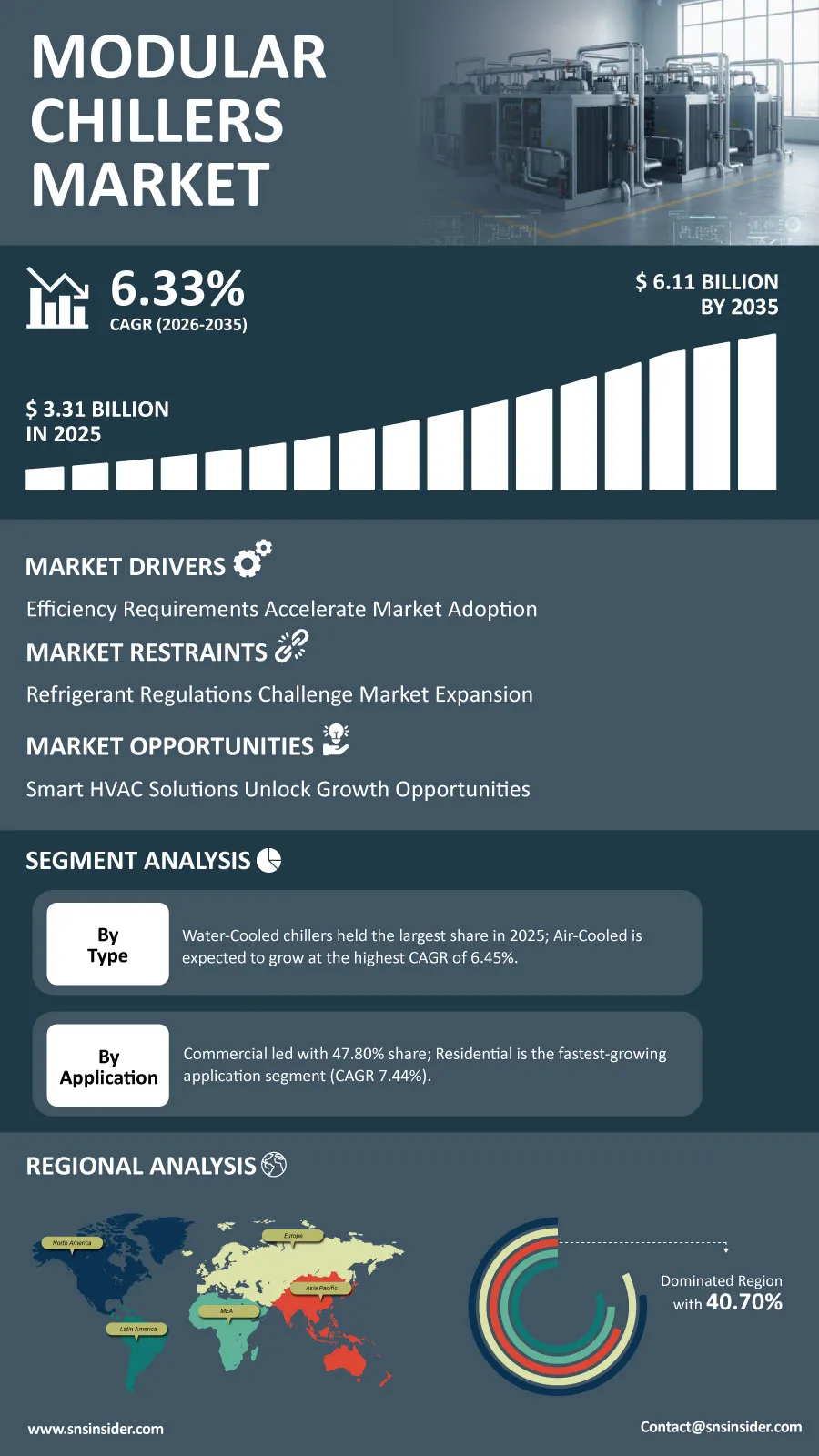
The Modular Chillers Market across the world is moving at a consistent pace owing to an increased interest among commercial infrastructure developers, industries, and data center service providers for energy-efficient cooling systems. “According to a recent study by SNS Insider, the global Modular Chillers Market size valued at USD 3.31 billion in 2025, is anticipated to grow to USD 6.11 billion by 2035, registering a CAGR of 6.33% over the 2026–2035 forecast period.”
Increasing demand for smart climate control systems is driving companies to opt for modular systems which have higher flexibility, easier maintenance, and better energy efficiency. With advancements in digital infrastructure and tightening of environmental standards, advanced cooling systems have been identified as an investment strategy in various sectors like healthcare, commercial real estate, manufacturing, and mission critical applications.
Increasing investments in hyperscale data centers, modernizing hospitals, and increasing use of green buildings are some factors which will keep the demand robust in future. Some of the manufacturers have also been developing cooling systems which are digitally connected and help in enhancing efficiency through predictive monitoring and optimization of systems.
To Get Detailed Insights on the Modular Chillers Market – Request a Sample Report
Smart Infrastructure and Energy Efficiency Create Long-Term Growth Opportunities
High-performance buildings, which are designed to be energy-efficient but maintain consistent interior climate control, are becoming more favored by governments and private organizations worldwide. The modular chiller system is one of the technologies that are commonly chosen by companies that need a scalable cooling system without having to interrupt their ongoing business.
The quick establishment of the artificial intelligence framework is creating more needs for redundancy cooling technologies that will help to run servers constantly. At the same time, hospitals, schools, hotels, and other facilities are modernizing, giving rise to more needs for modular HVAC systems.
The shift of HVAC technology towards eco-friendly refrigerants and integrated building automation platforms allows producers to design more effective and sustainable systems.
Key Market Insights Highlight Changing Cooling Requirements
As per the market share by product type, Water-Cooled Modular Chillers have dominated the market in 2025 due to their higher efficiency in commercial and industrial applications. Air-Cooled Modular Chillers have been estimated to grow at the fastest pace through 2035 due to their simple installation process and easy deployability.
On the basis of end-use, Commercial accounted for a share of 47.80% of total revenue generated in the global market in 2025 owing to growing requirement from office building, healthcare, hospitality, and data center industry. The Residential segment is anticipated to grow at the fastest CAGR owing to rising use of centralized cooling systems at residential sites with the help of advanced smart home solutions.
In the case of compressors used in modular chillers, Scroll Compressor was dominant due to its small size and quiet operation, but Screw Compressor is estimated to be the fastest growing due to higher cooling capacity in industrial applications.
As per the capacity, Systems with capacity of 200–500 kW accounted for the largest share of market during 2025, whereas, Above 500 kW systems are estimated to grow at the fastest pace during forecast period.
Digital HVAC Innovation Accelerates Industry Transformation
The evolution of modular chillers still hinges around innovation in technology. Manufacturers will deploy, IoT-enabled diagnostics and cloud-based monitoring platforms and intelligent control systems that help them in real-time optimization of equipment operations while lowering maintenance costs.
Technology improvements including variable-speed compressors, inverter technologies, and new refrigerant designs further enhance seasonal energy efficiency and reduce environmental footprint. These advancements aid the move to meet stricter building efficiency regulations as well as assist property owners in lowering operational costs in the longer term.
As commercial buildings continue to become more connected, operators must have a new level of integrated energy management ecosystems that blend together automation and predictive analytics with sustainable cooling technologies where modular chillers are expected play an integral role.
Asia Pacific Accounted for 40.70% Market Share in 2025; Residential Applications Forecast to Expand at a 7.44% CAGR by 2035
By 2025, Asia Pacific registered for more than 40.70% of global market revenue owing to rapid urbanization, commercial construction and industrial expansion along with substantial investments in modern HVAC infrastructure across China, India, Japan and Southeast Asia. Ongoing development of office complexes, healthcare facilities, hospitality and digital infrastructure is consolidating regional market leadership.
On the other hand, &North America is still a major growth market due to AI-driven data center construction growing demand for ultra-reliable cooling systems. There many investments include healthcare modernization, renovations in commercial facilities and energy-efficient government buildings these expands market size.
Europe has a solid demand are extremely strict building efficiency standards and sustainability practices push greenest cooling acicular technologies. In contrast, the commercial construction and smart city projects, along with a higher investment in climate-resilient infrastructure continue to dovetail in augmenting market opportunities across Middle East & Africa and Latin America.
Industry Participants Expand Innovation Through Intelligent Cooling Technologies
Competition within the modular chillers industry is becoming fiercer with investment in digitalization, environmental refrigerants, and highly efficient compressor systems by manufacturers. Innovation of products and development of partnerships are key strategies for firms that aim to meet the changing needs of their customers as well as contribute to worldwide decarbonization efforts.
Key companies operating in the global Modular Chillers Market include Carrier Global Corporation, Trane Technologies plc, Johnson Controls International plc, Daikin Industries Ltd., Mitsubishi Electric Corporation, LG Electronics Inc., Midea Group, Gree Electric Appliances Inc., Haier Group Corporation, Multistack LLC, Frigel Firenze S.p.A., Aermec S.p.A., Smardt Chiller Group Inc., Dunham-Bush Group, Climaveneta S.p.A., McQuay Air-Conditioning Ltd., Blue Star Limited, Thermax Limited, Schneider Electric SE, and Nanjing TICA Climate Solutions Co., Ltd.
An SNS Insider analyst Santosh Bhul commented, "Growing investment in digital infrastructure, sustainable buildings, and intelligent HVAC technologies is creating sustained demand for modular cooling solutions. Manufacturers that prioritize energy efficiency, smart connectivity, and environmentally responsible product innovation will be well positioned to capitalize on long-term opportunities across commercial, industrial, and residential markets."
About the Author

Get in touch




