
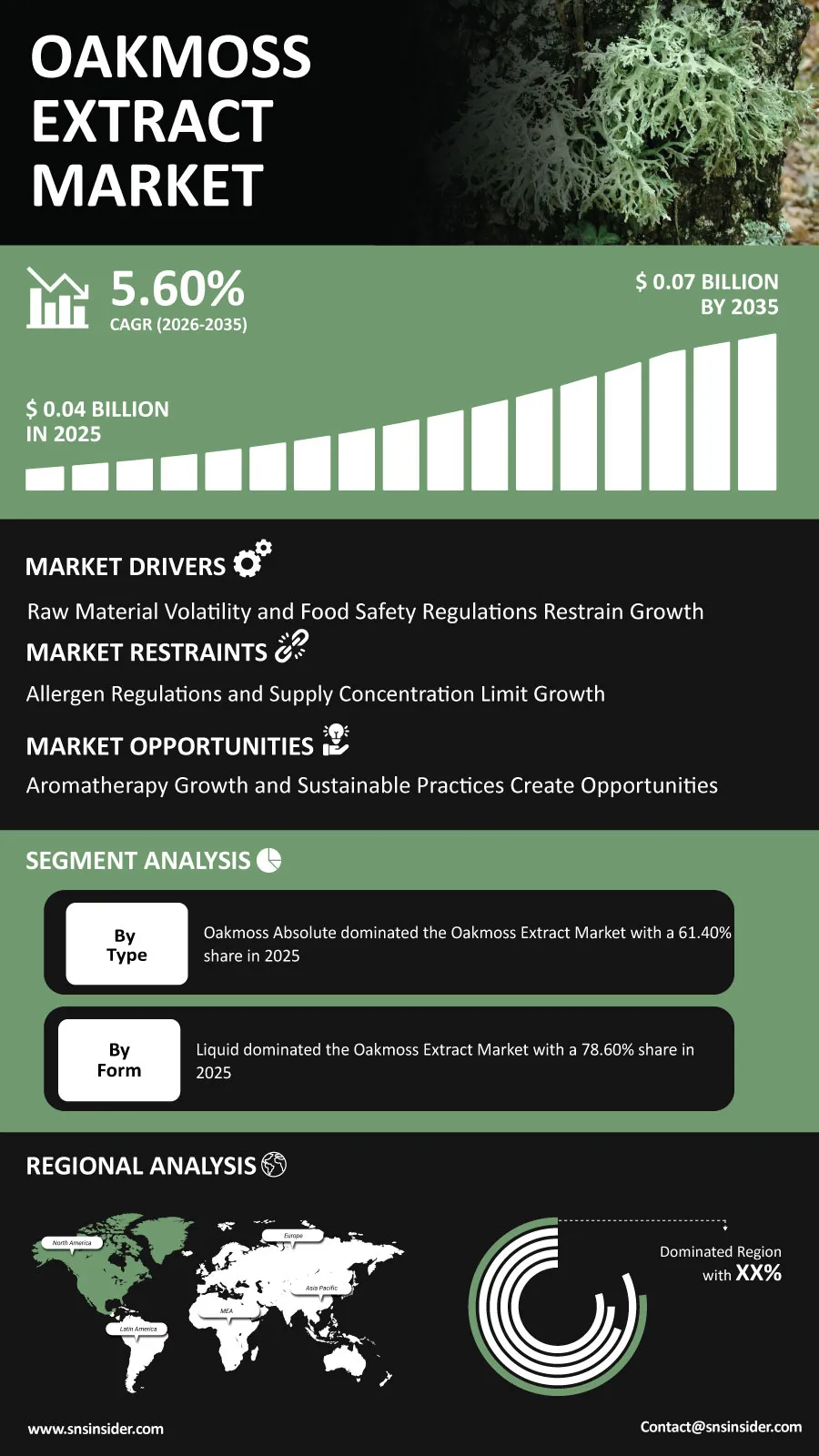
The global Oakmoss Extract Market is set for steady expansion as natural fragrance demand and aromatherapy trends continue to reshape perfumery and cosmetics ingredient sourcing worldwide. “According to a recent study by SNS Insider, the global Oakmoss Extract Market size valued at USD 0.0423 billion in 2025, is anticipated to grow to USD 0.0729 billion by 2035, registering a CAGR of 5.60% over the 2026–2035 forecast period.”
There have been notable changes within natural fragrance ingredient sourcing over time, due to which many fragrance houses who aim at improving the sustainability and regulatory compliance of their products can take advantage of this trend. This includes the need for more traceable, allergen-compliant oakmoss extract formulations that will provide perfumers with the ability to deliver distinctive natural fragrances while meeting evolving cosmetics regulations. This applies in situations where oakmoss extract is used across perfumery, cosmetics and personal care, and aromatherapy applications. Fragrance houses are constantly working hard to ensure that their natural ingredient sourcing performs better than before in order to meet various regulatory and consumer expectations.
To Get Detailed Insights on the Oakmoss Extract Market – Request a Sample Report
Natural Fragrance Sourcing Creates New Demand
The oakmoss extract market has evolved from a traditional perfumery fixative to an increasingly valued natural ingredient across cosmetics and wellness applications. The growing investment in sustainable harvesting, allergen-compliant purification, and traceable sourcing across fragrance houses of all sizes has required the development of more responsibly produced oakmoss extract products.
New sourcing and processing techniques can increase extract purity, improve regulatory compliance, and allow for expansion into increasingly diverse aromatherapy and wellness applications. This gives perfumers and formulators the possibility to deliver distinctive, nature-derived fragrance experiences while meeting evolving sustainability and safety expectations.
Fragrance houses, natural ingredient suppliers, and sustainable sourcing cooperatives are increasingly cooperating thanks to the growing interest in developing future solutions for traceable, responsibly harvested natural fragrance ingredients.
Key Market Findings Highlight High-Growth Segments
Oakmoss absolute accounted for all categories in the oakmoss extract market share, where its revenue share was estimated to be 61.40% in 2025 because of its intense fragrance and fixative use in perfumery. The most rapidly growing category in the market is oakmoss essential oil, which is anticipated to record a CAGR of 6.90% during 2026–2035 due to the increasing popularity of aromatherapy and wellness applications.
By type, liquid oakmoss extract accounted for the largest share in terms of market revenue share of 78.60% in 2025 because of the wide application of the product in perfume, cosmetic, and aromatherapy applications. The most rapidly growing type will be powder form extract that will register a CAGR of 7.40%.
Based on nature, organic oakmoss extract generated a share of 56.80% of market revenue in 2025 thanks to strong consumer demand for natural and eco-friendly ingredients. On the other hand, conventional oakmoss extract will be the segment recording the fastest revenue growth at a CAGR of 6.20%, supported by broader mainstream market adoption.
Distributive application trends are changing as well. Cosmetics and personal care accounted for a 52.60% revenue share in 2025 owing to oakmoss extract's rising use as a fixing base in perfumery. But aromatherapy will turn out to be the fastest-growing application through 2035, on the back of growing recognition of stress-relief and relaxation benefits.
Sustainability, Regulatory Compliance, and Traceability Gain Importance
In this regard, fragrance houses have been looking at oakmoss extract sourcing that would deliver more consistent quality while requiring greater regulatory compliance and sustainability assurance.
Innovation in purification technology, sustainable harvesting practices, and allergen concentration reduction has been making it possible for companies to come up with products that meet increasingly stringent cosmetics regulations. In addition to that, increasing emphasis on ethical sourcing and supply chain traceability is also making it possible for suppliers to find solutions that meet evolving regulatory and consumer expectations. Such trends are likely to become even more prominent in the future.
North America Emerges as the Largest Market with 83.60% Regional Revenue Share Amid Rising Natural Ingredient Demand
The North America region represented the largest share of regional market revenue in 2025, owing to strong domestic perfumery and cosmetics manufacturing infrastructure, growing consumer interest in natural and nature-derived personal care products, and expanding aromatherapy and wellness product consumption. On the other hand, Asia Pacific is expected to be the fastest-growing market during the forecast period through 2035, propelled by rising disposable incomes and growing consumer awareness of natural and sustainable personal care ingredients.
Leading Companies Drive Innovation and Competition
The environment continues to stay very dynamic since players continue innovating on sustainable sourcing and regulatory compliance as well as forming partnerships in order to enhance their position in the industry. Some of the major companies that operate in the global oakmoss extract market are dsm-firmenich, Givaudan, International Flavors & Fragrances, Symrise, Robertet Group, Berjé, Eden Botanicals, Bristol Botanicals, Scent Fill, and BMV Fragrances.
An SNS Insider analyst Parry Kardani commented, "The growing consumer preference for natural, sustainably sourced fragrance ingredients is creating sustained demand for traceable, regulatory-compliant oakmoss extract. Suppliers that successfully combine sustainable harvesting, allergen compliance, and formulation expertise will be best positioned to capitalize on emerging opportunities across perfumery, cosmetics, and aromatherapy applications.
About the Author

Get in touch




