
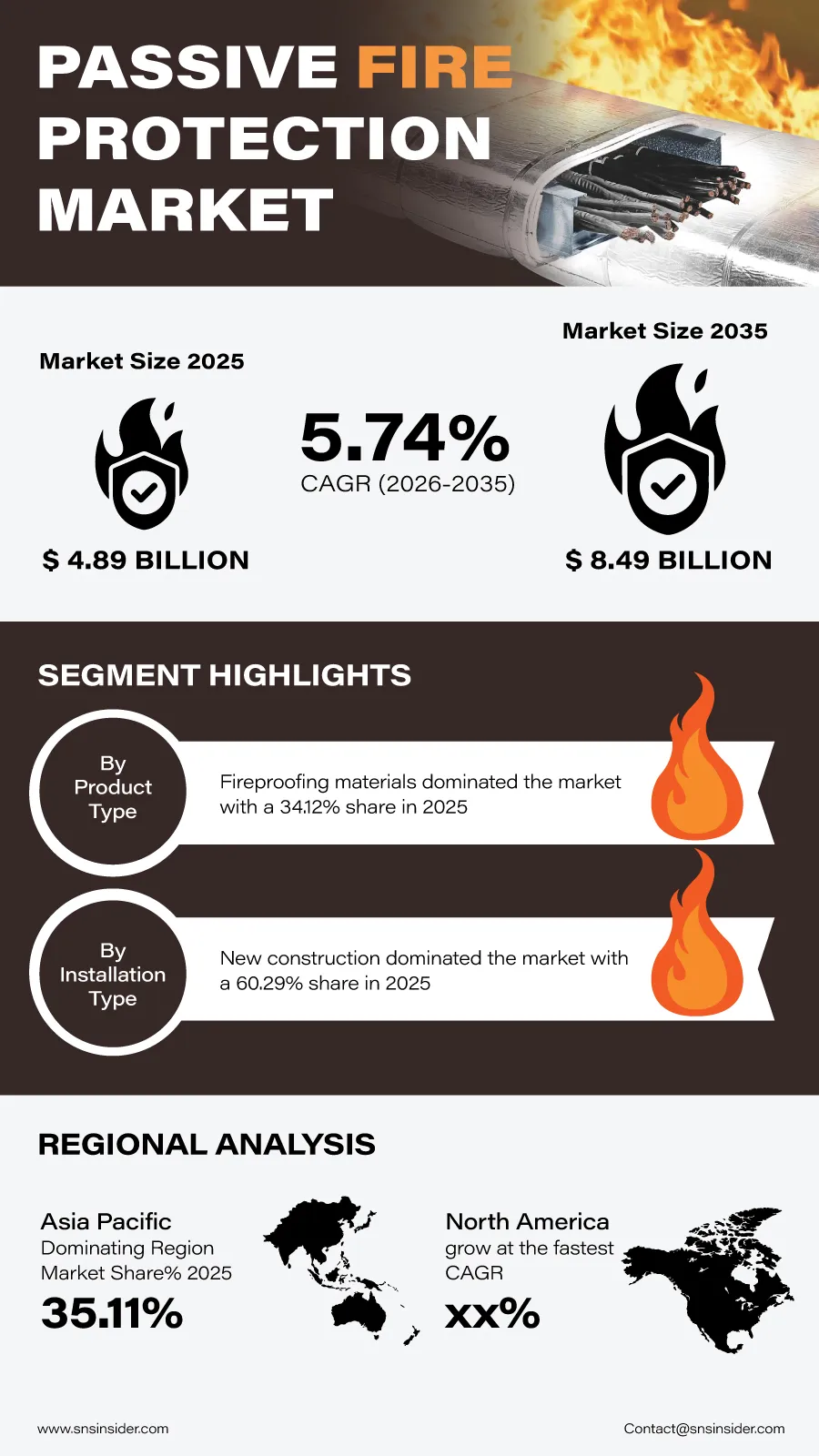
The global Passive Fire Protection Market is projected to witness significant growth as governments, developers, and industrial operators continue prioritizing resilient building design and enhanced fire safety standards. “According to a recent study by SNS Insider, the global Passive Fire Protection Market size valued at USD 4.89 billion in 2025, is anticipated to grow to USD 8.49 billion by 2035, registering a CAGR of 5.74% over the 2026–2035 forecast period.”
Investment in commercial, industrial, transport, and urban infrastructures has made the need for passive fire protection more and more important throughout the world. With increasing complexity of modern buildings, architects and engineers have increasingly adopted fire resistant building materials.
To Get Detailed Insights on the Passive Fire Protection Market – Request a Free Sample Report
Developers are taking increased interest in reducing risks not only in developed but developing countries also. Fireproof construction materials are now an integral component of the construction industry, whether in terms of development of structures or renovation of buildings.
Infrastructure Expansion Supports Long-Term Market Growth
Massive infrastructural projects continue to cause change in the demand for construction products. Huge investments are being made in the construction of hospitals, airports, transportation networks, manufacturing facilities, and smart cities, and all of these require comprehensive fire protection plans during the design phase.
On another front, refurbishment of aged commercial buildings is taking place so that they can satisfy the new fire code standards, and this trend is encouraging the increased use of passive fire protection systems for structural safety without employing any active protection system.
Further, the manufacturers are developing new materials that will help in meeting the increased durability, aesthetic appeal, and ease of installation needs of the contractors.
An Infographic Representation of the Global Passive Fire Protection Market
Key Market Insights Highlight Evolving Industry Demand
When it comes to product categories, fire protection materials are the biggest revenue generator for 2025 with 34.12% share due to the wide use of such materials in industrial sites, commercial buildings and infrastructural applications.
Simultaneously, the fastest growing product category is going to be the fire-resistant glass, with a CAGR of 7.38% owing to the increasing use of the fire-resistant glass in modern architecture where there is a need for clarity as well as fire resistance.
The new constructions were generating 60.29% of overall revenue in 2025 owing to the continuous constructions in the residential, commercial and industrial sectors around the world. Meanwhile, retrofitting and renovations will grow significantly faster, with the CAGR of 6.14%.
Commercial buildings have remained the biggest application area, with 30.11% of overall revenue in 2025. The transportation sector is expected to become the fastest growing application sector, with a CAGR of 6.76% owing to construction projects in airports, metro, railroads and marine transportation.
Construction and infrastructure are the leading end-use industry, providing 34.24% of overall revenue in 2025. However, the fastest growing end-use industry is going to be transportation and logistics due to increasing warehousing capabilities around the world.
Safety Compliance and Modern Construction Practices Drive Innovation
Fire protection system has become the element of strategy within the sustainable building design, not just a requirement. Clients of these buildings need protection systems that will help them preserve structural strength along with architectural flexibility and functionality.
Technology applied in digital design, such as BIM, also has influence on the selection of the products as it is possible to include the fire protection system to the project at an early stage with the help of this technology. Therefore, it is possible to create personalized protection systems, thus simplifying the installation process.
On the other hand, increasing investment in high-cost buildings such as data centers, hospitals, semiconductor production facilities, and logistics centers has created an additional demand for highly performative passive fire protection systems.
Asia Pacific Leads Global Market Expansion
Asia Pacific is expected to remain both the largest and fastest-growing regional market, accounting for 35.11% of global revenue in 2025 while advancing at a 6.20% CAGR through 2035. Rapid urbanization in China, India, Southeast Asia, Japan, and South Korea is creating high demands for the fire resistant construction material. The strong government initiatives for infrastructural development, increasing commercial construction activities, and strict safety regulation laws contribute significantly to the growth of the regional market.
The North American region continues to play a key role in the fire resistant construction material market due to effective building regulations, regular investments in commercial construction, and modernization of industrial infrastructure. Similarly, in the European region, there is a sustained demand due to renovations and changing fire safety legislations.
Meanwhile, the Middle East, Africa, and Latin America continue presenting attractive long-term opportunities as governments increase investments in transportation networks, industrial facilities, urban development, and public infrastructure.
Manufacturers Intensify Product Development Strategies
Competitiveness in the passive fire protection industry still lies in innovation in technology, certification of the products and expansion of geographical presence. Leading vendors continue developing high-end paints, glass systems, minerals-based insulation materials, and advanced fire stopping solutions to meet changing demands of the customers.
New product introductions, increase in production capabilities, and acquisition of new businesses are evidence of the willingness of the industry to support complicated construction environments and increasing customer compliance.
Key companies operating in the global Passive Fire Protection Market include 3M Company, Hilti Group, Sika AG, Etex Group, Rockwool International A/S, Morgan Advanced Materials plc, Hempel A/S, Jotun A/S, Akzo Nobel N.V., PPG Industries Inc., Sherwin-Williams Company, BASF SE, Saint-Gobain S.A., Knauf Insulation, and Promat International.
An SNS Insider analyst Himanshu Sharma commented, "As global construction standards continue evolving, passive fire protection is becoming a core component of resilient infrastructure development. Companies investing in certified, high-performance materials and innovative building solutions are well positioned to benefit from sustained demand generated by urban expansion, infrastructure modernization, and increasingly rigorous fire safety regulations."
About the Author

Get in touch




