
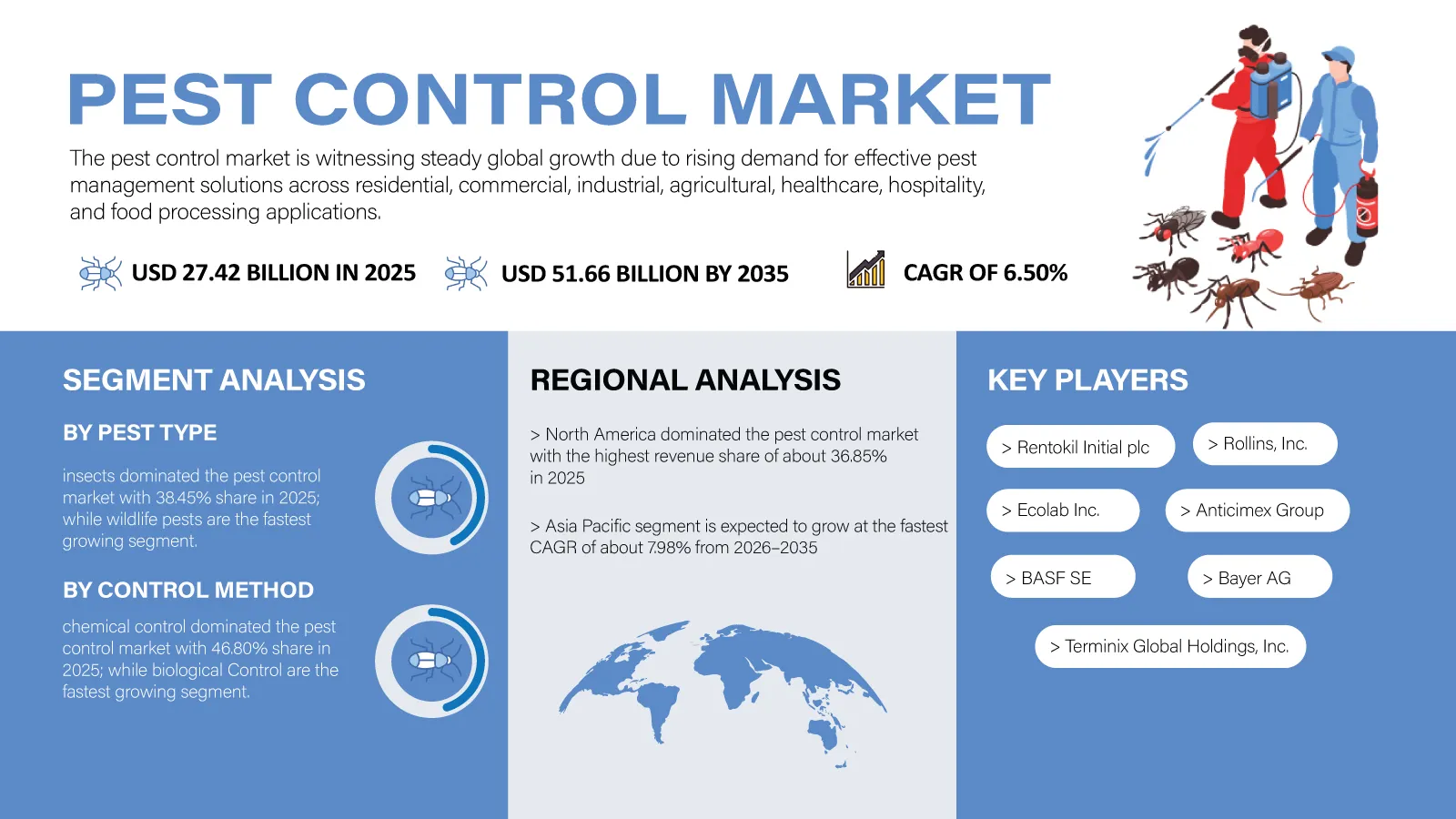
The global market for pest management is expected to grow consistently as there will be more effort put into protecting people’s health, ensuring protection of infrastructures and improving food safety standards by governments, organizations and individuals. Increased urbanization, changes in pest habits due to climate change and increased spending on hygiene prevention will affect the future market demands. “According to a recent study by SNS Insider, the global Pest Control Market size valued at USD 27.42 billion in 2025, is anticipated to grow to USD 51.66 billion by 2035, registering a CAGR of 6.50% over the 2026–2035 forecast period.”
Increased knowledge of the importance of sanitation and prevention of diseases is making many organizations, belonging to various sectors, implement strategies for long-term pest management instead of only depending on treatments as a reaction to a problem. This is because residential areas, hospitals, hotels, food manufacturing units, and farms seek solutions without causing any disruption.
To Get Detailed Insights on the Pest Control Market – Request a Free Sample Report
Digital technology is being invested in by industry participants to enhance service efficiency. Technology for connected monitoring, smart traps, predictions, and environmental treatment practices is contributing towards the delivery of early detection and effective interventions to ensure that the customer receives good results without unnecessary use of chemicals.
Smart Pest Management Technologies Drive Market Evolution
Pest management is moving towards a direction where there is more emphasis on integrated and technological-based methods that incorporate both prevention and treatment. Companies are embracing monitoring systems that are able to detect potential infestation threats in advance, thus ensuring that facility managers limit damages and ensure efficiency in maintenance and compliance.
Sustainability has also been driving changes in product innovations. Biologically-based controls, botanicals, and integrated pest management systems are becoming more popular due to growing concern about environmental sustainability among regulators and consumers. Manufacturers are still putting more efforts into their research to enhance efficacy and accuracy in treatment.
Key Market Insights Highlight Changing Industry Priorities
Across all types of pests, insects remained the biggest contributors to the revenue in 2025, holding 38.45% of the global market share owing to their demand for mosquito, termite, ant, and cockroach control. On the other hand, wildlife pest management is predicted to be the fastest growing one over the course of the next ten years owing to urban sprawl, which leads to increased interactions between humans and wildlife.
In terms of treatment techniques, chemical control remained dominant in the global market, holding a 46.80% revenue share in 2025 because of extensive use in large-scale pest control operations needing urgent actions. Biological control, on the other hand, is estimated to show the strongest growth during the upcoming ten years due to the growing need for environmentally friendly pest management solutions.
In terms of applications, the residential pest management segment generated 34.60% of the total revenue of the market in 2025 owing to increased consumer expenditure on preventive protection services. On the contrary, the agricultural segment is expected to show the highest rate of growth since growers implement sustainable pest management options in order to boost their crop production and reduce the usage of traditional pesticides.
Extermination services continued to occupy the dominant position among all offered services, having a 36.75% market share. Rodent control services, however, are estimated to grow the fastest because of growing concerns about contamination, diseases, and safety of food products storage.
Households were the dominant end user segment, generating 38.25% of the revenue of the market in 2025. Healthcare facilities are, however, expected to show the most dynamic growth among all others as hospitals and medical centers strengthen infection prevention measures and regulatory compliance initiatives.
Public Health and Food Safety Continue to Support Long-Term Demand
The rising threat of vector-borne diseases coupled with stringent sanitation requirements has made pest management a necessity for businesses in both developed and developing countries. Companies that have operations in the healthcare industry, food production industries, hospitality sectors, educational institutions, and logistics are realizing the need to take preventative measures.
In addition, the digitization of business processes has brought about changes in the way that pest control is provided. Through mobile apps, subscription services, remote monitoring systems, and predictive maintenance systems, service providers have been able to offer their clients better visibility of their services.
Regional Markets Present Diverse Growth Opportunities
North America will still be the largest regional market by generating 36.85% of the global revenue in 2025. The region’s growth is driven by strong regulatory control, high levels of service infrastructure, and the usage of professional pest management.
Asia Pacific region is estimated to exhibit the highest CAGR of about 7.98% during the forecast period ending 2035. The region will see rapid growth owing to increasing urbanization, rising middle classes, new construction activities, and government policies focusing on improved sanitation and public health.
Europe will continue to gain from the presence of stringent environmental regulations that promote sustainable pest management solutions. Latin America and Middle East & Africa are experiencing high demands due to commercial and tourism developments.
Industry Leaders Accelerate Innovation and Digital Service Expansion
Competition within the global pest control market remains active as companies strengthen digital capabilities, expand geographic reach, and invest in environmentally responsible treatment technologies. Recent developments include AI-powered monitoring systems, connected pest detection platforms, data-driven inspection tools, and integrated hygiene management solutions designed to improve efficiency and customer satisfaction.
Leading companies operating in the global Pest Control Market include Rentokil Initial plc, Rollins, Inc., Ecolab Inc., Anticimex Group, Terminix Global Holdings, Inc., Bayer AG, BASF SE, Syngenta AG, FMC Corporation, Bell Laboratories, Inc., Arrow Exterminators, Massey Services, Inc., Dodson Pest Control, Pelsis Group Ltd, ORKIN LLC, Truly Nolen of America, Inc., Hawx Pest Control, Cook's Pest Control, Abell Pest Control, and Aptive Environmental.
An SNS Insider analyst Himanshu Sharma commented, "As urban expansion, public health priorities, and sustainability initiatives continue shaping pest management strategies, demand for intelligent, environmentally responsible solutions is expected to remain strong. Companies combining digital monitoring technologies with preventive service models and eco-conscious treatment approaches are well positioned to capitalize on the market's long-term growth trajectory."
About the Author

Get in touch




