
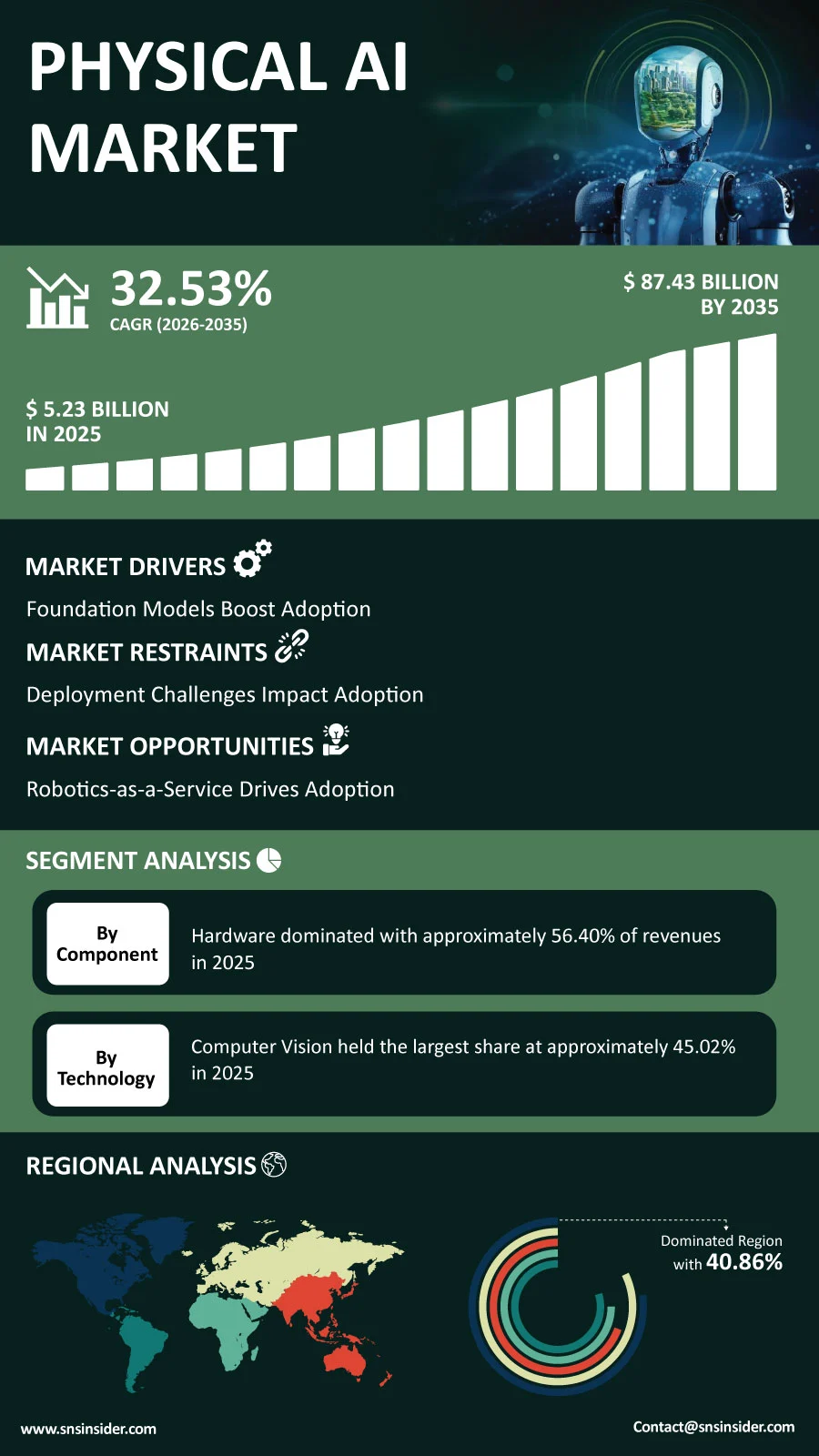
The global Physical AI Market is entering a period of rapid expansion as artificial intelligence increasingly moves beyond software applications into intelligent machines capable of interacting with the physical world. “According to a recent study by SNS Insider, the global Physical AI Market size valued at USD 5.23 billion in 2025, is anticipated to grow to USD 87.43 billion by 2035, registering a CAGR of 32.53% over the 2026–2035 forecast period.”
With the increasing need for autonomous robotics in industries, such as manufacturing, logistics, health care, military applications, and commercial sectors, Physical AI technologies are experiencing huge investments in recent years. Intelligent robots that have abilities to perceive, make decisions, and execute tasks on their own are being used by businesses for increasing efficiency and dealing with manpower issues.
With the integration of basic AI models, computer vision, reinforcement learning, and powerful edge computing devices, robots' abilities are rapidly changing. Current physical AI systems are now capable of comprehending natural language, interacting safely with people, and learning constantly from their surroundings.
To Get Detailed Insights on the Physical AI Market – Request a Sample Report
Intelligent Robotics and AI Automation Create Long-Term Growth Opportunities
There is a substantial investment in the advancement of future robotics, as automation becomes a key component for competitiveness in the economy. With an increase in the deployment of collaborative robots, autonomous mobile robots, and inspection robots, there is great potential for the Physical AI solutions in global industries.
Automation by using the humanoid robots has opened up a whole new market for automation. Businesses are looking at the use of human-like robot systems which will be able to function in their current work environment without the need for any change in infrastructure. This is likely to result in a broadening of the scope of Physical AI beyond manufacturing industries.
Digital twin simulation platform, AI-based robotic training simulators, and edge AI computing are making deployments easier and quicken the process. Improvements in the areas of robot perception, manipulation, and autonomy are making it possible to achieve greater commercial success in more complicated environments.
Key Market Insights Highlight Shifting Demand Patterns
Based on component, hardware is estimated to account for 56.40% of global market revenue in 2025 owing to the extensive deployment of sensors, actuators, AI processors, mobility systems, and integrated robotic platforms that form the foundation of Physical AI solutions. The software segment is expected to witness the fastest growth through 2035 as demand rises for robotic operating systems, digital twin platforms, AI perception software, and intelligent control applications.
By technology, computer vision held approximately 45.02% market share in 2025 because visual perception remains essential for navigation, object recognition, quality inspection, and autonomous decision-making across nearly every robotic application. Reinforcement learning and control systems are projected to record the highest growth during the forecast period as simulation-based robotic training and adaptive learning become increasingly commercialized.
In terms of form factor, industrial robots represented around 36.12% of total market revenue in 2025 due to their widespread deployment across automotive, electronics, heavy engineering, and advanced manufacturing industries. Cobots are anticipated to experience the fastest expansion through 2035 as manufacturers increasingly adopt collaborative robotic systems capable of safely working alongside human employees.
Among applications, manufacturing and automotive generated approximately 45.20% of market revenue in 2025, while healthcare is expected to register the strongest growth as robotic-assisted surgery, rehabilitation systems, and intelligent clinical automation continue gaining industry acceptance.
Advanced AI Technologies Accelerate Industry Transformation
Physical AI is fast transforming the field of automation with continual improvements in foundation models, edge computing, multimodal sensing, and smart robotics. Machines are now able to carry out increasingly sophisticated physical operations while being adaptive to changes in the environment without requiring much human assistance due to artificial intelligence.
Integrating both software and hardware technologies that are able to enable autonomous navigation, prediction-based maintenance, dexterous manipulation, and collaborative work between robots and humans is being achieved by developers. These technologies can help businesses operate more effectively while increasing the applicability of robots in diverse areas.
North America Held Approximately 42% of the Physical AI Market Share in 2025; Asia Pacific Projected to Register the Fastest CAGR Through 2035
The Asia Pacific region is anticipated to develop into the largest as well as fastest-growing regional market up until 2035, backed up by heavy investments made towards industrial automation, robots manufacturing, smart factory development, and intelligent logistics infrastructure. The countries, such as China, Japan, South Korea, and India keep developing their own domestic robotics industry while supporting industrial transformation driven by AI.
The North America region retains the title of the world’s most technologically advanced Physical AI market due to significant investments being made in AI research, defense automation, medical robotics, and intelligent manufacturing solutions. The presence of the major robotics developers and semiconductor manufacturers keeps contributing to innovation and commercial activities in the region.
The Europe region is also witnessing steady growth of the market on the basis of advanced manufacturing projects, industrial digitalization, and use of collaborative robots in the automotive, aerospace, and precision engineering industries. At the same time, the countries in the Middle East, Africa, and Latin America are intensively investing in automation technologies.
Industry Participants Focus on Innovation and Next-Generation Robotic Intelligence
The competitive landscape continues to evolve rapidly as technology companies, robotics manufacturers, semiconductor providers, and AI software developers invest aggressively in autonomous systems, humanoid robotics, intelligent perception technologies, and edge AI platforms. Strategic partnerships, research collaborations, and commercialization initiatives are accelerating innovation while expanding the practical deployment of Physical AI across multiple industries worldwide.
Key companies operating in the global Physical AI Market include SoftBank Robotics Group, ABB, Toyota Motor Corporation, FANUC, KUKA AG, Siemens, Boston Dynamics, Tesla, NVIDIA, Google DeepMind, Agility Robotics, Mech-Mind Robotics, Hanson Robotics, Universal Robots, iRobot, Intuitive Surgical, Doosan Robotics, Covariant, Apptronik, and UBTech.
An SNS Insider analyst Sakshi Kale commented, "Physical AI represents the next major evolution of artificial intelligence by combining advanced machine learning with intelligent robotic systems capable of interacting safely and autonomously within real-world environments. Organizations investing in next-generation robotics, edge AI computing, and adaptive automation technologies will be well positioned to capitalize on one of the fastest-growing technology markets over the coming decade."
About the Author

Get in touch




