
Autonomous Mobile Robots Market Report Scope & Overview:
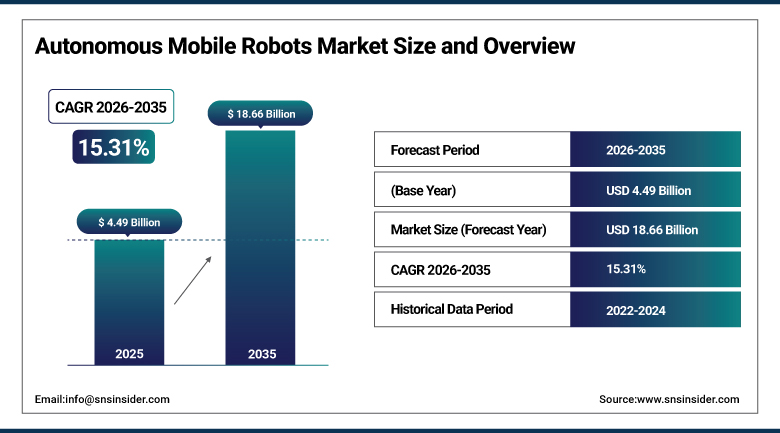
The Autonomous Mobile Robots Market was valued at USD 4.49 Billion in 2025 and is expected to reach USD 18.66 Billion by 2035, growing at a CAGR of 15.31% from 2026 to 2035.
The autonomous mobile robots market is experiencing high growth due to the confluence of requirements and technology readiness, labor shortages, and high labor costs. Autonomous mobile robots refer to self-navigating robots that have the ability to move around without any fixed tracks or guide wires, thanks to the use of sensors, LiDAR, and vision-based technologies to complete tasks of material handling, transportation, and logistics in warehouses, manufacturing plants, and hospitals. In addition, there are several other factors that contribute to the growth of the market, such as the growth of e-commerce and omnichannel retail leading to increased demand for automated warehouses and logistics operations, and growth of AMRs in healthcare and pharmaceuticals, among others.
Rising e-commerce and warehouse automation, expansion of AMRs in healthcare and pharmaceuticals, adoption of AMRs in agriculture and food processing, and enhanced safety and efficiency in industrial and logistics operations continue to fuel the autonomous mobile robots market's broad-based adoption across an increasingly diverse range of industrial and commercial applications worldwide.
To Get more information Autonomous Mobile Robots Market - Request Free Sample Report
Autonomous Mobile Robots Market Trends
- Rising adoption of vision-based navigation systems is eliminating the need for expensive sensors and reflective targets, reducing capital outlay for mid-market operators seeking automation solutions.
- Growing sustained investment in advanced hardware platforms remains a primary growth driver, as AMR adoption scales globally across increasingly diverse industrial and commercial applications.
- Increasing deployment of heavy payload robots exceeding 500 kg capacity is expanding AMR use into industrial-grade material handling requiring powerful electric motors and advanced stability systems.
- Expanding application of AMRs in the hospitality industry is broadening the technology's reach beyond traditional warehouse and manufacturing settings into service-oriented commercial environments.
- Strategic partnerships among robotics manufacturers, software developers, and end-use industry operators are supporting development of increasingly capable, application-specific AMR platforms.
The U.S. Autonomous Mobile Robots Market Outlook
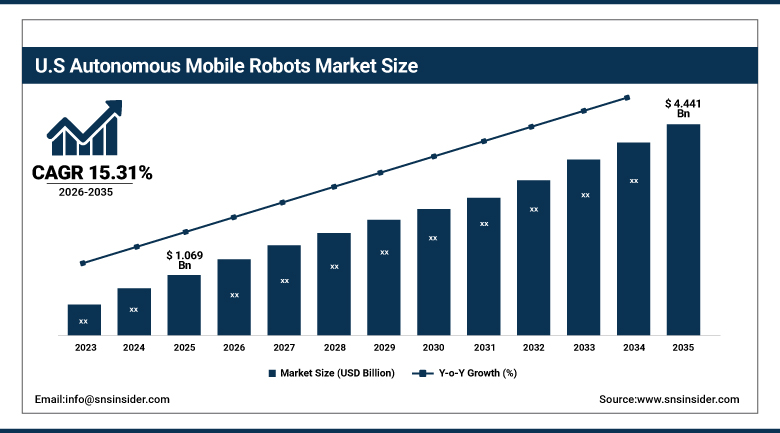
The U.S. autonomous mobile robots market was valued at USD 1.06 Billion in 2025 and is projected to reach USD 4.44 Billion by 2035, growing at a CAGR of 15.31% during 2026–2035.
Top logistics and manufacturing companies within the country are continuing to develop the use of AMR technology, fueled by the growing shortage of workers and the associated cost of such workers within the industrial industry in the country. The rapid growth of e-commerce as well as omnichannel retailing, along with automation in manufacturing, warehousing and healthcare operations, is further bolstering the demand for AMRs in the country.
The autonomous mobile robots market in the United States saw its expansion in 2025 as a result of increased automation in warehouses, e-commerce order fulfillment, and manufacturing upgrades. Rising labor shortages and increasing labor cost have led logistics operators and manufacturing companies to employ autonomous mobile robots for tasks such as material handling, picking, transporting, and moving around inventory. More usage of AMRs in hospitals and distribution centers has expanded the potential addressable market for these machines in the country.
Autonomous Mobile Robots Market Segment Analysis
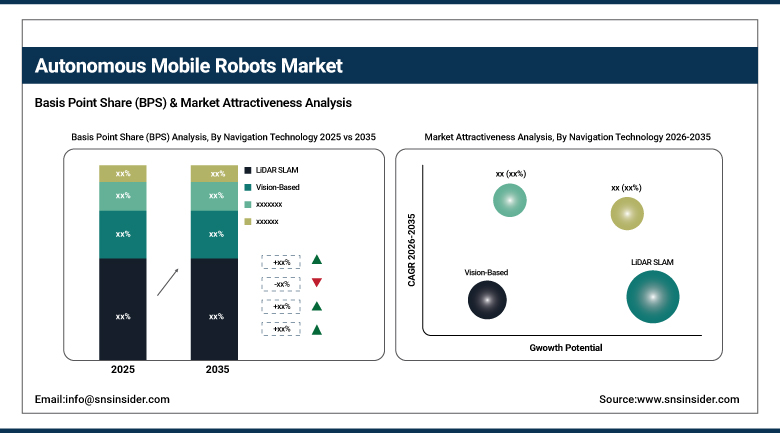
- By Navigation Technology, LiDAR SLAM dominated the autonomous mobile robots market with a 40.88% share in 2025, while vision-based is the fastest-growing navigation technology segment with a CAGR of 20.64% from 2026–2035.
- By Payload Capacity, 100–500 kg dominated the autonomous mobile robots market with a 37.22% share in 2025, while above 1,000 kg is the fastest-growing payload capacity segment with a CAGR of 18.21% from 2026–2035.
- By End-User Industry, warehouse & logistics dominated the autonomous mobile robots market with a 32.94% share in 2025, while healthcare & pharmaceuticals is the fastest-growing end-user industry segment with a CAGR of 22.60% from 2026–2035.
- By Component, hardware dominated the autonomous mobile robots market with a 65.40% share in 2025, while software is the fastest-growing component segment with a CAGR of 19.80% from 2026–2035.
By Navigation Technology, LiDAR SLAM dominated the autonomous mobile robots market, while vision-based is the fastest-growing segment.
The LiDAR SLAM technology had a market share of 40.88% in 2025 due to repeatability at the millimeter level in congested aisles. LiDAR SLAM is the most popular technology type due to its high level of accuracy and reliability even in the complex environment of warehouses and manufacturing facilities, being the preferred option for many autonomous mobile robots market.
Vision-based systems, expanding at 20.64% CAGR, eliminate expensive sensors and reflective targets, which reduces capital outlay for mid-market operators. As edge processors handle real-time image segmentation at lower power budgets, the autonomous mobile robot market size for vision navigation will further increase, driving rapid segment growth across increasingly cost-conscious deployment scenarios.
By Payload Capacity, 100–500 kg dominated the autonomous mobile robots market, while above 1,000 kg is the fastest-growing segment.
By payload capacity, the 100–500 kg class captured 37.22% share of the market size in 2025. This capacity range remains the dominant category owing to its versatility across the majority of warehouse and logistics material handling applications, offering an effective balance between load capacity and maneuverability suited to typical industrial floor operations worldwide.
Robots above 1,000 kg will advance at 18.21% CAGR over the outlook period. Heavy payload robots with a weight carrying capacity greater than 500 kg generally use powerful electric motors for their motion, providing excellent stability, advanced sensors, and industrial grade construction, driving rising demand across increasingly large-scale, high-volume operational environments.
By End-User Industry, warehouse & logistics dominated the autonomous mobile robots market, while healthcare & pharmaceuticals is the fastest-growing segment.
By end-user industry, warehouse and logistics accounted for 32.94% share in 2025. Warehouse and logistics operations remain the dominant end-user category owing to the rapid expansion of e-commerce and omnichannel retail increasing demand for automated warehouse and logistics operations, representing the foundational and most established application driving overall AMR demand worldwide.
The Healthcare & Pharmaceuticals segment is expected to register the fastest CAGR of 22.60% during the forecast period 2026-2035. Expansion of AMRs in healthcare and pharmaceuticals is driving rapid segment growth, as hospitals and pharmaceutical facilities increasingly deploy autonomous robots for medication delivery, supply transport, and other material handling applications requiring consistent, contactless operation.
By Component, hardware dominated the autonomous mobile robots market, while software is the fastest-growing segment.
In the component segment, the hardware sub-segment captures the largest market share, and as AMR adoption scales globally, sustained investment in advanced hardware platforms remains a primary growth driver for the autonomous mobile robots market, representing the foundational cost and value component of the majority of commercial AMR deployments worldwide.
The Software segment is expected to register the fastest CAGR of 19.80% during the forecast period 2026-2035. Growing sophistication in fleet management, navigation algorithms, and AI-driven decision-making software is driving rising segment growth, as operators increasingly value software capability differentiating AMR platform performance across diverse deployment environments.
Regional Analysis
|
Region |
Major Country |
Share within Region, 2025 (%) |
|---|---|---|
|
North America |
United States |
85.00% |
|
Europe |
Germany |
27.60% |
|
Asia Pacific |
China |
44.60% |
|
Middle East & Africa |
UAE |
25.60% |
|
Latin America |
Brazil |
37.70% |
North America Autonomous Mobile Robots Market Insights
North America held the significant share in the the autonomous mobile robots market, driven by increasing labor shortages and rising workforce costs across the region's substantial industrial and logistics automation investment.
The US was the leading country within the North America autonomous mobile robots market in 2025, reinforced by rapid expansion of e-commerce and omnichannel retail increasing demand for automated warehouse operations. Canada is contributing to regional growth through its own expanding logistics and manufacturing automation adoption.
Get Customized Report as per Your Business Requirement - Enquiry Now
Europe Autonomous Mobile Robots Market Insights
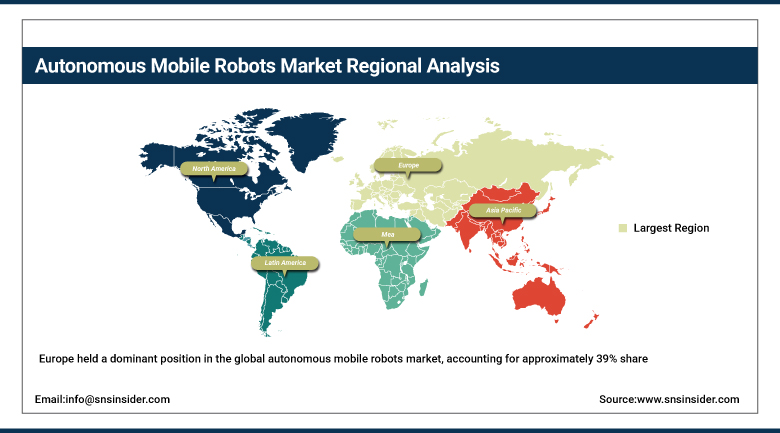
Europe held a dominant position in the global autonomous mobile robots market, accounting for approximately 39% share, driven by strong presence of leading robotics manufacturers and growing manufacturing automation investment across the region.
Germany is one of the major markets in Europe owing to its strong manufacturing automation base and growing consumer demand for advanced industrial robotics. Other countries such as the Netherlands and the United Kingdom are also contributing to market growth through expanding logistics and warehouse automation adoption.
Asia Pacific Autonomous Mobile Robots Market Insights
The Asia-Pacific region is estimated to account for a significant portion of 2025 revenue and is expected to grow fastest due to Chinese companies who leverage both software differences and cost differences and are expected to be the fastest-growing region over the forecast period.
China was the leading country in the Asia-Pacific region and accounted for the highest revenue share in 2025 because of its large-scale manufacturing sector and rapidly growing robotics manufacturing capabilities. Japan and South Korea are also contributing to regional growth through expanding advanced manufacturing automation and rising demand for autonomous material handling solutions.
Middle East & Africa and Latin America Autonomous Mobile Robots Market Insights
Middle East & Africa and Latin American regions are gradually expanding autonomous mobile robots adoption as logistics and manufacturing automation investment grows across both regions, supported by increasing regional interest in operational efficiency improvements.
Brazil is set to be a prominent Latin American market fueled by growing domestic logistics and manufacturing automation investment. The Middle East & Africa region has UAE and Saudi Arabia investing in modern industrial infrastructure that is gradually increasing demand for autonomous mobile robots across their expanding logistics and manufacturing sectors.
Market Dynamics
Growth Drivers: Rising labor shortages and e-commerce automation demand driving market growth
The convergence of operational needs and technological maturity, increasing labor shortages, and rising workforce costs are among the primary drivers of the autonomous mobile robots market. As e-commerce and omnichannel retail grow rapidly, the demand for automation of warehouses and logistics is growing as well, thereby sustaining the growth of the market in various industrial and commercial applications globally.
AMR’s growing use by the end user, the use of AMRs in healthcare and pharmaceuticals, and the use of AMRs in agriculture and food processing will sustain the growth of the market. Advancements in artificial intelligence, sensors, and navigation technology, improvements in safety and efficiency in industrial and logistics processes, and rising usage of AMRs in the hospitality industry will support demand during the forecast period.
Restraints: High initial investment and integration complexity limiting market expansion
One of the main barriers to market growth is high initial investment associated with autonomous mobile robots, which continues to constrain broader adoption among smaller operators facing budget limitations despite strong underlying interest in automation benefits.
Additionally, challenges in integration and deployment of AMR technologies, including communication and connectivity issues affecting navigation and perception, continue to complicate implementation for operators seeking to deploy AMR fleets across complex, dynamic facility environments. The technical complexity of ensuring reliable fleet coordination and safety across increasingly large-scale deployments further requires substantial ongoing software and systems integration investment.
Opportunities: Expansion of healthcare applications and vision-based navigation creating new growth avenues
Expansion of AMRs in healthcare and pharmaceuticals represents a substantial market opportunity, as hospitals and pharmaceutical facilities increasingly deploy autonomous robots for medication delivery, supply transport, and other material handling applications requiring consistent, contactless operation.
There is a considerable growth opportunity in the continued development of vision-based navigation technology reducing capital outlay for mid-market operators. The expansion of e-commerce, agriculture, and food processing automation adoption in emerging markets across Asia Pacific and Latin America is likely to unlock substantial new demand throughout the forecast period.
Recent Developments:
- 2025: Locus Robotics expanded its AMR deployment for warehouse and logistics customers across North America, strengthening its position supplying automated material handling solutions to e-commerce fulfillment operators.
- 2025: Geekplus Technology launched an updated vision-guided navigation AMR platform, offering operators reduced sensor costs and improved deployment flexibility across diverse warehouse environments.
- 2026: Mobile Industrial Robots, part of Teradyne, expanded its AMR production capacity, strengthening its ability to supply growing manufacturing sector demand for autonomous material handling solutions.
- 2026: Zebra Technologies, through its Fetch Robotics business, launched a new healthcare-focused AMR platform designed for hospital logistics, targeting medication delivery and supply transport applications.
Autonomous Mobile Robots Market key players are:
- ABB Ltd.
- OMRON Corporation
- Teradyne Inc. (Mobile Industrial Robots)
- Geekplus Technology Co., Ltd.
- GreyOrange, Inc.
- Seegrid Corporation
- 6 River Systems, Inc. (Shopify)
- Aethon Inc. (John Bean Technologies)
- Clearpath Robotics Inc. (Rockwell Automation)
- Fetch Robotics, Inc. (Zebra Technologies)
- IAM Robotics
- Locus Robotics Corp.
- inVia Robotics, Inc.
- Vecna Robotics, Inc.
- Zebra Technologies Corporation
- KUKA AG
- Fanuc Corporation
- Yaskawa Electric Corporation
- Kongsberg Maritime AS
- Amazon Robotics LLC
Autonomous Mobile Robots Market Report Scope :
| Report Attributes | Details |
|---|---|
| Market Size in 2025 | USD 4.49 Billion |
| Market Size by 2035 | USD 18.66 Billion |
| CAGR | CAGR of 15.31% From 2026 to 2035 |
| Base Year | 2025 |
| Forecast Period | 2026-2035 |
| Historical Data | 2022-2024 |
| Report Scope & Coverage | Market Size, Segments Analysis, Competitive Landscape, Regional Analysis, DROC & SWOT Analysis, Forecast Outlook |
| Key Segments | • By Navigation Technology (LiDAR SLAM, Vision-Based, Magnetic/Inductive/QR Guided, Hybrid & Multi-Sensor Fusion) • By Payload Capacity (Up to 100 kg, 100–500 kg, 500-1,000 kg, Above 1,000 kg) • By End-User Industry (Warehouse & Logistics, Healthcare & Pharmaceuticals, Manufacturing, Automotive, Food and Beverage, Defense and Security, Mining and Minerals, Others) • By Component (Hardware, Software) |
| Regional Analysis/Coverage | North America (US, Canada), Europe (Germany, UK, France, Italy, Spain, Russia, Poland, Rest of Europe), Asia Pacific (China, India, Japan, South Korea, Australia, ASEAN Countries, Rest of Asia Pacific), Middle East & Africa (UAE, Saudi Arabia, Qatar, South Africa, Rest of Middle East & Africa), Latin America (Brazil, Argentina, Mexico, Colombia, Rest of Latin America). |
| Company Profiles | ABB Ltd., OMRON Corporation, Teradyne Inc. (Mobile Industrial Robots), Geekplus Technology Co., Ltd., GreyOrange, Inc., Seegrid Corporation, 6 River Systems, Inc. (Shopify), Aethon Inc. (John Bean Technologies), Clearpath Robotics Inc. (Rockwell Automation), Fetch Robotics, Inc. (Zebra Technologies), IAM Robotics, Locus Robotics Corp., inVia Robotics, Inc., Vecna Robotics, Inc., Zebra Technologies Corporation, KUKA AG, Fanuc Corporation, Yaskawa Electric Corporation, Kongsberg Maritime AS, Amazon Robotics LLC. |
Frequently Asked Questions
Key players in the Autonomous Mobile Robots Market include ABB Ltd., OMRON Corporation, Teradyne Inc. (Mobile Industrial Robots), Geekplus Technology Co., Ltd., and Locus Robotics Corp., among others.
Key opportunities in the Autonomous Mobile Robots Market include e-commerce warehouse automation, labor-shortage mitigation, AI-enabled navigation, healthcare automation, and expansion of AMRs across manufacturing and logistics facilities.
The market is driven by the convergence of operational needs and technological maturity, increasing labor shortages, and rising workforce costs.
The LiDAR SLAM segment dominated the Autonomous Mobile Robots Market, accounting for approximately 40.88% market share.
The Europe region dominated the Autonomous Mobile Robots Market in 2025, accounting for approximately 39% share.
