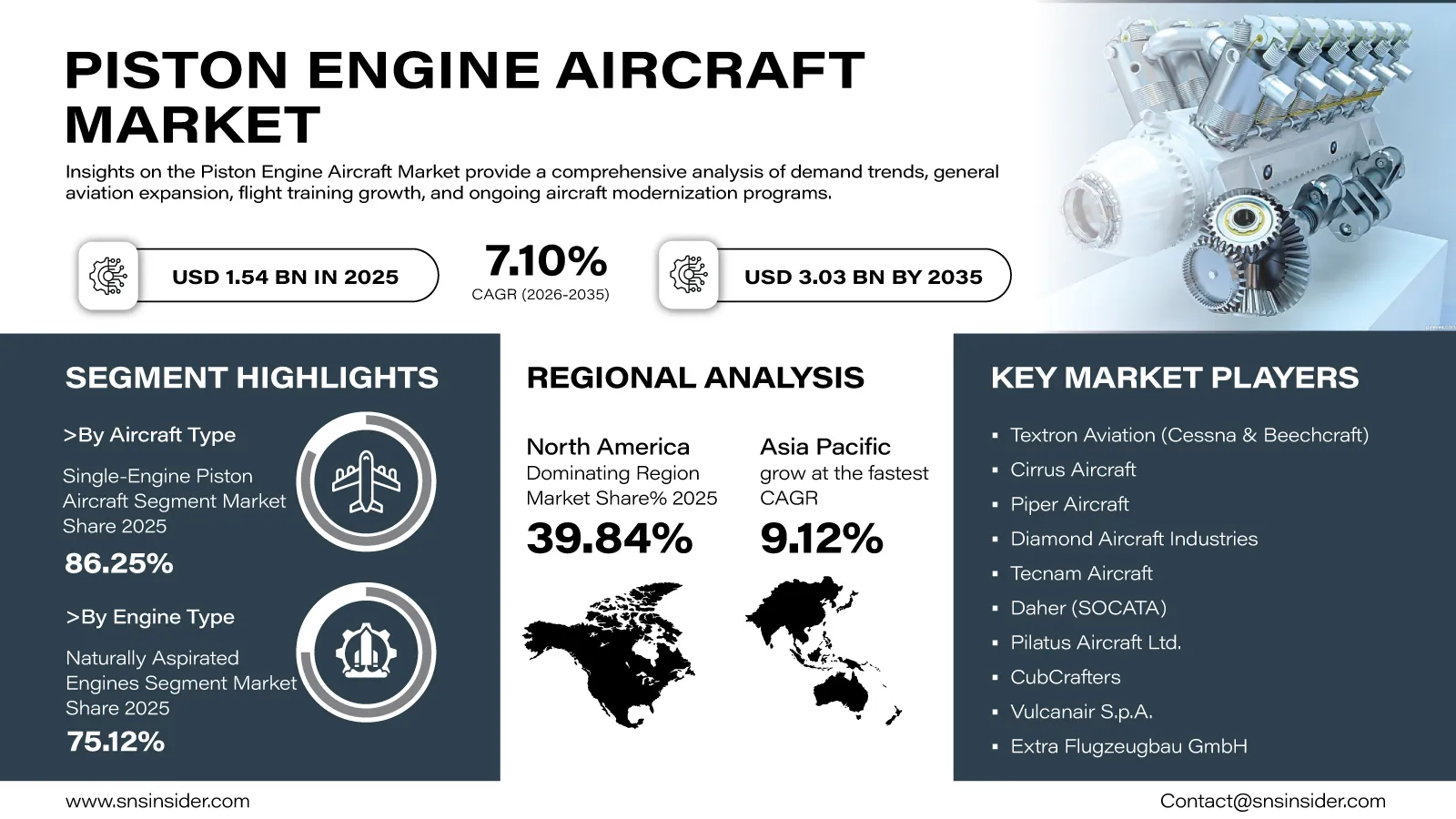
The global market for Piston Engine Aircraft is predicted to show consistent growth in the coming decade as flight schools, general aviation firms, and owners of private aircraft invest in new and efficient aircraft. “According to a recent study by SNS Insider, the global Piston Engine Aircraft Market size valued at USD 1.54 billion in 2025, is anticipated to grow to USD 3.03 billion by 2035, registering a CAGR of 7.10% over the 2026–2035 forecast period.”
Rising demand for competent pilots, development of facilities for flight training programs, and upgrading of old fleets of planes characterize the current state of the general aviation industry. Modern aircraft producers are equipping their new airplanes with cutting-edge cockpits, more efficient engines, and various safety systems in order to adapt to changing needs of different fields.
To Get Detailed Insights on the Piston Engine Aircraft Market – Request a Free Sample Report
As efforts continue to be made by governments and aviation authorities to solve pilot shortage problems, piston planes keep on being the cornerstone of flying schools all over the world because of their low cost of operation, flexibility, and capacity to be used for introductory flight training.
Aviation Training Expansion Creates Long-Term Growth Opportunities
There is renewed focus on training pilots in the aviation industry amid efforts by commercial airlines to increase their fleet capacity and cater to an increasing number of passengers. Flight schools are investing in more intensive training courses and upgrading their fleets with next-generation piston planes that come with advanced avionics and safety features.
The rise of recreational flights, business travel, aerial mapping, agriculture and regional connectivity programs is also fueling growth in the general aviation segment of the market. All this is widening the application range of piston planes beyond pilot training, thus generating new sources of income for producers and services companies.
On the other hand, technological innovations still play a key role in driving the market dynamics. The modern glass cockpits, advanced navigation systems, composite materials and efficient engines make next-generation piston planes very appealing to users.
Key Market Insights Highlight Evolving Demand Patterns
The share of the revenue generated by the single engine piston aircraft was expected to reach 86.25% in 2025, owing to its acceptance in flying schools, private purposes, and recreational activities due to its cost-effectiveness and user-friendliness. The multi-engine piston aircraft is expected to exhibit the highest growth rate until 2035 at a CAGR of 10.01%, owing to the growing demand for pilot certifications and specific requirements of aviation along with redundancy considerations.
By application, Flying Training & Pilot Academies made up 34.14% of total market revenue in 2025, as there has been an increase in aviation education enrollments globally. General aviation is anticipated to be one of the fastest growing application segments due to increasing private flying and utility aviation operations.
By engine type, naturally aspirated engines retained 75.12% of market revenue in 2025, owing to their robustness, easy maintainability, and large installed base. Turbocharged engines are estimated to register the highest growth rate in the forecast period, fueled by the demand for better altitudes and efficiencies.
Flight Schools and Training Institutes were responsible for 36.85% of total market revenue in 2025 and are expected to retain top position among end-user categories due to fast growing investments in aviation education programs.
An Infographic Representation of the Global Piston Engine Aircraft Market
Fleet Modernization and Digital Cockpit Technologies Shape Industry Development
Operators are increasingly upgrading their old fleets with technologically superior models that can facilitate the current training demands and safety standards in aviation. Digital flight display, navigation system, and situational awareness capabilities have been introduced among others in the newly manufactured piston airplanes.
In addition, aircraft manufacturers are focusing on operational efficiency with fuel savings, maintenance savings, and greater aircraft reliability. This makes it easier to cut down the operational cost of these new airplanes.
Increasingly, there has been a focus on sustainability in aviation, which is prompting innovations in the manufacture of light aircraft with efficient power plants.
Regional Markets Continue to Strengthen Global Demand
The North American region held a share of 39.84% of the total global Piston Engine Aircraft Market in 2025 due to its vast general aviation facilities, well-established flight training infrastructure, and substantial fleet of piston engine aircrafts. The continuous replacement of aircrafts and private aviation operations are further adding on to its market dominance.
The Asia Pacific region is forecasted to exhibit the highest growth in terms of the Piston Engine Aircraft market over the forecast period owing to the fast-paced development of aviation academies, growing number of pilot license programs, rising air connectivity in the region, and various governmental incentives.
As the developing nations keep spending on aviation infrastructure and training of the staff, there will be an increasing need for reliable and affordable training airplanes during the coming decade.
Industry Participants Accelerate Product Innovation
There is still much competition in the market, with companies engaging in the development of state-of-the-art avionics, aircraft safety equipment, light-weight materials, and efficient power systems. Collaborations with aviation schools and pilot schools are proving to be an added advantage to improve market position amid increasing demand.
Key companies operating in the global Piston Engine Aircraft Market include Textron Aviation (Cessna & Beechcraft), Cirrus Aircraft, Piper Aircraft, Diamond Aircraft Industries, Tecnam Aircraft, Daher (SOCATA), Pilatus Aircraft Ltd., CubCrafters, American Champion Aircraft Corporation, Vulcanair S.p.A., Extra Flugzeugbau GmbH, Mooney International Corporation, Flight Design GmbH, Pipistrel (Textron eAviation), Robin Aircraft (Apex Group), Maule Air Inc., Glasair Aviation, Cessna, Beechcraft, and BRM Aero.
An SNS Insider analyst Santosh Bhul commented, "Expanding pilot training requirements, increasing general aviation activity, and ongoing fleet modernization are creating sustained opportunities across the piston engine aircraft industry. Manufacturers that continue investing in advanced avionics, operational efficiency, and training-focused aircraft platforms will be well positioned to benefit from the market's long-term growth trajectory."
About the Author

Get in touch