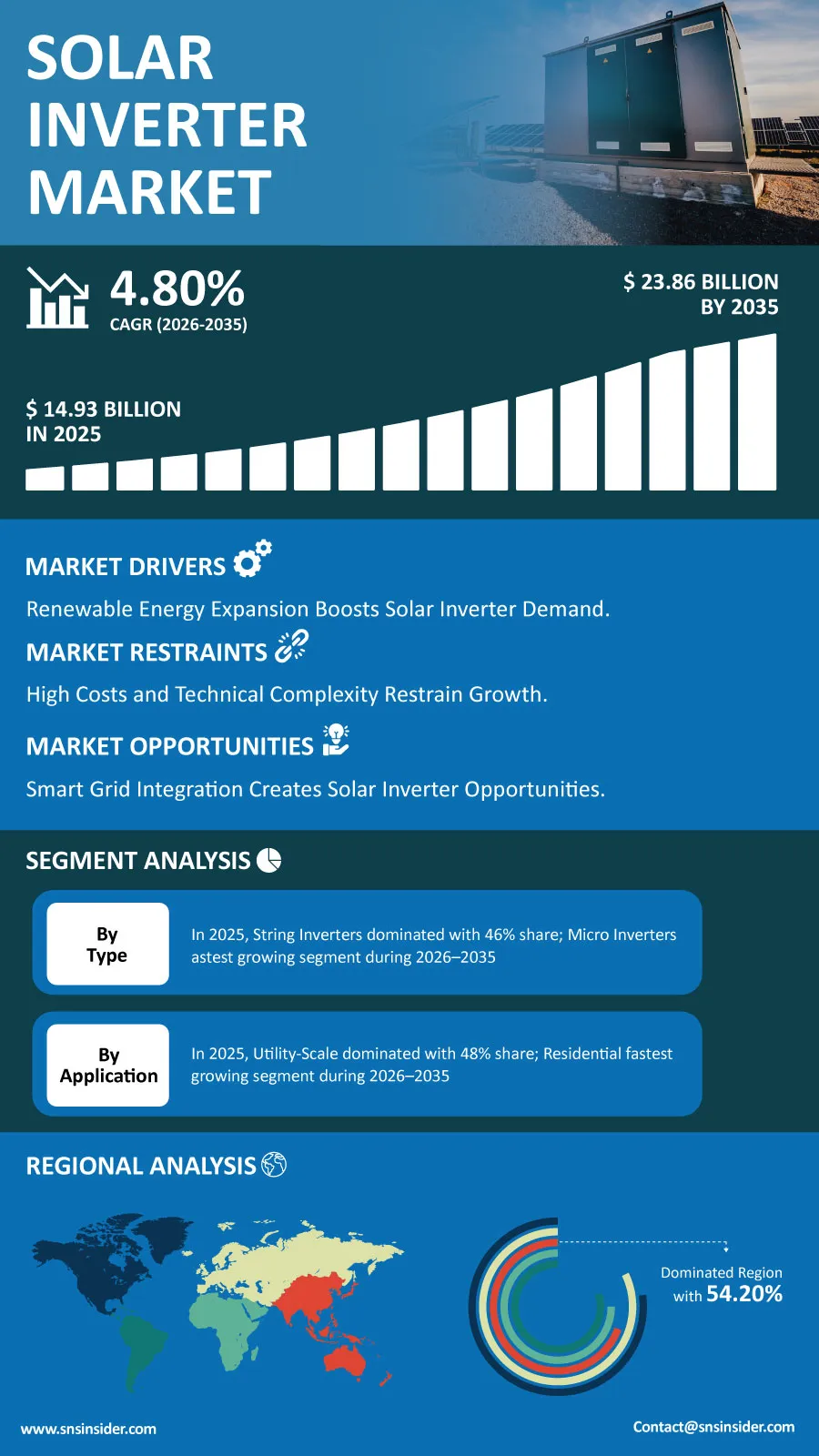
The global Solar Inverter Market is witnessing sustained momentum as countries accelerate renewable energy deployment and modernize electricity infrastructure to support cleaner power generation. “According to a recent study by SNS Insider, the global Solar Inverter Market size valued at USD 14.93 billion in 2025, is anticipated to grow to USD 23.86 billion by 2035, registering a CAGR of 4.80% over the 2026–2035 forecast period.”
With the rise in investment in solar panels in various sectors including residential, industrial, and utility, there is an emerging demand for innovative inverters to boost power conversion efficiency and maintain the stability of the grid system. With the increasing decentralization of energy systems, solar inverters have become not only converters but energy management systems with digital monitoring and grid support capabilities.
With the increased growth in the distribution of solar power, along with reduced costs for installation and good renewable energy policies, companies and utilities are being driven towards using high-efficiency inverters. Inverters are also getting developed, which can provide better efficiency levels while integrating batteries and digital energy systems.
To Get Detailed Insights on the Solar Inverter Market – Request a Sample Report
Smart Energy Infrastructure Creates Long-Term Growth Opportunities
Ongoing global initiatives aimed at developing the clean energy infrastructure have continued to create positive prospects for the solar inverter industry. Investments towards the development of renewable energy solutions have been rising rapidly among countries that aim at enhancing their energy security, reducing carbon emissions, and improving electricity reliability.
Rise in the use of battery energy storage solutions has also paved way for more advanced hybrid inverter technologies that can regulate electricity generation as well as storage from one platform. Additionally, ongoing modernization of electrical grids and introduction of smart grids have led to an increased need for intelligent inverters that offer real-time monitoring and regulation capabilities.
Digital technologies, such as AI, cloud analytics, and IoT connectivity are also transforming energy management through prediction of maintenance and optimization of system performance in both residential and commercial solar systems.
Key Market Insights Highlight Changing Installation Trends
Based on type, String Inverters accounted for 46% of global market revenue in 2025 due to their cost efficiency, operational simplicity, and extensive deployment across commercial and utility-scale projects. Micro Inverters are expected to record the fastest growth through 2035 as demand increases for module-level optimization and higher energy yields.
By system type, Grid-Tied Inverters represented 62% of market revenue in 2025, supported by widespread grid-connected solar installations worldwide. Hybrid Inverters are anticipated to experience the strongest expansion over the forecast period as battery storage adoption continues to accelerate.
In terms of application, Utility-Scale projects contributed 48% of total market revenue during 2025 owing to continued investment in large solar farms. The Residential segment is forecast to register the highest growth through 2035 as rooftop solar installations become increasingly attractive for homeowners seeking energy independence.
By end user, Utilities captured 50% of market share in 2025 through ongoing renewable infrastructure investments, while Residential Users are projected to emerge as the fastest-growing customer segment over the coming decade.
Intelligent Inverter Technologies Transform Renewable Energy Systems
Innovation remains a defining characteristic of the solar inverter industry as manufacturers introduce solutions that improve efficiency, safety, and system intelligence. Advanced inverter platforms now incorporate digital monitoring, automated fault detection, cybersecurity features, and seamless integration with battery storage systems.
Grid-forming technologies, AI-powered diagnostics, and cloud-connected performance analytics are helping operators maximize electricity generation while improving long-term asset management. These innovations are becoming increasingly valuable as distributed energy resources expand and utilities seek greater grid flexibility.
With governments placing greater emphasis on resilient and sustainable energy infrastructure, advanced inverter technologies are expected to play an increasingly central role in supporting future electricity networks.
Asia Pacific Accounted for 54.20% Market Share in 2025; Forecast to Expand at a 5.85% CAGR by 2035
The Asia-Pacific region contributed 54.20% of market revenues in 2025 and is expected to continue being the leader in growth rates with a 5.85% CAGR until 2035 due to highly developed manufacturing capacity, increased photovoltaic installations, favorable government policies, and fast growth in electricity demand. China, India, Japan, and South Korea are among the most important drivers of growth in this region.
North America has been experiencing healthy growth rates due to the rise of investments in modernization of smart grids, distributed solar generation, and residential batteries in both the USA and Canada. Government programs and technological innovations contribute to widespread adoption of new technologies.
Europe is one of the biggest markets for growth with high ambitions of the region regarding reducing CO2 emission, development of renewable energy, and other factors. Latin America and the Middle East & Africa regions are growing steadily due to their investments in utility-scale solar facilities, rural electrification, and renewable energy investments.
Industry Participants Focus on Smart, Efficient, and Scalable Solutions
Competition within the global solar inverter market continues to intensify as manufacturers prioritize product innovation, manufacturing expansion, and digital energy management capabilities. Companies are investing in advanced semiconductor technologies, software-enabled monitoring platforms, and integrated storage solutions to address evolving customer requirements across residential, commercial, and utility applications.
Key companies operating in the global Solar Inverter Market include Huawei Technologies, Sungrow Power Supply, SolarEdge Technologies, Enphase Energy, SMA Solar Technology, Fronius International, GoodWe Power Supply Technology, Ginlong Technologies (Solis), Growatt New Energy Technology, TMEIC (Toshiba Mitsubishi-Electric), Delta Electronics, Schneider Electric SE, ABB Ltd., Mitsubishi Electric Corporation, Siemens AG, Power Electronics S.L., SofarSolar, KACO New Energy GmbH, TBEA Co., Ltd., and Chint Power Systems (CPS).
An SNS Insider analyst Santosh Bhul commented, “The continued evolution of intelligent inverter technologies, growing renewable energy investments, and increasing integration of battery storage are reshaping the global solar industry. Organizations focusing on digital energy management, high-efficiency conversion technologies, and grid-ready inverter solutions are expected to remain well positioned as clean energy adoption accelerates worldwide.”
About the Author

Get in touch