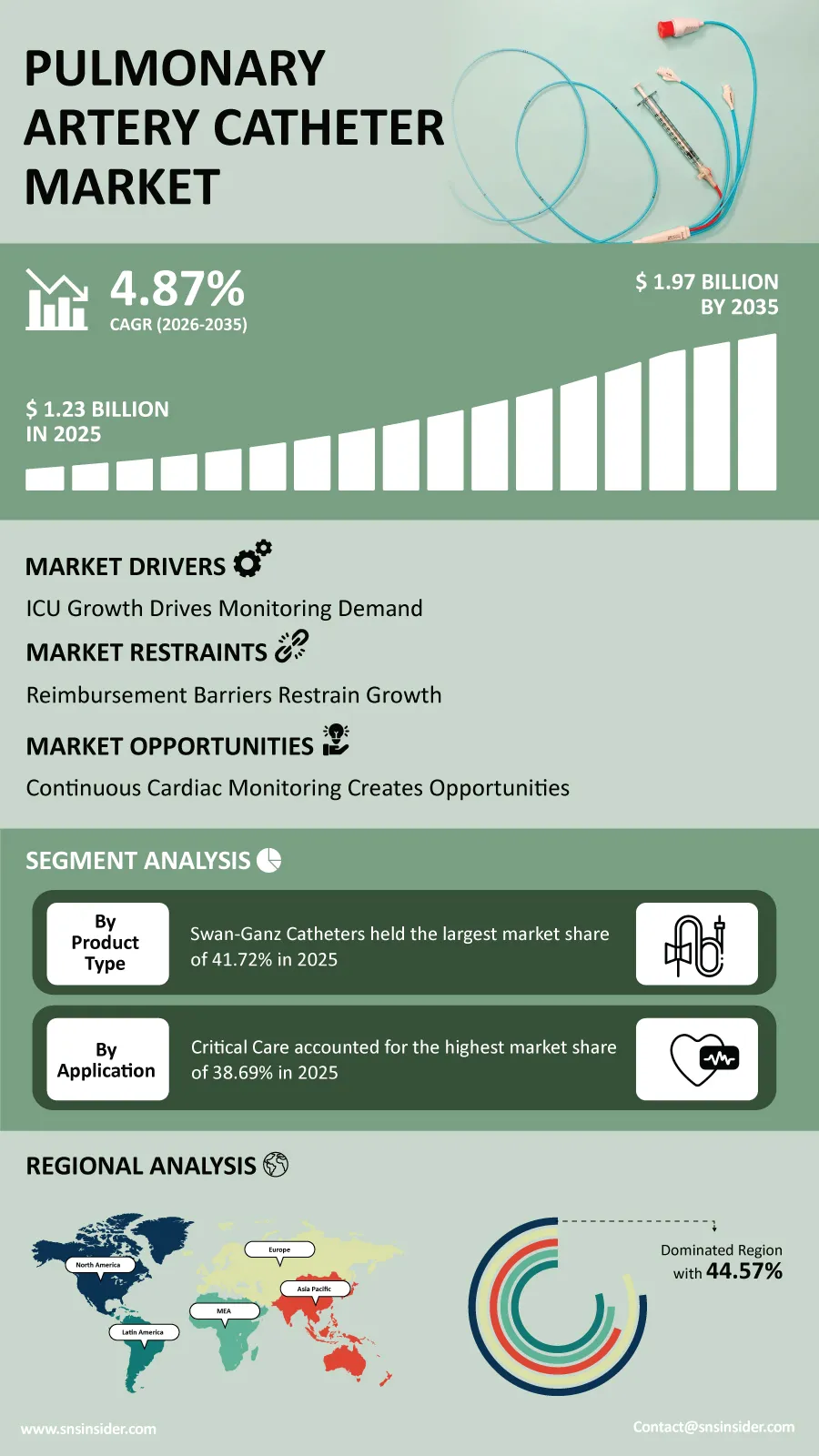
The global Pulmonary Artery Catheter Market is expected to witness steady growth over the next decade as healthcare providers continue strengthening critical care capabilities and investing in advanced cardiovascular monitoring technologies. “According to a recent study by SNS Insider, the global Pulmonary Artery Catheter Market size valued at USD 1.23 billion in 2025, is anticipated to grow to USD 1.97 billion by 2035, registering a CAGR of 4.87% over the 2026–2035 forecast period.”
The growing necessity of accurate cardiovascular diagnosis, availability of intensive care units, and usage of advanced monitoring technologies are changing the landscape of patient management in all healthcare organizations around the world. The healthcare industry is focusing on immediate clinical decisions, which would favor the adoption of advanced monitoring instruments for performing complicated surgical operations and treating critically ill patients.
In continuation with the trend of modernization of intensive care units and cardiology departments, the demand for efficient hemodynamic monitoring equipment will remain stable throughout the forecast period.
To Get Detailed Insights on the Pulmonary Artery Catheter Market – Request a Sample Report
Innovation in Hemodynamic Monitoring Continues to Improve Critical Care
Technology development continues to change the face of critical care medicine. Medical device companies are developing new catheter technologies that will help to increase efficiency, increase measurement accuracy, and streamline workflow processes.
With advancements in sensor technology, minimally invasive catheter placement, and monitoring devices, it is now easier for physicians to get more detailed physiological information on patients. This is ensuring that patients receive highly personalized care in high-risk clinical environments.
Increasing investment in digital monitoring devices and hospital integration technologies is also contributing to the advancement of cardiac monitoring solutions.
Key Market Findings Highlight Emerging Opportunities
Among product categories, Swan-Ganz catheters accounted for 41.72% of global market revenue in 2025, maintaining their position as the most widely utilized solution across critical care and cardiac procedures.
Meanwhile, continuous cardiac output catheters are expected to register the fastest growth through 2035, expanding at a CAGR of 6.12%, supported by increasing demand for continuous physiological assessment during complex medical interventions.
By monitoring technique, thermodilution represented 45.38% of total market revenue in 2025, reflecting its established role in advanced cardiovascular monitoring. At the same time, continuous cardiac output monitoring is projected to record the fastest growth at a CAGR of 6.04%, driven by increasing clinical preference for uninterrupted hemodynamic assessment.
Application analysis further demonstrates expanding clinical utilization. Critical care accounted for 38.69% of market revenue in 2025, highlighting the importance of pulmonary artery catheters in managing critically ill patients. Meanwhile, cardiac monitoring is anticipated to witness the fastest growth, advancing at a CAGR of 5.97% through 2035, supported by growing procedural volumes and increasing cardiovascular healthcare investments.
From an end-user perspective, hospitals represented 52.34% of global market revenue in 2025, while intensive care units are expected to grow at the fastest CAGR of 6.21%, reflecting continued expansion of specialized critical care services worldwide.
Expanding Critical Care Infrastructure Strengthens Market Outlook
Healthcare providers are increasing investments in advanced monitoring technologies to improve patient outcomes across emergency medicine, cardiovascular care, and surgical services. The growing emphasis on evidence-based treatment protocols and real-time physiological monitoring is supporting greater adoption of pulmonary artery catheter systems across tertiary care hospitals and specialty medical centers.
Increasing focus on clinician training, workflow optimization, and integrated monitoring solutions is also contributing to broader utilization of advanced hemodynamic monitoring technologies.
Regional Markets Continue to Create Growth Opportunities
The North American region contributed to 44.57% of the total market share in 2025 owing to its well-developed infrastructure for hospitals, critical care solutions, and advanced technologies used in cardiovascular monitoring. The investments in specialized cardiac care and intensive care solutions contribute to the leadership of the region.
In contrast, the Asia-Pacific region will be the fastest-growing market at a CAGR of 5.94% until 2035. The factors that contribute to its growth include expansion of health infrastructure, investments in critical care centers, cardiovascular treatment facilities, and availability of medical technologies.
Industry Leaders Continue to Advance Critical Care Technologies
Competition within the pulmonary artery catheter market remains strong as manufacturers continue investing in product innovation, technological advancement, clinician education, and global expansion strategies. Companies are increasingly focused on improving monitoring accuracy, procedural efficiency, and patient safety through next-generation catheter solutions.
Leading companies operating in the global pulmonary artery catheter market include Edwards Lifesciences, ICU Medical, Argon Medical Devices, B. Braun, Becton, Dickinson and Company, Medtronic, Teleflex, Boston Scientific, Terumo Corporation, and Abbott Laboratories.
An SNS Insider analyst Parry Kardani commented, "Advancements in hemodynamic monitoring technologies, combined with expanding critical care infrastructure and increasing cardiovascular healthcare investments, are creating new opportunities across the pulmonary artery catheter market. Manufacturers delivering clinically efficient, user-friendly, and technology-enabled monitoring solutions are expected to strengthen their competitive position over the coming decade."
About the Author

Get in touch