
Pulmonary Artery Catheter Market Report Scope & Overview:
The Pulmonary Artery Catheter market is witnessing steady growth owing to the rise in critical care procedures and the increasing prevalence of cardiovascular diseases across the globe. Moreover, the growth can be attributed to expanding ICU capacities coupled with the growing demand for precise hemodynamic monitoring in cardiac and surgical settings. The pulmonary artery catheters are specialized devices used in critical care to measure cardiac output, pressures, and venous oxygen saturation. The devices obtained are inserted through central veins and advanced into the pulmonary artery for real-time monitoring without the use of invasive surgical procedures.
The Pulmonary Artery Catheter Market was valued at USD 1.23 Billion in 2025 and is expected to reach USD 1.97 Billion by 2035, growing at a CAGR of 4.87% from 2026 to 2035.
Pulmonary Artery Catheter usage exceeded 1.1 million units in 2025, driven by rising ICU procedures and growing adoption of advanced hemodynamic monitoring.

To Get more information On Pulmonary Artery Catheter Market - Request Free Sample Report
Pulmonary Artery Catheter Market Trends:
-
Rising ICU admissions and complex cardiac procedures are boosting demand for precise hemodynamic monitoring devices.
-
Growing prevalence of cardiovascular diseases is accelerating adoption of pulmonary artery catheters in critical care.
-
Increased use of continuous cardiac output and advanced monitoring techniques is improving patient outcomes and clinical decision-making.
-
Technological advancements in catheter design, materials, and minimally invasive insertion are enhancing safety and performance.
-
Expansion of cardiac care units and specialty clinics is driving demand for reliable and easy-to-use monitoring solutions.
-
Collaborations between device manufacturers and hospitals are fostering innovation and broader market reach.
Key Market Highlights
|
Market Parameter |
Market Highlight / Data |
Key Growth Driver |
|---|---|---|
|
Largest Product Type |
Swan-Ganz Catheters – 41.72% share in 2025 |
Long-standing clinical reliability and broad adoption in cardiac critical care. |
|
Fastest-Growing Product Type |
Continuous Cardiac Output Catheters – 6.12% CAGR |
Rising demand for precise cardiac output measurement in complex surgeries. |
|
Largest Monitoring Technique |
Thermodilution – 45.38% share in 2025 |
Accuracy, clinical familiarity, and cost-effectiveness in ICU settings. |
|
Fastest-Growing Monitoring Technique |
Continuous Cardiac Output – 6.04% CAGR |
Technological improvements and demand for non-stop hemodynamic data. |
|
Largest Application |
Critical Care – 38.69% share in 2025 |
Essential for managing severe cardiac conditions, sepsis, and organ failure. |
|
Fastest-Growing Application |
Cardiac Monitoring – 5.97% CAGR |
Increased cardiovascular surgeries and need for real-time output tracking. |
|
Largest End User |
Hospitals – 52.34% share in 2025 |
Large patient volumes and comprehensive cardiac and ICU facilities. |
|
Fastest-Growing End User |
Intensive Care Units – 6.21% CAGR |
Expansion of ICUs and rising demand for continuous hemodynamic monitoring. |
|
Largest Region |
North America – 44.57% share in 2025 |
Well-established ICU and cardiac care infrastructure in the U.S. and Canada. |
|
Fastest-Growing Region |
Asia Pacific – 5.94% CAGR |
Rising ICU admissions, cardiovascular procedures, and expanding healthcare infrastructure. |
U.S. Pulmonary Artery Catheter Market Insights:
The U.S. Pulmonary Artery Catheter Market is projected to grow from USD 0.38 Billion in 2025 to USD 0.58 Billion by 2035, at a CAGR of 4.35%. Growth is driven by rising ICU admissions, increasing cardiovascular procedures, adoption of advanced PAC devices, and investments in critical care and cardiac monitoring infrastructure.

Pulmonary Artery Catheter Market Growth Drivers:
-
Increasing ICU admissions and complex cardiac procedures driving demand for precise hemodynamic monitoring devices.
Increasing ICU admissions and rising complex cardiac procedures are key drivers of Pulmonary Artery Catheter Market growth. Hospitals, intensive care units, and cardiac clinics are adopting advanced PAC devices for precise hemodynamic monitoring, improved patient management, and optimized treatment decisions. Growth in critical care and cardiovascular surgeries further fuels demand for continuous cardiac output and pressure-monitoring catheters. Expansion of cardiac care infrastructure, coupled with technological innovations in catheter design and minimally invasive insertion, is enhancing clinical outcomes and supporting sustained market growth.
Over 52% of hospitals and intensive care units adopted pulmonary artery catheters in 2025 to enhance hemodynamic monitoring and patient management.
Pulmonary Artery Catheter Market Restraints:
-
High device costs and limited insurance reimbursement are restricting widespread adoption of pulmonary artery catheters.
High costs of pulmonary artery catheters and limited insurance reimbursement remain key restraints for market growth. Advanced PAC devices, including continuous cardiac output and pressure-monitoring catheters, increase procedural expenses, limiting adoption among small and mid-sized hospitals and clinics. In many regions, inconsistent reimbursement policies discourage routine use, particularly in elective cardiac procedures. Additionally, budget constraints, need for specialized clinician training, and concerns over procedure complexity further restrict widespread adoption, slowing market penetration despite rising critical care and cardiovascular surgery demand.
Pulmonary Artery Catheter Market Opportunities:
-
Growing demand for advanced hemodynamic monitoring and continuous cardiac output devices offers significant market expansion opportunities.
Growing demand for advanced hemodynamic monitoring and continuous cardiac output devices presents significant opportunities for the Pulmonary Artery Catheter Market. Hospitals, intensive care units, and cardiac clinics are increasingly adopting PACs to enhance patient monitoring, optimize treatment decisions, and improve clinical outcomes. Manufacturers providing innovative, user-friendly, and cost-effective catheter solutions can capitalize on this trend. Ongoing advancements in catheter design, minimally invasive insertion techniques, and monitoring technologies enable broader adoption across critical care and cardiac surgery settings.
Over 48% of hospitals and intensive care units adopted pulmonary artery catheters in 2025, driven by increasing critical care procedures and cardiovascular surgeries.
Pulmonary Artery Catheter Market Segmentation Analysis:
-
By Product Type, Swan-Ganz Catheters held the largest market share of 41.72% in 2025, while Continuous Cardiac Output Catheters are expected to grow at the fastest CAGR of 6.12% during 2026–2035.
-
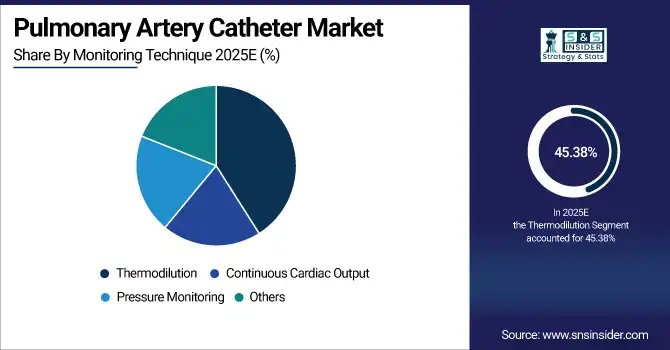
By Monitoring Technique, Thermodilution dominated with a 45.38% share in 2025, while Continuous Cardiac Output is projected to record the fastest CAGR of 6.04% through 2026–2035.
-
By Application, Critical Care accounted for the highest market share of 38.69% in 2025, while Cardiac Monitoring is expected to expand at the fastest CAGR of 5.97% during the forecast period.
-
By End-User, Hospitals held the largest share of 52.34% in 2025, while Intensive Care Units are anticipated to grow at the fastest CAGR of 6.21% through 2026–2035.
By Product Type, Swan-Ganz Catheters Dominate While Continuous Cardiac Output Catheters Grow Rapidly:
Swan-Ganz Catheters segment dominated the market due to its long-standing clinical reliability, broad adoption in cardiac and critical care, and proven effectiveness in continuous hemodynamic monitoring. In 2025, usage exceeded 460,000 units, reflecting widespread deployment in ICUs, cardiac surgery, and trauma care.
Continuous Cardiac Output Catheters are the fastest-growing segment, driven by rising demand for precise cardiac output measurement in complex surgeries and critical care. Their adoption increased to over 200,000 units in 2025, particularly in advanced ICU settings and specialized cardiac centers.
By Monitoring Technique, Thermodilution Dominates While Continuous Cardiac Output Grows Rapidly:
Thermodilution segment dominated the market due to its accuracy, clinical familiarity, and cost-effectiveness in ICU and surgical settings. In 2025, over 500,000 procedures utilized thermodilution techniques for real-time cardiac output assessment, ensuring optimal patient management.
Continuous Cardiac Output is the fastest-growing segment, supported by technological improvements and demand for non-stop, precise hemodynamic data. Its adoption surpassed 230,000 procedures in 2025, especially in high-acuity ICUs and during complex cardiac surgeries where continuous monitoring improves outcomes.
By Application, Critical Care Dominates While Cardiac Monitoring Grows Rapidly:
Critical Care segment dominated the market as PACs are essential for managing severe cardiac conditions, sepsis, and multi-organ failure in ICUs. In 2025, PACs were used in over 480,000 critical care procedures, underscoring their role in life-saving interventions.
Cardiac Monitoring is the fastest-growing segment, driven by increased cardiovascular surgeries, minimally invasive procedures, and the need for real-time cardiac output tracking. Usage exceeded 210,000 procedures in 2025, particularly in specialized cardiac centers and advanced surgical units.
By End-User, Hospitals Dominate While Intensive Care Units Grow Rapidly:
Hospitals segment dominated the market due to their large patient volumes, comprehensive cardiac and ICU facilities, and routine use of PACs for critical care management. In 2025, hospitals accounted for over 540,000 PAC procedures, reflecting wide acceptance across general, cardiac, and trauma care departments.
Intensive Care Units is the fastest-growing segment, driven by expansion of ICUs, rising cardiovascular cases, and demand for continuous hemodynamic monitoring. PAC utilization in ICUs exceeded 220,000 procedures in 2025, particularly in tertiary care hospitals and specialized critical care centers.
Pulmonary Artery Catheter Market Regional Analysis:
North America Pulmonary Artery Catheter Market Insights:
The North America Pulmonary Artery Catheter Market is dominated, holding a 44.57% share in 2025, driven by well-established ICU and cardiac care infrastructure in the U.S. and Canada. Strong adoption of Swan-Ganz and advanced continuous cardiac output catheters across hospitals and specialized cardiac centers fuels growth. Rising cardiovascular procedures, critical care demand, and technological advancements in catheter design and minimally invasive insertion further support market expansion. Robust clinician training, supportive reimbursement policies, and hospital procurement budgets reinforce North America’s leadership in this mature market.

Get Customized Report as per Your Business Requirement - Enquiry Now
U.S. Pulmonary Artery Catheter Market Insights:
The U.S. Pulmonary Artery Catheter Market is strongly driven by rising ICU admissions, advanced cardiac care infrastructure, and widespread adoption of Swan-Ganz and continuous cardiac output catheters. Growing cardiovascular procedures, critical care demand, and investments in minimally invasive catheter technologies, along with clinician training, reinforce the U.S. as North America’s dominant market.
Asia-Pacific Pulmonary Artery Catheter Market Insights:
The Asia-Pacific Pulmonary Artery Catheter Market is the fastest-growing region, projected to expand at a CAGR of 5.94% during 2026–2035. Growth is driven by rising ICU admissions, increasing cardiovascular procedures, and expanding healthcare infrastructure across China, India, Japan, and Southeast Asia. Adoption of Swan-Ganz and continuous cardiac output catheters, investments in minimally invasive monitoring technologies, and development of advanced cardiac care units are accelerating PAC uptake and strengthening Asia-Pacific’s dynamic market growth.
China Pulmonary Artery Catheter Market Insights:
The China Pulmonary Artery Catheter Market is driven by rising ICU admissions, increasing cardiovascular procedures, and expanding hospital and cardiac care infrastructure. Rapid adoption of Swan-Ganz and continuous cardiac output catheters, growing investments in minimally invasive monitoring technologies, and strengthening critical care capabilities are accelerating PAC uptake, positioning China as a key contributor to Asia-Pacific market growth.
Europe Pulmonary Artery Catheter Market Insights:
The Europe Pulmonary Artery Catheter Market is driven by increasing ICU admissions, advanced cardiac care infrastructure, and investments in minimally invasive monitoring procedures. Countries such as Germany, France, and the UK are shaping regional demand through widespread adoption of Swan-Ganz and continuous cardiac output catheters. Expansion of intensive care units, cardiac specialty centers, and supportive healthcare policies are boosting PAC adoption. Continuous innovations in catheter design, monitoring technologies, and clinician training reinforce Europe’s significance in the PAC market.
Germany Pulmonary Artery Catheter Market Insights:
Germany is a key market in the European Pulmonary Artery Catheter landscape, driven by advanced cardiac and ICU infrastructure and high critical care volumes. Growth is supported by widespread adoption of Swan-Ganz and continuous cardiac output catheters, investments in minimally invasive monitoring procedures, and strong regulatory focus on patient safety, clinician training, and procedural efficiency.
Latin America Pulmonary Artery Catheter Market Insights:
The Latin America Pulmonary Artery Catheter Market is growing due to rising ICU admissions and expanding cardiac care infrastructure. Adoption is supported by increasing use of Swan-Ganz and continuous cardiac output catheters across Brazil, Mexico, and Argentina, with investments in minimally invasive monitoring, critical care facilities, and clinician training driving regional market growth.
Middle East and Africa Pulmonary Artery Catheter Market Insights:
The Middle East & Africa Pulmonary Artery Catheter Market is expanding due to rising ICU admissions and improving cardiac care infrastructure. Increasing adoption of Swan-Ganz and continuous cardiac output catheters in hospitals and critical care units is driving demand, with Saudi Arabia, the UAE, and South Africa emerging as key regional markets.
Pulmonary Artery Catheter Market Competitive Landscape:
Edwards Lifesciences Corporation is a leader in medical technology, specializing in heart valve therapies and advanced hemodynamic monitoring systems, including the widely used Swan-Ganz pulmonary artery catheters. Its dominance stems from decades of clinical expertise, robust R&D, and innovations in continuous cardiac output and pressure monitoring technologies. Edwards maintains a strong presence through extensive distribution networks, clinician training programs, and regulatory approvals, ensuring reliable performance in ICUs and cardiac care units, reinforcing its position as a market leader.
-
In June 2025, Ethicon launched the ETHICON 4000 Stapler with 3D Staple Technology and enhanced Gripping Surface, improving tissue compression, reducing bleeding, and supporting open, laparoscopic, and future robotic surgeries.
ICU Medical, Inc. is a U.S.-based medical technology company known for critical care and hemodynamic monitoring products, including advanced pulmonary artery catheters for continuous cardiac output and venous oximetry. The company dominates through a strong focus on patient safety, accuracy, and innovation. Strategic acquisitions, such as Hospira’s critical care portfolio, expand its offerings. Distribution, partnerships with hospitals, and investments in training programs enhance adoption. Its reliable and user-friendly PAC devices strengthen ICU and cardiac care performance, securing market leadership.
-
In April 2025, Baxter introduced the Hemopatch Sealing Hemostat with room-temperature storage, enabling rapid bleeding control and tissue sealing in open and minimally invasive surgeries, improving OR efficiency and accessibility, supporting faster patient recovery times.
Argon Medical Devices, Inc. is a specialty medical device manufacturer with a diverse portfolio covering interventional radiology, vascular surgery, and critical care, including pulmonary artery catheters. The company’s market presence is supported by high-quality, reliable products, long-standing clinician relationships, and regulatory compliance. Argon emphasizes innovation, safe design, and effective hemodynamic monitoring solutions. Strategic partnerships, broad distribution, and focused investments in training programs allow Argon to compete effectively in the PAC market, making it a recognized player in critical care and cardiac monitoring.
-
In July 2025, B. Braun expanded its hemostatic and related medical portfolio by launching an expanded Heparin Sodium Premixed Injection product line, adding new high‑dose formulations to its heparin offering and enhancing bleeding management support in surgical and catheter care settings across the U.S. market.
Pulmonary Artery Catheter Market Key Players:
Some of the Pulmonary Artery Catheter Companies are:
-
Edwards Lifesciences Corporation
-
ICU Medical, Inc.
-
Argon Medical Devices, Inc.
-
B. Braun Melsungen AG
-
Becton, Dickinson and Company (BD)
-
Medtronic plc
-
Teleflex Incorporated
-
Boston Scientific Corporation
-
Getinge AB
-
Terumo Corporation
-
Smiths Medical Group
-
Merit Medical Systems, Inc.
-
Vygon SA
-
Cook Medical
-
Cardinal Health Corp
-
Nipro Corporation
-
Philips Healthcare Corp
-
Abbott Laboratories
-
AngioDynamics, Inc.
-
Coloplast Group
| Report Attributes | Details |
|---|---|
| Market Size in 2025 | USD 1.23 Billion |
| Market Size by 2035 | USD 1.97 Billion |
| CAGR | CAGR of 4.87% From 2026 to 2035 |
| Base Year | 2025 |
| Forecast Period | 2026-2035 |
| Historical Data | 2022-2024 |
| Report Scope & Coverage | Market Size, Segments Analysis, Competitive Landscape, Regional Analysis, DROC & SWOT Analysis, Forecast Outlook |
| Key Segments | • By Product Type (Swan-Ganz Catheters, Balloon-Tipped Catheters, Thermodilution Catheters, Continuous Cardiac Output Catheters, Others) • By Monitoring Technique (Thermodilution, Continuous Cardiac Output, Pressure Monitoring, Others) • By Application (Cardiac Monitoring, Hemodynamic Assessment, Critical Care, Surgical Procedures, Trauma Care, Others) • By End-User (Hospitals, Intensive Care Units, Ambulatory Surgical Centers, Cardiac Clinics, Specialty Clinics, Others) |
| Regional Analysis/Coverage | North America (US, Canada), Europe (Germany, UK, France, Italy, Spain, Russia, Poland, Rest of Europe), Asia Pacific (China, India, Japan, South Korea, Australia, ASEAN Countries, Rest of Asia Pacific), Middle East & Africa (UAE, Saudi Arabia, Qatar, South Africa, Rest of Middle East & Africa), Latin America (Brazil, Argentina, Mexico, Colombia, Rest of Latin America). |
| Company Profiles | Edwards Lifesciences Corporation, ICU Medical, Inc., Argon Medical Devices, Inc., Teleflex Incorporated, Becton, Dickinson and Company, Medtronic plc, Smiths Medical, Getinge AB, Cook Medical, Merit Medical Systems, Braun Melsungen AG, Nihon Kohden Corporation, Fujifilm Holdings Corporation, Terumo Corporation, AngioDynamics, Inc., Edwards Critical Care, Vygon SA, Cordis Corporation, Lepu Medical Technology, Beijing Anzhen Medical Technology |

Frequently Asked Questions
North America dominated with a 44.57% share in 2025, while Asia-Pacific is the fastest-growing region, expected to expand at a CAGR of 5.94% during 2026–2035.
Swan-Ganz Catheters dominated with a 41.72% share in 2025, while Continuous Cardiac Output Catheters are projected to grow at the fastest CAGR of 6.12% during 2026–2035.
Ans: Growth is driven by rising ICU admissions, increasing cardiovascular procedures, demand for precise hemodynamic monitoring, and adoption of advanced PAC devices.
The market is valued at USD 1.23 Billion in 2025 and is projected to reach USD 1.97 Billion by 2035.
The Pulmonary Artery Catheter Market is expected to grow at a CAGR of 4.87% during 2026–2035.
