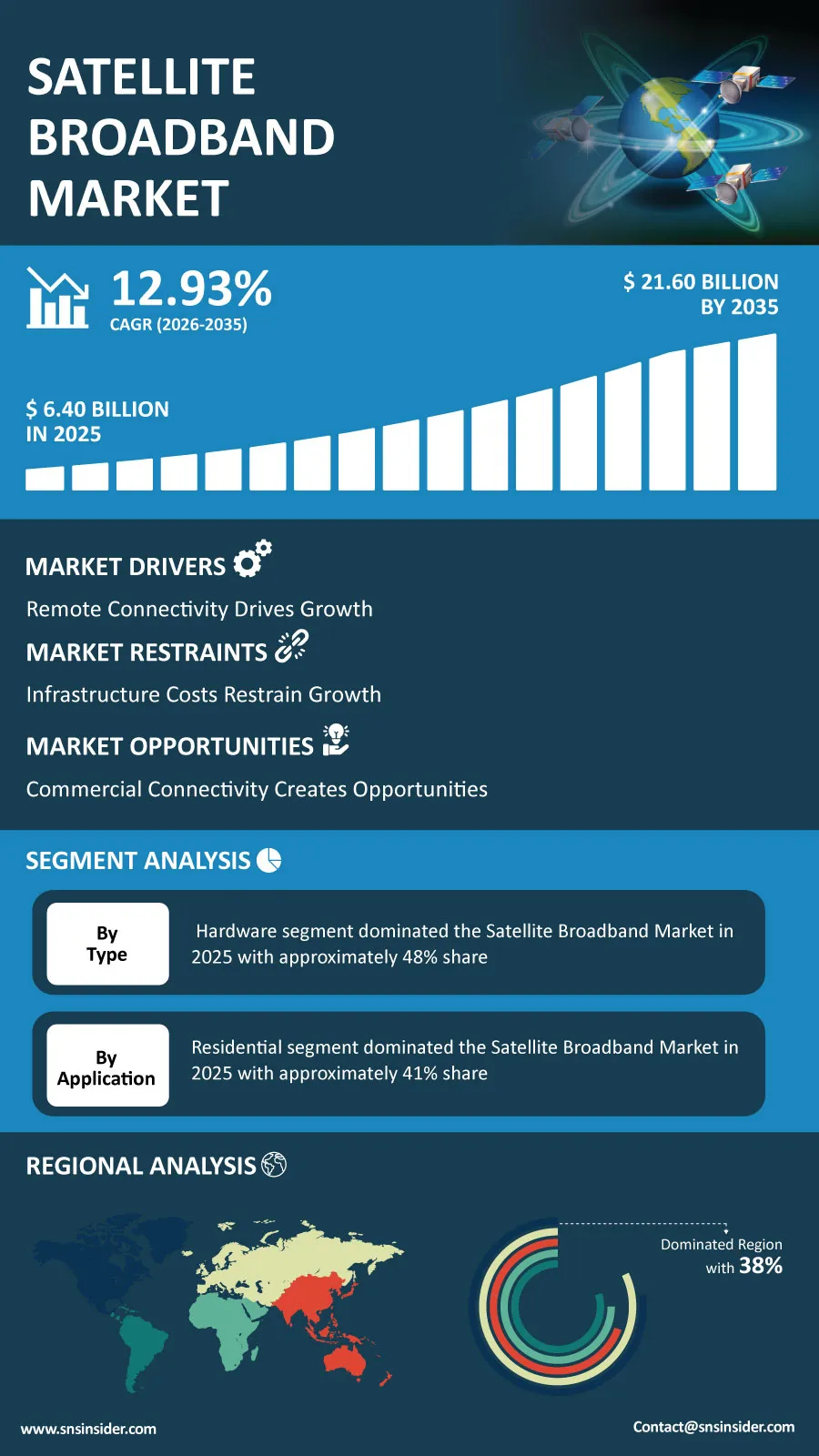
The global Satellite Broadband Market is poised for robust growth as demand for reliable high-speed internet continues to expand beyond the reach of conventional terrestrial networks. According to a recent study by SNS Insider, the global Satellite Broadband Market size valued at USD 6.40 billion in 2025, is anticipated to grow to USD 21.60 billion by 2035, registering a CAGR of 12.93% over the 2026–2035 forecast period.
With the growing digital transformation of industries and increasing reliance on cloud computing, telecommuting, e-learning, and e-government, the demand for satellite-based connectivity is on the rise. Corporations, organizations, and households have started using satellite broadband connectivity to provide seamless connectivity in remote and inaccessible areas globally.
The development and implementation of LEO constellations will change the competitive dynamics by providing superior network performance and coverage along with low latency. With increased public-private funding in the development of advanced satellite communication technologies, there will be plenty of opportunities to explore.
To Get Detailed Insights on the Satellite Broadband Market – Request a Sample Report
Expansion of Global Connectivity Programs Creates New Growth Opportunities
The need for broadband connectivity is becoming vital as the Internet becomes more critical to economic development and inclusion. Large projects dedicated to improving Internet availability for under-served regions will fuel increased satellite spending and ensure market growth over a long period of time.
Moreover, the use of broadband is spreading in industries where constant communication is required outside conventional network coverage. Companies working on seas, airlines, defense enterprises, and business customers all opt for satellite broadband to ensure reliable communication and constant connectivity.
Ongoing advancements in satellite miniaturization, phased-array antennas, intelligent ground stations, and multi-orbit communication platforms are further enhancing service quality while expanding deployment possibilities.
Key Market Insights Highlight Shifting Demand Patterns
By type, hardware segment held around 48% of global market revenue in 2025, supported by growing demand for satellite terminals, satellite antennas, modems, and user equipment required for broadband deployment. The services segment is projected to experience the fastest growth through 2035 as organizations increasingly invest in managed connectivity, installation, monitoring, and network optimization services.
Based on application, the residential segment accounted for 41% of market revenue in 2025 as satellite broadband becomes an increasingly practical solution for households located in underserved areas. Government and defense applications are forecast to register the strongest growth during the forecast period, driven by rising investments in secure communications, border surveillance, emergency response, and national security infrastructure.
By frequency band, the Ku Band segment was generated approximately 44% of market revenue in 2025 owing to its widespread deployment across commercial broadband, broadcasting, aviation, and maritime communications. Ka Band is projected to emerge as the fastest-growing segment as high-throughput satellite systems continue supporting bandwidth-intensive applications.
In terms of end users, telecommunications providers augment accounted for approximately 38% of market revenue in 2025 through expanding broadband coverage and network backhaul capabilities. The aviation sector is expected to witness the fastest growth as airlines increase investments in next-generation in-flight connectivity and passenger digital services.
Next-Generation Satellite Networks Drive Industry Transformation
The satellite broadband sector continues to undergo a lot of evolution due to the implementation of innovative communication systems that have the ability to facilitate higher capacities, reduced latencies, and increased resiliency. Collaboration in multi-orbital satellites is now becoming an important factor for satellite providers to offer flexible services in enterprise, mobility, and government sectors.
Collaboration efforts between satellite firms, telecoms, and technology providers continue to fuel innovation and increase service availability in developed and emerging countries.
North America Leads with 38% Market Share in 2025 as Asia Pacific Emerges as the Fastest-Growing Region
North America is forecasted to retain its dominant position in the worldwide market, generating around 38% of overall revenue in 2025. Demand in the region is driven by increased investment in the deployment of LEO satellites, rural broadband programs, and adoption of technology in the telecommunications, defense, aviation, and marine sectors.
The Asia Pacific is estimated to lead the fastest-growing regional markets due to government investments in digital infrastructures, rural network development, and communication satellite systems. Internet penetration rate, adoption of cloud technology, and demand for broadband solutions from remote areas drive the growth of the regional market.
Industry Participants Focus on Capacity Expansion and Network Innovation
Competition across the satellite broadband market is intensifying as leading companies invest in high-capacity satellites, next-generation communication platforms, and integrated multi-orbit service offerings. Industry participants are prioritizing network performance, service scalability, and global coverage while strengthening partnerships with telecom providers and enterprise customers.
Key companies operating in the global Satellite Broadband Market include SpaceX, Hughes Network Systems, Viasat Inc., Eutelsat Communications, SES S.A., OneWeb, Inmarsat Global Limited, Telesat Canada, Iridium Communications Inc., Thuraya Telecommunications Company, Intelsat S.A., Globalstar Inc., Hispasat S.A., Singtel Satellite, Gilat Satellite Networks Ltd., Skycasters LLC, Yahsat, Kacific Broadband Satellites Group, Speedcast International Limited, and Swarm Technologies Inc.
An SNS Insider analyst Sushant Kadam commented, “Growing investments in next-generation satellite constellations, increasing demand for universal broadband access, and the expansion of digital services across remote regions are creating substantial opportunities for the industry. Companies that strengthen network capacity, improve service quality, and develop scalable connectivity solutions will be well positioned to benefit from the market's long-term growth trajectory.”
About the Author

Get in touch