
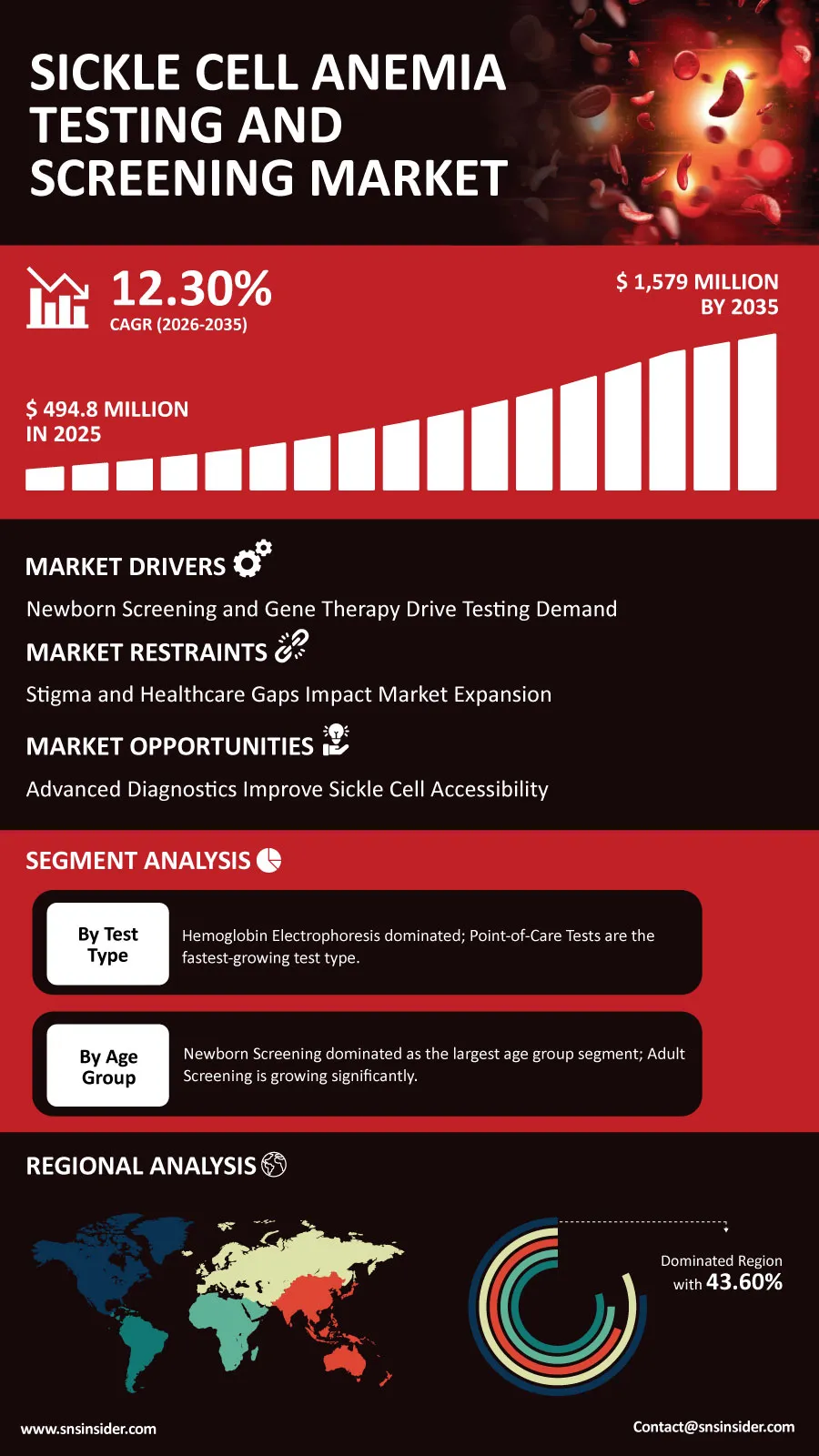
The global Sickle Cell Anemia Testing and Screening Market is expected to experience significant growth over the next decade as healthcare systems worldwide strengthen early disease detection programs and improve access to advanced diagnostic technologies. “According to a recent study by SNS Insider, the global Sickle Cell Anemia Testing and Screening Market size valued at USD 494.8 million in 2025, is anticipated to grow to USD 1,579 million by 2035, registering a CAGR of 12.30% over the 2026–2035 forecast period.”
As awareness about genetic diseases grows, along with the advancement of public health screening and diagnostic technology, the management of sickle cell disease around the world is changing dramatically. More and more attention is being paid by health professionals to early diagnosis, carrier detection, and regular disease monitoring for the improvement of patients' results and proper planning of treatment.
Innovations in diagnostic technology which are able to offer speedy and precise test results will continue to improve access to testing services, not only in existing healthcare settings but also in underprivileged areas where healthcare access is limited.
To Get Detailed Insights on the Sickle Cell Anemia Testing and Screening Market – Request a Sample Report
Innovation Continues to Transform Sickle Cell Diagnostics
Technology is revolutionizing the landscape of sickle cell diagnostics by virtue of molecular diagnostics, mobile diagnostics, digital pathology, and artificial intelligence-based analysis methods. This is providing laboratories the opportunity to streamline their processes and offer diagnostic testing beyond the walls of hospitals.
Increased focus on newborn screening, community healthcare efforts, and reproductive health is driving the uptake of diagnostics in many patients. Increasing emphasis on precision medicine in the current healthcare systems is boosting the need for proper diagnostic data.
Increased collaboration between the government, research institutions, diagnostic companies, and healthcare providers is positively impacting the industry by improving screening abilities of the nation and increasing disease awareness.
Key Market Findings Highlight Growth Opportunities
Among test types, hemoglobin electrophoresis accounted for the largest share of the global market in 2025, maintaining its position as a widely adopted diagnostic approach for confirming sickle cell disease across healthcare institutions worldwide.
Meanwhile, point-of-care testing is projected to emerge as the fastest-growing test category through 2035, driven by increasing demand for rapid, decentralized diagnostic solutions capable of supporting screening programs in resource-limited settings.
By patient category, newborn screening represented the leading market segment in 2025, reflecting continued expansion of government-supported early detection initiatives. At the same time, adult screening is expected to witness strong growth during the forecast period, supported by increasing carrier testing, genetic counseling, and comprehensive patient evaluation for emerging treatment options.
From an end-user perspective, government laboratories accounted for approximately 40.11% of global market revenue in 2025, supported by large-scale public health screening programs. However, private laboratories are anticipated to register the fastest growth, reflecting increasing demand for advanced genetic testing, specialized diagnostics, and personalized healthcare services.
Growing Focus on Early Diagnosis Strengthens Market Outlook
Preventive screening and early detection are becoming key focuses of healthcare institutions as a way to minimize risks associated with health problems and improve patient outcomes. The development of national programs for newborn screening, increased availability of genetic counseling, as well as increased awareness among healthcare practitioners contribute to an increase in testing volume globally.
Increased importance of advanced diagnostic methods for selecting patients, monitoring diseases, and developing treatment options also contributes to continuous investment in laboratory facilities and advanced testing procedures. This is predicted to drive demand for innovative screening solutions for the next ten years.
Regional Markets Continue to Expand
North America contributed to 43.60% of the global market share during 2025 due to the presence of well-established newborn screening programs, diagnostic facility, and innovation in laboratory technology. Investment in precision medicine and diagnostic services will further bolster its market dominance.
On the other hand, Asia Pacific is expected to exhibit the highest growth in terms of CAGR at 13.43%, owing to the favorable government initiatives in healthcare, expansion in laboratories, rising awareness about diseases, and investments made in community-based screening programs in India and Southeast Asia.
Leading Companies Accelerate Diagnostic Innovation
Competition within the sickle cell anemia testing and screening market continues to intensify as leading diagnostic companies focus on expanding product portfolios, improving testing accuracy, and strengthening laboratory automation capabilities. Strategic investments in molecular diagnostics, point-of-care technologies, and digital healthcare solutions are expected to further enhance market competitiveness.
Key companies operating in the global sickle cell anemia testing and screening market include Bio-Rad Laboratories, Thermo Fisher Scientific, Abbott Laboratories, Danaher Corporation, Siemens Healthineers, Roche Diagnostics, Quest Diagnostics, Laboratory Corporation of America Holdings, Agilent Technologies, and Sysmex Corporation.
An SNS Insider analyst Parry Kardani commented, "The expansion of newborn screening programs, rapid advances in diagnostic technologies, and increasing emphasis on precision healthcare are fundamentally transforming sickle cell disease management. Continued innovation in accessible and high-performance testing solutions will play a critical role in improving early diagnosis and supporting better patient outcomes worldwide.
About the Author

Get in touch




