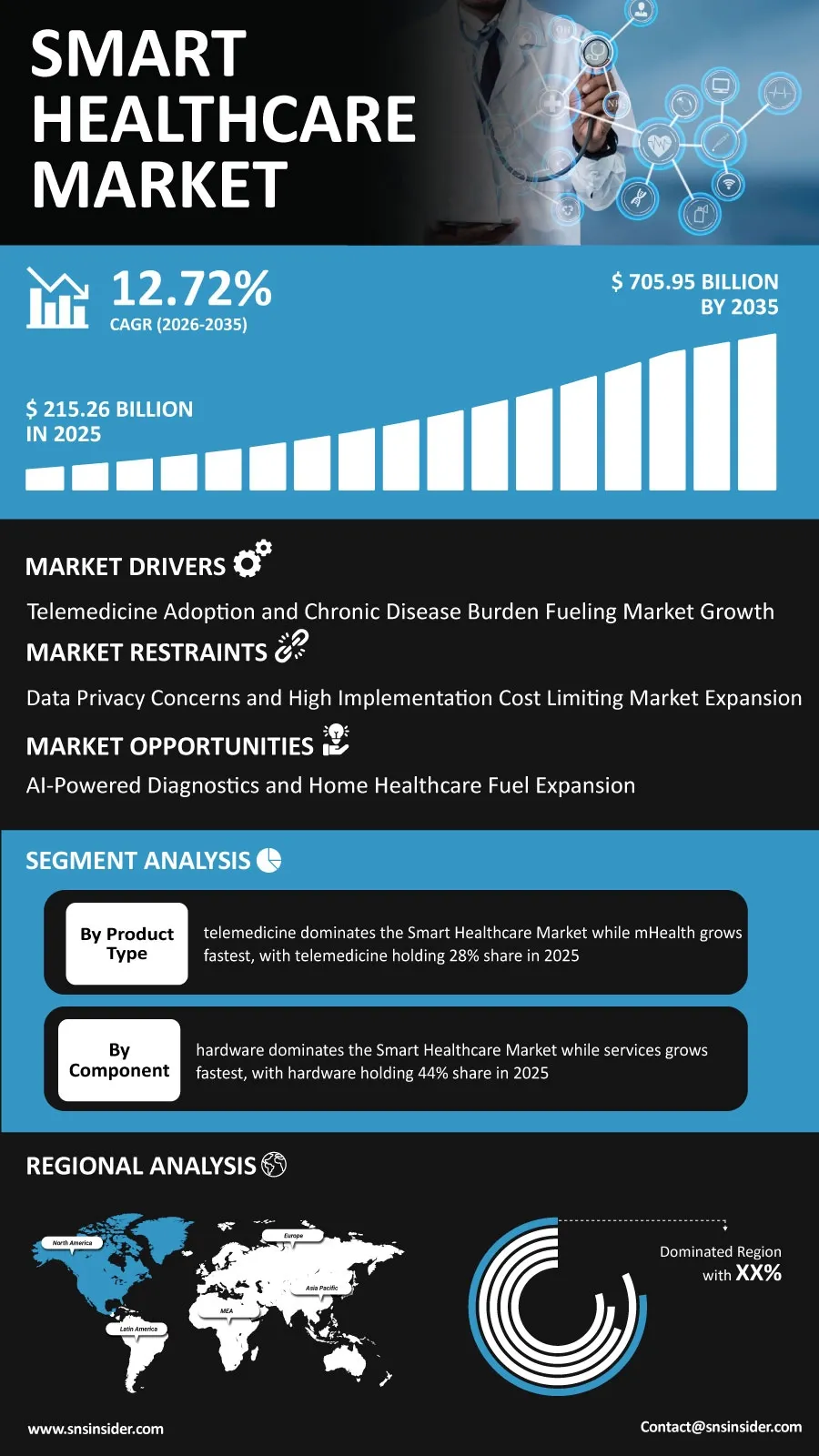
The Smart Healthcare Market is on a steady growth path through 2035, as telemedicine adoption and chronic disease burden continue reshaping how care actually gets delivered worldwide. “According to a recent study by SNS Insider, the Smart Healthcare Market size valued at USD 215.26 billion in 2025, is anticipated to grow to USD 705.95 billion by 2035, registering a CAGR of 12.72% over the 2026-2035 forecast period.”
Healthcare has spent most of its history built around episodic, in-person visits, a model that works reasonably well for acute problems but struggles badly with chronic conditions that need monitoring between appointments rather than only during them. Smart healthcare technology is genuinely rewriting that model, turning passive patients into continuously monitored individuals whose health data reaches providers in real time.
Strategic partnerships between medical device makers, technology companies, and electronic health record vendors are what's actually making this connected care vision function in practice, since no single vendor can deliver the full stack of hardware, software, and data integration that smart healthcare genuinely requires.
To Get Detailed Insights on the Smart Healthcare Market – Request a Sample Report
Connected Care Partnerships Reshape Vendor Strategy
Where healthcare technology vendors once competed primarily on standalone product features, deep integration partnerships between device makers and EHR platforms are increasingly what determines whether a solution actually gets adopted at scale.
This shift is changing how vendors structure their go-to-market strategy, since interoperability capability is becoming as important a competitive factor as core device or software performance used to be on its own.
Companies investing early in these connected care partnerships are positioning themselves to capture hospital system relationships that increasingly favor integrated ecosystems over disconnected point solutions.
Key Market Findings Highlight High-Growth Segments
Telemedicine held the largest share of the Smart Healthcare Market in 2025, at 28%, reflecting years of established use accelerated by growing reimbursement parity with in-person care.
mHealth is the fastest-growing product type, expanding at a 8.56% CAGR, pulled forward by smartphone-based applications bridging clinical care and everyday patient behavior.
By component, hardware led with 44% share in 2025, while services is growing fastest, at an 7.47% CAGR, as providers rely on ongoing technical support and managed care coordination.
Medication management remained the largest application at 26% share, but chronic disease management is climbing fastest, at a 8.20% CAGR, driven by aging populations and rising chronic condition rates.
Clinical Validation and Interoperability Anchor Competitive Positioning
Healthcare providers are increasingly evaluating smart healthcare vendors on clinical validation and interoperability capability nearly as much as on cost, particularly for AI-driven diagnostic and monitoring tools.
Investment in EHR integration and connected device ecosystems is becoming a genuine competitive differentiator among larger vendors, while smaller players without that investment increasingly compete only in narrow, single-function niches.
This divide is expected to sharpen further as hospital systems continue consolidating their technology vendor relationships around fewer, more integrated platforms.
North America Leads as Asia Pacific Grows Fastest
North America holds the largest share of global market revenue, anchored by advanced healthcare infrastructure and strong government support for digitalization. Asia Pacific, meanwhile, is growing fastest, propelled by expanding healthcare infrastructure and rapid deployment of AI-based healthcare systems across Japan, Australia, and India.
Europe holds a meaningful, mature share as well, shaped by comprehensive national healthcare systems and strong regulatory frameworks supporting digital health adoption.
Leading Companies Drive Innovation and Competition
Competition in this market centers on clinical validation, EHR integration capability, and connected device ecosystems nearly as much as on price, with significant partnership and acquisition activity reshaping the competitive landscape.
Some of the major companies that operate in the global smart healthcare market are Koninklijke Philips N.V., International Business Machines Corporation, Cisco Systems, Inc., Alphabet Inc., Microsoft Corporation, GE Healthcare Technologies Inc., Samsung Electronics Co., Ltd., Abbott Laboratories.
An SNS Insider Analyst Parry Kardani commented, “Smart healthcare has moved well past isolated pilot programs, providers now need genuinely integrated ecosystems spanning hardware, software, and data connectivity, and the companies capturing the fastest-growing parts of this market are the ones building deep interoperability partnerships rather than competing on standalone device features alone. As chronic disease burden and hospital-at-home adoption keep expanding globally, vendors with strong clinical validation and integration capability are best positioned to lead.”
About the Author

Get in touch