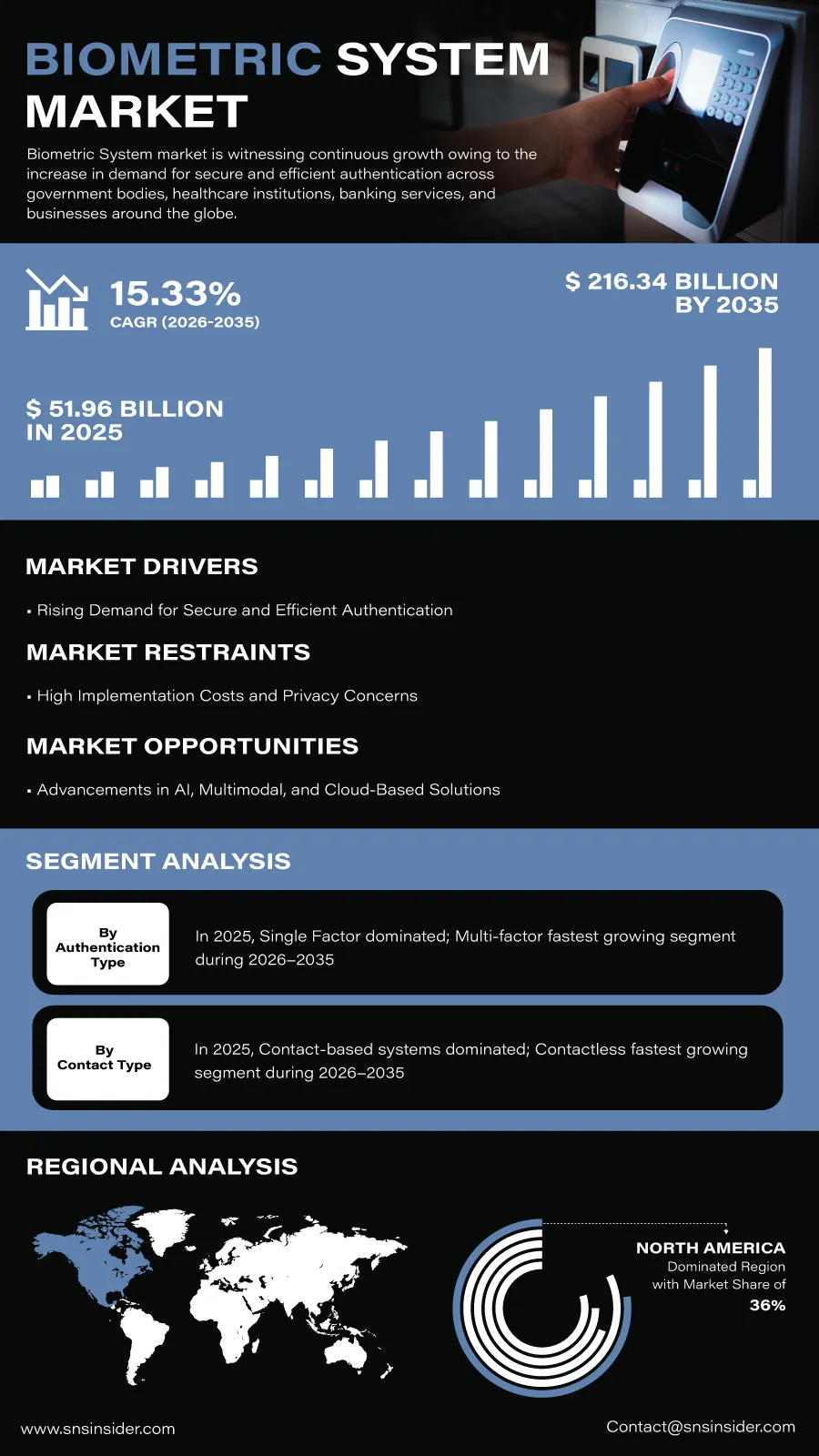
The global Biometric System Market is poised for substantial growth as organizations increasingly prioritize digital identity verification, fraud prevention, and secure access management. “According to a recent study by SNS Insider, the global Biometric System Market size valued at USD 51.96 billion in 2025, is anticipated to grow to USD 216.34 billion by 2035, registering a CAGR of 15.33% over the 2026–2035 forecast period.”
With the increased usage of electronic banking, smart devices, and online government services, there is an ever-increasing need for authentication methods that offer convenience as well as enhanced identity protection. Fingerprint recognition, facial recognition, and iris recognition technologies have become essential components of security strategy in government organizations, financial organizations, hospitals, and businesses.
The advancements in artificial intelligence (AI) and machine learning have contributed to further enhancement of biometrics through improved recognition accuracy and adaptability of the process. Such innovations have prompted organizations to upgrade traditional authentication systems and use password-free security methods.
To Get Detailed Insights on the Biometric System Market – Request a Sample Report
Digital Identity Initiatives Create New Growth Opportunities
Government and businesses are adopting biometric technology to enhance identity management capabilities, facilitate verifications, and minimize vulnerability to security breaches. National identity systems, border control mechanisms, and e-government systems have opened up new areas for companies that can provide scalable biometric platforms.
Another emerging trend that is generating new opportunities for companies in the field is the rise of cloud computing and remote service delivery. Cloud-based biometric software allows businesses to conduct identity verification processes from multiple locations and makes it easier to integrate the system into digital infrastructure.
However, implementation expenses, data protection obligations, and concerns about the storage and misuse of sensitive biometric information remain important challenges. Vendors that combine reliable authentication with robust privacy safeguards and regulatory compliance are likely to gain a competitive advantage.
Key Market Insights Highlight Shifting Demand Patterns
By authentication type, Single-factor authentication was leading the market in 2025, owing to its simplicity, cost-effectiveness, and wide usage in cell phones, laptops, and access control devices. Multi-factor authentication is expected to grow at the highest rate up until 2035, whereby biometric identification will be used along with either passwords, one-time passcodes, or security tokens.
Based on contact type, contact-based systems held the leading position in 2025, benefiting from established fingerprint recognition applications and comparatively economical deployment. Contactless systems are expected to expand more rapidly as facial and iris recognition gain traction across airports, healthcare facilities, commercial buildings, and digital identity services.
By offering, hardware accounted for the largest market share in 2025, reflecting demand for biometric scanners, cameras, sensors, and associated identification equipment. Software is projected to register the fastest growth as AI-powered algorithms, identity analytics, and advanced matching capabilities become increasingly important to authentication performance.
In terms of deployment mode, on-premises solutions led the market in 2025 because organizations handling sensitive information prioritize direct control over infrastructure and data. Cloud-based deployment is expected to grow fastest, driven by scalability, lower infrastructure requirements, and increasing demand for remote verification and software-as-a-service security platforms.
AI and Contactless Verification Reshape Authentication
Biometric security is no longer limited to the traditional fingerprint recognition system but is shifting towards biometric solutions that can process several identity factors. Multimodal authentication, which is based on biometric traits such as facial recognition and fingerprints, allows companies to have other methods of verifying an identity when needed.
Contactless recognition has become more relevant in recent times owing to the need for speedy verification processes in high-foot traffic areas. Software driven by artificial intelligence has been able to help with authentication processes.
North America Leads Market with 36% Share as Asia Pacific Grows at a 17.2% CAGR
North America had a market share of about 36% in 2025, due to the presence of well-established cybersecurity framework, technological advancements, and extensive biometric deployment in the government, banking, and healthcare sectors. The U.S. has been a big player, as the country's market is worth USD 12.50 billion in 2025 and estimated to grow up to USD 30.20 billion by 2035.
The Asia Pacific region is anticipated to grow at a fast pace, with a CAGR of 17.2% up to 2035. Big digital identity programs, increasing adoption of smartphones, growth in digital payments, and increased secure transactions have been driving the regional market growth. Increasing investments in digital government and corporate security solutions are likely to provide growth opportunities in both emerging and developed markets.
Industry Participants Focus on Innovation and Integration
Competitiveness in the biometrics systems industry is increasing because technological companies are producing more reliable recognition systems, highly sophisticated sensors, and comprehensive identity management suites. Technological firms are emphasizing artificial intelligence-based verification processes, multimodal functionalities, contactless mechanisms, and solutions that integrate security and convenience together.
Key companies operating in the global Biometric System Market include Apple Inc., Samsung Electronics, Thales Group, NEC Corporation, HID Global, Crossmatch, Fujitsu, Gemalto, IDEMIA, BioID, Safran Identity & Security, Innovatrics, Suprema, Vision-Box, Aware, Inc., Veridium, SecuGen, ZKTeco, Paravision, and Rank One Computing.
An SNS Insider analyst Sushant Kadam commented, “The growing demand for secure digital identity, expanding government identification programs, and advances in AI-powered recognition are creating significant opportunities for biometric technology providers. Companies that prioritize accuracy, privacy protection, and seamless integration across digital platforms will be well positioned to capitalize on the market’s long-term expansion.”
About the Author

Get in touch