
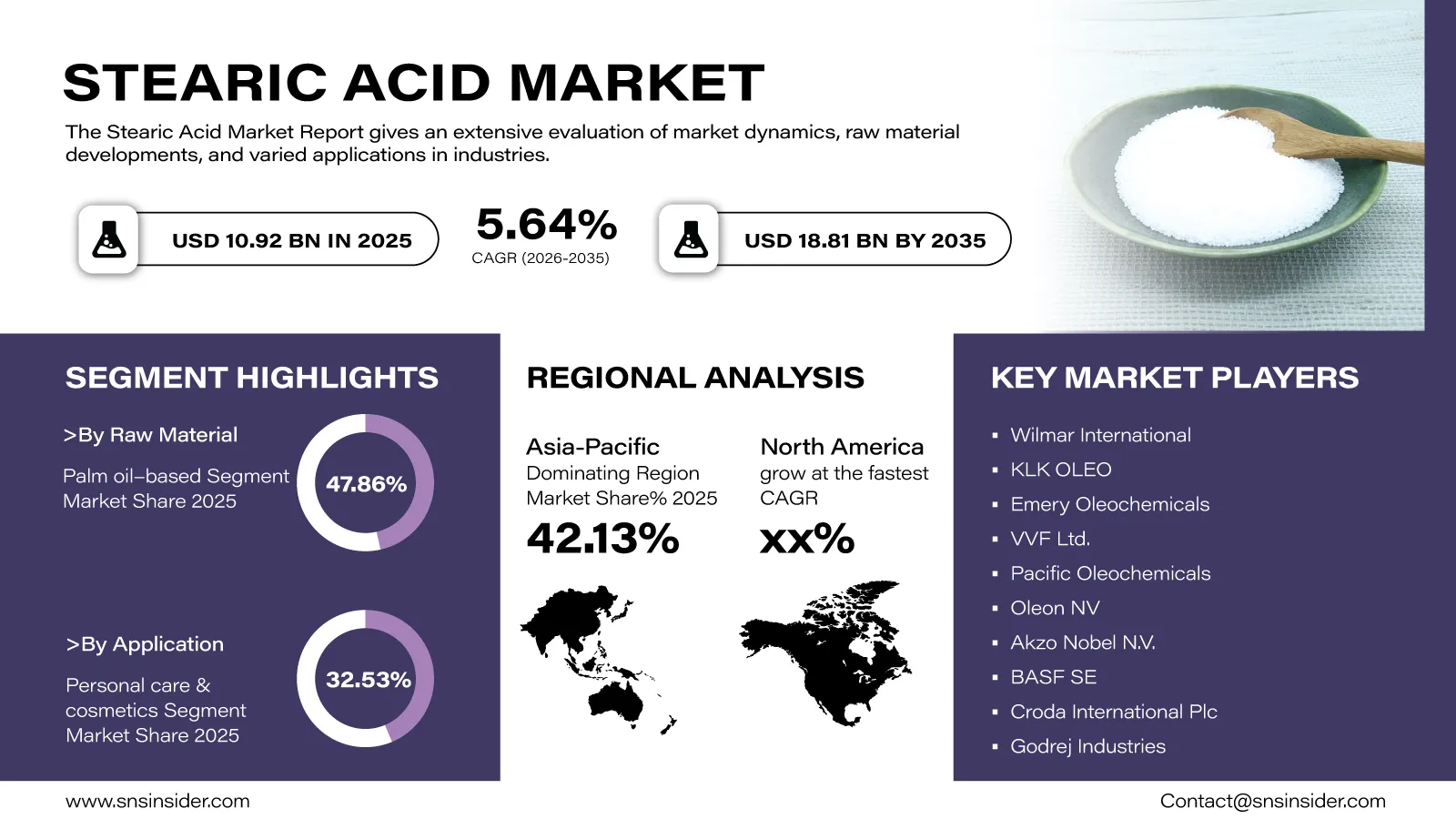
The global Stearic Acid Market is poised for steady expansion through 2035 as manufacturers across consumer goods, healthcare, industrial processing, and specialty chemicals continue increasing the use of bio-based ingredients and multifunctional additives. “According to a recent study by SNS Insider, the global Stearic Acid Market size valued at USD 10.92 billion in 2025, is anticipated to grow to USD 18.81 billion by 2035, registering a CAGR of 5.64% over the 2026–2035 forecast period.”
Increasing focus on sustainable raw material inputs, along with increasing production of personal care products, pharmaceuticals, and industrial formulations, will create positive market conditions for sustained future growth. With companies looking for formulation enhancers that can help them achieve their environmental goals, the significance of stearic acid continues to increase in several end-user industries.
To Get Detailed Insights on the Stearic Acid Market – Request a Free Sample Report
Increased investment in oleochemicals production, development in biobased feedstocks and expansion in manufacturing capacities are making prospects for the industry better. Manufacturers are trying their best to improve the quality of products along with increasing their sustainability in supply chains and sourcing methods.
Bio-Based Manufacturing Trends Strengthen Long-Term Market Outlook
The shift towards renewable chemicals is changing demand dynamics within the global specialty chemicals industry as firms begin using more natural substances in production as a result of increasing pressure through regulations, corporate sustainability efforts, and customer demands.
Stearic acid can gain advantage from the shift because of the diversity of uses in cosmetic formulation, pharmaceutical formulation, food processing, lubricants, plastic, and rubber manufacture. The trend towards clean technology and low carbon emission chain is creating new business opportunities for suppliers by encouraging production and procurement of products in an environmentally friendly manner.
Meanwhile, industrialization trends in emerging economies along with increased expenditures of consumers on cosmetics and healthcare products create additional growth opportunities for manufacturers.
Key Market Insights Reflect Changing Industry Priorities
Of all the categories of raw materials, palm oil-derived stearic acid will constitute 47.86% of the worldwide market revenue in 2025, which will be growing at the fastest pace until 2035 at a CAGR of 5.95% owing to its supply chain network and the increasing preference for renewable oleochemicals.
By application, personal care and cosmetics will contribute 32.53% of the market revenue in 2025 and will also emerge as the fastest-growing segment, with a CAGR of 6.42% on account of rising preferences for skincare, beauty, and hygiene products.
From the end-use point of view, consumer goods will hold 35.68% market share in 2025 as a result of wide usage of the product in household as well as personal care products. At the same time, pharmaceutical and healthcare applications are expected to witness the highest growth rate of 6.95% CAGR during the forecast period.
As far as grade is concerned, industrial grade of stearic acid accounted for 41.03% of market revenue in 2025 because of its wide acceptance in the rubber, plastics, and manufacturing industries. On the other hand, cosmetic grade products will witness the fastest growth with a CAGR of 6.39% owing to the rising demand for premium skincare products.
With regards to product form, flakes will make up 29.66% market revenue in 2025, attributable to its ease in handling and storage, whereas the liquid and molten form is expected to grow at the fastest pace of 7.59% CAGR, supported by continuous processing requirements across modern manufacturing facilities.
Sustainability and Product Innovation Shape Competitive Strategies
Manufacturers are now beginning to invest in technologies that will reduce their environmental impact along with improving their efficiency levels. Sustainably sourced materials, more advanced refinement processes, and increased usage of certified renewable raw materials have become key competitive advantages on the global market.
Moreover, innovations in product development are going beyond industrial uses, and manufacturers are working on producing formulations that meet higher purity standards. Such high added-value products allow manufacturers to comply with more stringent requirements while tapping into more lucrative markets.
Supply chain diversification and investments in regional manufacturing facilities are further helping producers manage raw material volatility and improve long-term supply stability.
Asia-Pacific Leads Global Expansion While North America Advances Premium Applications
Asia-Pacific held a 42.13% share of the global market revenue in 2025 owing to its high oleochemical manufacturing infrastructure, feedstock abundance, and rapid consumer goods sectors expansion. Continuous demand from countries such as China, India, Japan, and Southeast Asia will further strengthen the dominance of the region as sustainable manufacturing receives increased investments.
The North American region is set to exhibit healthy growth in the coming years on account of the rising demand for pharmaceutical ingredients, luxurious cosmetic formulations, and environmentally friendly chemicals. Investments in healthcare and bio-based specialty chemicals will drive the regional growth in the coming years.
Europe still remains one of the significant regions due to the fast-growing regulatory programs promoting sustainable sourcing and production of environmentally friendly oleochemicals.
Latin America and the Middle East & Africa have emerged as regions offering growth prospects owing to industrialization, healthcare spending, and consumer goods manufacturing.
Industry Participants Accelerate Sustainable Oleochemical Development
Competition within the global stearic acid market is increasingly centered on sustainability, production efficiency, and portfolio diversification. Leading manufacturers are strengthening research capabilities, expanding manufacturing capacity, and enhancing supply chain transparency to address growing global demand for bio-based specialty chemicals.
Major companies operating in the global Stearic Acid Market include Wilmar International, KLK OLEO, Emery Oleochemicals, VVF Ltd., Pacific Oleochemicals, Oleon NV, BASF SE, Croda International Plc, Godrej Industries, Kao Corporation, PT Musim Mas, Procter & Gamble Chemicals, Ashland Global Holdings Inc., ChemCeed LLC, and Univar Solutions Inc.
An SNS Insider analyst Himanshu Sharma commented, "Growing demand for sustainable specialty chemicals, expanding healthcare manufacturing, and continued innovation in bio-based raw materials are creating a favorable long-term outlook for the stearic acid market. Companies that prioritize responsible sourcing, product quality, and application-specific innovation are expected to strengthen their competitive position throughout the forecast period."
About the Author

Get in touch




