
Stearic Acid Market Report Scope & Overview:
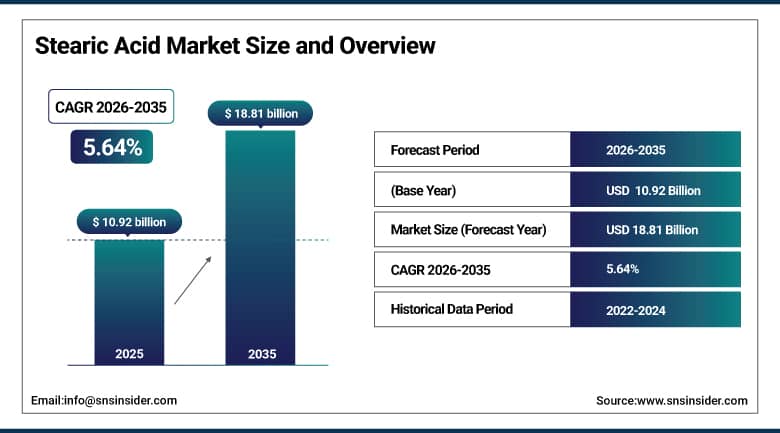
The Stearic Acid Market size is valued at USD 10.92 Billion in 2025 and is projected to reach USD 18.81 Billion by 2035, growing at a CAGR of 5.64% during the forecast period 2026–2035.
The Stearic Acid Market Report gives an extensive evaluation of market dynamics, raw material developments, and varied applications in industries. The rising application of stearic acid in personal care & cosmetics, healthcare and pharmaceuticals, food & beverages, and the rubber & plastics industry are the key factors behind strong market growth during the forecast period of 2026-2035.
Global consumption of Stearic acid exceeded 15 million metric tons in 2025, fueled by rising consumer goods demand and expanding healthcare and industrial infrastructure.
To Get More Information On Stearic Acid Market - Request Free Sample Report
Stearic Acid Market Trends:
-
The market is shifting toward bio-based raw materials such as palm, coconut, and soybean oils.
-
Personal care and cosmetics remain the largest application segment, driving consistent demand.
-
Pharmaceutical and healthcare usage of stearic acid is expanding steadily.
-
Food and beverage industries are adopting stearic acid as an additive and stabilizer.
-
Rubber and plastics industries continue to provide stable industrial demand.
-
Sustainability concerns are pushing companies toward eco-friendly production practices.
-
Cosmetic, pharmaceutical, and food grades are growing faster than industrial grade.
-
Flakes and powder forms dominate usage, while liquid forms are gaining traction in niche applications.
-
Volatility in palm oil prices remains a major challenge for producers.
U.S. Stearic Acid Market Insights:
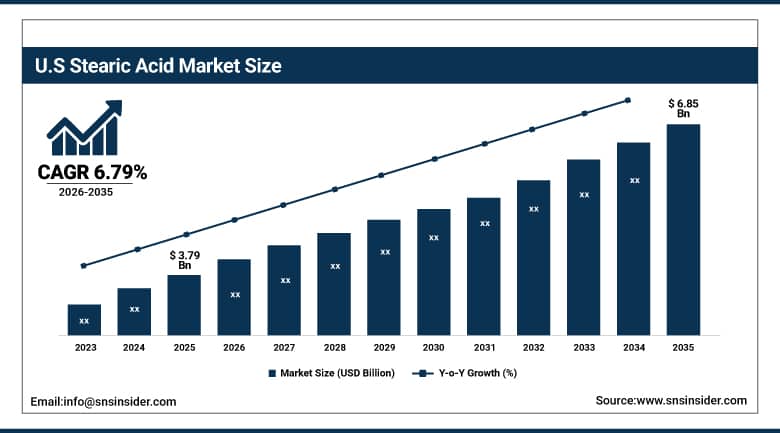
The U.S. Stearic Acid Market is projected to grow from USD 3.79 Billion in 2025 to USD 6.85 Billion by 2035, at a CAGR of 6.79%. Growth in demand will be fueled by growing use in cosmetics and personal care products, increased applications in the pharmaceutical industry, higher consumption in food and beverages, and consistent use in rubber, plastics, and other industries.
Stearic Acid Market Growth Drivers:
-
Rising demand from personal care, rubber, and plastics industries driving stearic acid market growth
The growth in the use of cosmetics and other personal care products, increase in rubber processing requirements, and growth in plastics production have been identified as major factors driving the stearic acid market. The usage of stearic acid in cosmetics as an emulsifying, thickening, and stabilizing agent in products such as soaps, creams, lotions, and deodorants has increased significantly in recent times. Moreover, there is considerable demand for stearic acid from the rubber industry as an activator for vulcanization processes. This is especially the case in the manufacture of tires and industrial rubber items. Growth in the production and processing of plastics has also contributed to its demand as a lubricant and release agent.
Over 60% of stearic acid consumption in 2025 was driven by personal care, rubber processing, and plastics applications, highlighting strong and sustained industrial demand.
Stearic Acid Market Restraints:
-
Stringent sustainability and regulatory pressures on palm oil sourcing, which limit supply flexibility and increase compliance costs for producers.
Fluctuations in raw material availability and pricing, particularly palm oil, tallow, and other vegetable-based feedstocks, are a major restraint for the stearic acid market. Since stearic acid production is highly dependent on oleochemical inputs, any disruption in agricultural output, climate conditions, or supply chain logistics directly impacts production costs and pricing stability. Manufacturers face margin pressure due to unpredictable feedstock costs and increasing competition for palm-derived raw materials across food, biofuel, and chemical industries. Additionally, geopolitical tensions and trade restrictions in key producing regions further contribute to supply uncertainty, limiting consistent market expansion and profitability across the value chain.
Approximately 40% of stearic acid production costs are linked to raw material inputs, making price volatility a critical challenge for industry participants.
Stearic Acid Market Opportunities:
-
Growing shift toward bio-based and sustainable chemicals creating market opportunities
The trend toward bio-based, sustainable and eco-friendly products is likely to create favorable prospects for the growth of the market for stearic acid. Since stearic acid can be produced mostly from natural sources of fat and oil, there are high chances that it will benefit from the increased demand for environmentally-friendly products that substitute petrochemical additives. Many sectors, such as cosmetics, pharma, polymers, and rubber industries, are moving away from conventional approaches and are adopting green chemistry, in order to decrease their carbon footprint and meet new requirements.
Over 65% of future growth opportunities in the stearic acid market between 2026 and 2035 are expected to come from bio‑based raw materials, high‑grade cosmetic and pharmaceutical applications.
Stearic Acid Market Segmentation Analysis:
-
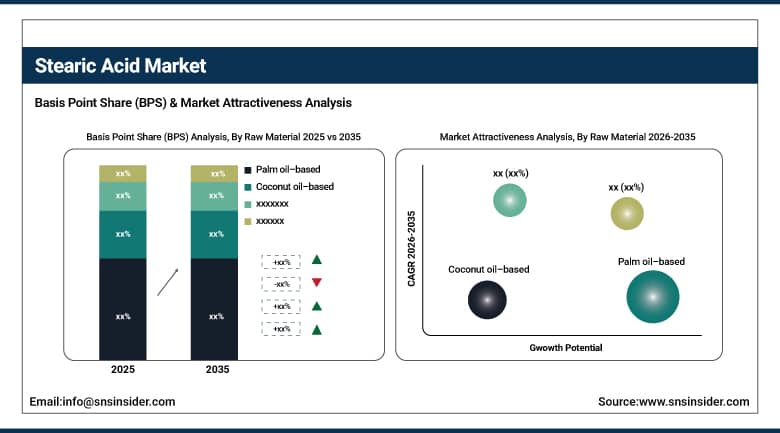
By Raw Material, Palm oil–based held the largest market share of 47.86% in 2025, while they are also expected to grow at the fastest CAGR of 5.95% during 2026–2035.
-
By Application, Personal care & cosmetics dominated with 32.53% market share in 2025, whereas they are also projected to record the fastest CAGR of 6.42% through 2026–2035.
-
By End-Use Industry, Consumer goods industry accounted for the highest market share of 35.68% in 2025, while Pharmaceutical & healthcare industry are expected to grow at the fastest CAGR of 6.95% during the forecast period.
-
By Grade, Industrial grade dominated with a 41.03% share in 2025, while Cosmetic grade is anticipated to expand at the fastest CAGR of 6.39% through 2026–2035.
-
By Form, Flakes held the largest share of 29.66% in 2025, while Liquid / molten form is expected to grow at the fastest CAGR of 7.59% during the forecast period.
By Raw Material, Palm Oil–Based Stearic Acid Dominates and Continues to Grow Rapidly:
The Palm Oil-Based stearic acid sub-segment occupied the dominant share of the market since it was highly available, cheap, and well-supplied throughout major production regions, especially in the Asia-Pacific region. The compound is popular in the manufacturing industry due to its quality, large-scale use, and application in personal care, rubber, and plastic formulations.
The Palm Oil-Based stearic acid is also expected to be the most fastest growing sub-segment due to growing consumer demand for biodegradable and green chemicals. Growing usage of personal care products, increasing production of rubber and tires, and growing utilization in plastic and lubricant applications are driving this trend.
By Application, Personal Care & Cosmetics Dominates and Continues to Grow Rapidly:
Personal Care & Cosmetics segment dominate the market due to the wide application of stearic acid in soaps, creams, lotions, shampoos, deodorants, etc. This is mainly owing to the functional aspects such as its property as emulsifying, stabilizing, and thickening agents in cosmetic products. Increasing demand for skincare, grooming, and hygiene products in the global market would ensure a stable and consistent growth of stearic acid.
Moreover, the Personal Care & Cosmetics sector was also noted to be the fastest-growing segment due to the increasing awareness among consumers about skincare, disposable incomes, and development of beauty and personal care industries in developing nations. In addition, growing trend toward natural, safe, and biodegradable substances in cosmetics was further prompting producers to use better grades of stearic acid in products.
By End-Use Industry, Consumer Goods Industry Dominates While Pharmaceutical & Healthcare Industry Grows Rapidly:
Consumer Goods emerged as the dominant segment due to the presence of consistent demand from personal care, cosmetic, soap, and household product manufacturers. The application of stearic acid in these industries for emulsification, viscosity enhancement, and stabilization makes it essential in the production process, ensuring the dominance of this category in the stearic acid market.
Pharmaceuticals & Healthcare has been identified as the fastest-growing segment due to increasing demand for stearic acid as an excipient in tablet formulation, ointment, and drug delivery systems. High investments made by governments toward improving healthcare infrastructure along with rapid growth in generic drug manufacturing and development of novel formulations have played a vital role in boosting the uptake.
By Grade, Industrial Grade Dominates While Cosmetic Grade Grows Rapidly:
Industrial Grade stearic acid segment dominates the market due to it found widespread application in processes related to rubber, plastic products, lubricants, and various industrial processes. The economic nature and easy availability of this product make it the ideal product for industrial purposes and its demand remains high due to its application in tire production.
The Cosmetic Grade segment is expected to have the fastest growth rate in the coming years due to the growing demand for personal care and skincare products, including creams, lotions, soaps, and deodorants. An increase in the preference of consumers for high-quality and safer cosmetic products has led to increasing usage of cosmetic grade stearic acid in cosmetics formulation process.
By Form, Flakes Dominate While Liquid / Molten Form Grows Rapidly:
Flakes segment dominated the market due to ease of handling, storage stability, and wide usage across industrial applications such as rubber processing, plastics, and cosmetics manufacturing. Flake form allows efficient blending and dosing in large-scale production processes, making it the most preferred format for bulk buyers. Its logistical advantages and compatibility with existing supply chains continue to support its dominance.
Liquid / molten form is the fastest-growing segment, driven by increasing demand for process efficiency and direct integration into manufacturing systems. It is widely used in continuous production processes in chemicals, plastics, and personal care industries where faster mixing and reduced processing time are critical.
Stearic Acid Market Regional Analysis:
Asia-Pacific Stearic Acid Market Insights:
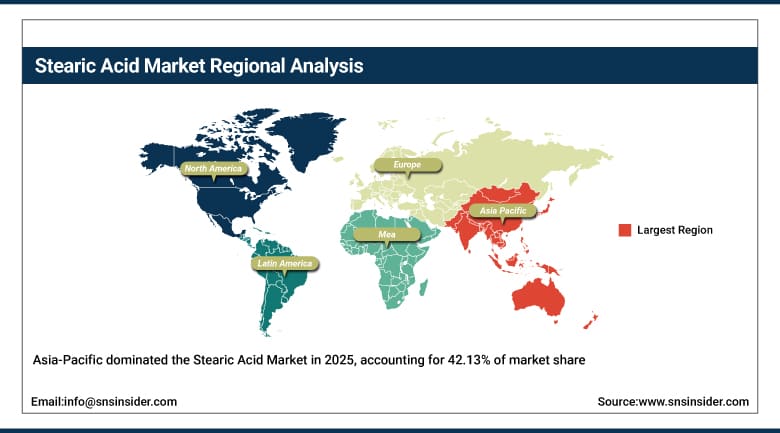
Asia-Pacific Region is the dominating region, which holds the highest market share at 42.13%, and this is the fastest-growing region, which is projected to grow at a CAGR of 6.41% over 2026–2035. This growth is supported by high demand for biopolymers in personal care products, cosmetics, rubber, and plastics segments in the countries such as China, India, Japan, and Southeast Asian nations. Consumer purchasing power and health care facilities, along with the industrialization of the economies, will speed up their adoption. Asia-Pacific benefits from strong government support for sustainable oleochemical production, with investments in bio-based feedstock and eco-friendly manufacturing practices further strengthening the region’s competitive advantage.
Get Customized Report as Per Your Business Requirement - Enquiry Now
China Stearic Acid Market Insights:
China leads the stearic acid market in the Asia-Pacific region, thanks to huge imports of palm oil and sound manufacturing facilities. Cosmetics, medicines, and industrial uses are driving the demand, which is gaining rapid acceptance of advanced formulations. The growth in consumer products industry, rising demand for health care, and sustainable manufacturing are paving way for China to emerge as an important player in market growth. With advanced infrastructure and rising disposable income levels, China is anticipated to retain its dominance, contributing significantly to market growth in Asia-Pacific.
North America Stearic Acid Market Insights:
North America is a fully developed yet continually expanding market and forecasted to grow steadily up to 2035. In terms of consumption, North America is led by the United States, wherein application for pharmaceuticals, healthcare, and cosmetics is prevalent. There is steady growth on the part of Canada in its food & beverages use application. Emphasis on sustainable and bio feedstock has shifted the production landscape. Industrial applications in rubber & plastics will remain constant; however, future growth will come from cosmetics & pharmaceutical grades.
United States Stearic Acid Market Insights:
The U.S. is responsible for taking up an important share of the North American consumption for stearic acid. Stearic acid demand is constant among the pharmaceutical, cosmetics, and industrial sectors owing to investments made in sustainable resources and FDA compliance. While the industrial segment has maintained its position, the cosmetics and pharmaceuticals have been growing at a quicker pace due to changes in consumer lifestyle.
Europe Stearic Acid Market Insights:
The European stearic acid industry is dominated by usage in the cosmetic, personal care, and healthcare sector, with consistent demand for the product in Germany, France, and the United Kingdom. Environmental regulations on palm oil procurement are boosting demand for environmentally friendly and biodegradable options. Although industrial demand in rubber and plastic segments is consistent, significant growth will be seen in cosmetic and pharmaceutical products.
Germany Stearic Acid Market Insights:
Germany is a major player in the stearic acid market in Europe due to high demands in the cosmetics sector, the healthcare segment, and the industrial sector. The focus on sustainability and environmental regulations in the country will result in producers turning to bio-based materials. There will be higher demand for pharmaceutical-grade stearic acid and cosmetic-grade stearic acid compared to that for industrial applications, thanks to lifestyle changes and investment in healthcare. Germany will lead Europe in shifting to sustainable stearic acid until 2035.
Latin America Stearic Acid Market Insights:
The Latin American stearic acid industry is mainly fueled by rising demands from food and beverages, healthcare, and cosmetics industries. Brazil remains at the forefront of stearic acid production due to its abundant palm oil and increased industrial usage. Cosmetics and personal care sectors have also been gaining momentum owing to the steady increase in disposable incomes. Demand from the pharmaceutical industry continues to grow. The dependence on imported stearic acid of high quality in the region offers room for growth.
Middle East & Africa Stearic Acid Market Insights:
The Middle East & Africa stearic acid industry enjoys healthy support due to escalating demand for its application in food additives, industrial manufacturing, and consumer products. Healthcare industry expansion coupled with increased usage of cosmetics and pharmaceuticals is driving demand. Imports have been predominant, but investments into local manufacture are on the rise. Usage in industries is significant; however, usage in cosmetics and pharmaceuticals is on an upward trend.
Stearic Acid Market Competitive Landscape:
Wilmar International
Wilmar International is an agribusiness corporation that ranks high among the biggest players in the industry and also produces oleochemicals including stearic acid. The company has a wide range of fatty acids, which are primarily extracted from palm and palm kernel oils using efficient splitting and distillation techniques. The products produced by Wilmar include stearic acid used in the manufacture of rubber products, candles, cosmetics, soaps, and metal soaps. Wilmar International has a global presence and dominates the Asian Pacific region.
-
In September 2025, Wilmar reported steady growth in its oleochemicals division, highlighting sustainability initiatives and expanding production capacity to meet rising demand for bio-based stearic acid across Asia-Pacific markets.
KLK OLEO
Wilmar International is a multinational agri-food corporation that has its place in the top ranks of the largest companies in the sector. It also deals with oleochemical products such as stearic acid. Wilmar International has an extensive selection of fatty acids obtained mainly from palm oil through effective splitting and distillation methods. The products offered by Wilmar International include stearic acid for making rubber products, candles, cosmetics, soaps, and metal soaps. Wilmar International operates internationally but controls the Asian Pacific market.
-
In April 2025, KLK OLEO has expanded its sustainable oleochemical portfolio, focusing on bio-based surfactants and fatty acids, while strengthening its supply chain to meet rising demand in personal care and industrial applications.
Emery Oleochemicals
Emery Oleochemicals was established in 1840 and is known as an innovator in natural products chemistry and being one of the biggest manufacturers of stearic acid in the world. Emery Oleochemicals’ OleoBasics business unit provides fatty acids sourced from sustainable oils and fats for application in various industries, such as plastic, rubber, cosmetics, and pharmaceuticals. Emery Oleochemicals enjoys a good reputation based on technical knowledge and a commitment to sustainability and product branding (EMERY and EMERSOL).
-
In December 2025, Emery Oleochemicals appointed Min Chong as Group CEO and achieved ISO 50001 certification, reinforcing its commitment to energy efficiency and sustainable oleochemical production.
Stearic Acid Market Key Players:
Some of the Stearic Acid Market Companies are:
-
Wilmar International
-
KLK OLEO
-
Emery Oleochemicals
-
VVF Ltd.
-
Pacific Oleochemicals
-
Oleon NV
-
Akzo Nobel N.V.
-
BASF SE
-
Croda International Plc
-
Godrej Industries
-
PT Sumi Asih Oleochemicals
-
Kao Corporation
-
Procter & Gamble Chemicals
-
Acme-Hardesty Co.
-
3F Industries Ltd.
-
ChemCeed LLC
-
Stephan Company
-
PT Musim Mas
-
Univar Solutions Inc.
-
Ashland Global Holdings Inc.
| Report Attributes | Details |
|---|---|
| Market Size in 2025 | USD 10.92 Billion |
| Market Size by 2035 | USD 18.81 Billion |
| CAGR | CAGR of 5.64% From 2026 to 2035 |
| Base Year | 2025 |
| Forecast Period | 2026-2035 |
| Historical Data | 2022-2024 |
| Report Scope & Coverage | Market Size, Segments Analysis, Competitive Landscape, Regional Analysis, DROC & SWOT Analysis, Forecast Outlook |
| Key Segments | • By Raw Material (Palm Oil–Based, Tallow (Animal Fat)–Based, Coconut Oil–Based, Soybean Oil–Based, Synthetic Petroleum–Based, Others), • By Application (Personal Care & Cosmetics, Rubber Processing, Plastics & Polymers, Pharmaceuticals, Candles & Surfactants Production, Others), • By End-Use Industry (Consumer Goods Industry, Automotive & Tire Industry, Pharmaceutical & Healthcare Industry, Chemical & Industrial Manufacturing, Food & Beverage Additives Industry, Others), • By Grade (Industrial Grade, Cosmetic Grade, Pharmaceutical Grade, Food Grade, Others), by Form (Flakes, Powder, Beads/Pellets, Liquid/Molten Form, Others) |
| Regional Analysis/Coverage | North America (US, Canada), Europe (Germany, UK, France, Italy, Spain, Russia, Poland, Rest of Europe), Asia Pacific (China, India, Japan, South Korea, Australia, ASEAN Countries, Rest of Asia Pacific), Middle East & Africa (UAE, Saudi Arabia, Qatar, South Africa, Rest of Middle East & Africa), Latin America (Brazil, Argentina, Mexico, Colombia, Rest of Latin America). |
| Company Profiles | Wilmar International, KLK OLEO, Emery Oleochemicals, VVF Ltd., Pacific Oleochemicals, Oleon NV, Akzo Nobel N.V., BASF SE, Croda International Plc, Godrej Industries, PT Sumi Asih Oleochemicals, Kao Corporation, Procter & Gamble Chemicals, Acme-Hardesty Co., 3F Industries Ltd., ChemCeed LLC, Stephan Company, PT Musim Mas, Univar Solutions Inc., Ashland Global Holdings Inc. |

Frequently Asked Questions
Asia-Pacific dominated with a 42.13% share in 2025, while it is also the fastest-growing region, expected to expand at a CAGR of 6.41% during 2026–2035.
Industrial grade dominated with a 41.03% share in 2025, while Cosmetic grade is projected to grow at the fastest CAGR of 6.39% during 2026–2035.
Growth is driven by rising demand for personal care and cosmetics, expanding use in pharmaceuticals and healthcare, increasing consumption in the food and beverage industry.
The market is valued at USD 10.92 Billion in 2025 and is projected to reach USD 18.81 Billion by 2035.
The Stearic Acid Market is projected to grow at a CAGR of 5.64% during 2026–2035.
