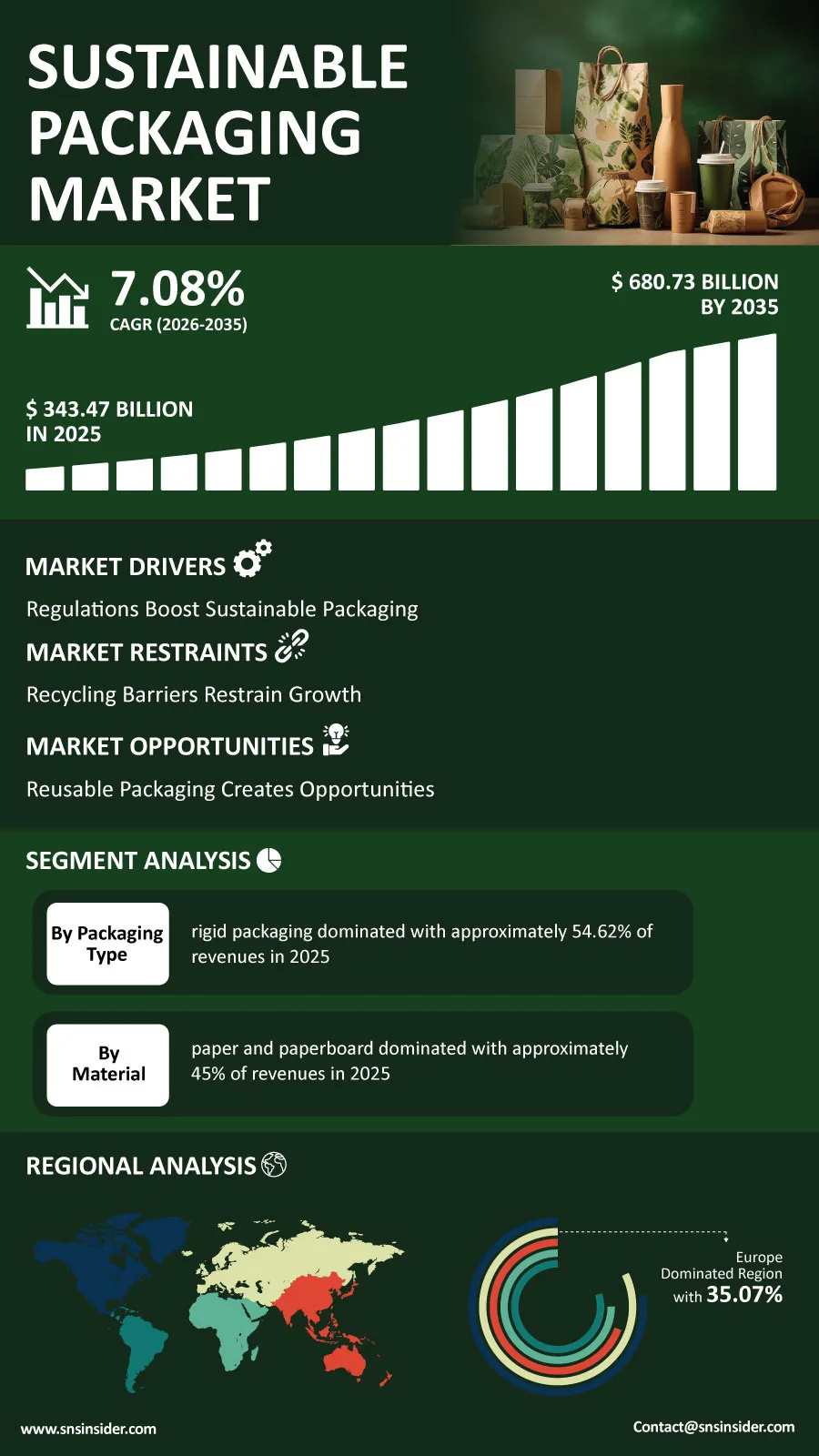
The global Sustainable Packaging Market is gaining substantial momentum as companies across food, beverage, healthcare, retail and e-commerce business line hasty accelerate the adoption of sustainable packaging materials. “According to a recent study by SNS Insider, the global Sustainable Packaging Market size valued at USD 343.47 Billion in 2025, is anticipated to grow to USD 680.73 Billion by 2035, registering a CAGR of 7.08% over the 2026–2035 forecast period.”
Increasing regulatory pressure towards reducing plastic waste is further driving the need for sustainable and eco-friendly products in packaging globally as consumers are leaning towards more environmentally friendly products. Governments are passing stricter recycling targets and EPRs that push producers to swap conventional plastic use with recycled, biodegradable or non-biodegradable but reusable substitutes. Meanwhile, multinational brands are boosting the sustainability ambition with circular packaging systems and renewable materials.
Technologies such as bio-based polymers, recycled plastics, high-performance paper packaging and chemical recycling technology are advancing rapidly creating even more commercial opportunities. These innovations will help manufacturers achieve better package performance, while lowering carbon emissions and advancing the world toward a more sustainable future.
To Get Detailed Insights on the Sustainable Packaging Market – Request a Sample Report
Circular Economy Investments and Eco-Friendly Materials Create Long-Term Growth Opportunities
Corporate sustainability programs and government-supported environmental regulations are creating new catalysts throughout the packaging value chain. They have increased their investments in renewable raw materials, recycled-content packaging and reusable delivery systems in response to changing regulatory demands and consumer expectations.
According to Smithers, the growth of online shopping is fueling demand for light-weight corrugated packaging and recyclable protective products, paper-based cushions, and right-sized shipping material. Elsewhere, greater barrier coatings and fibre-based packaging technology are enabling paper products to consolidate share from plastic packaging in food, drink & home care applications without sacrificing protection of the product inside.
Key Market Insights Highlight Shifting Demand Patterns
By packaging type, Rigid Packaging was estimated to encompass around 54.62% share of global market revenue in 2025 owing to prevailing acceptance of recyclable glass, metal and paperboard packaging solutions. Through 2035, Flexible Packaging is projected to post the fastest growth as manufacturers roll-out recyclable mono-material films, compostable pouches, and lightweight packaging formats.
Paper & Paperboard accounted for nearly 45% of total revenue by material in 2025 due to strong acceptability, recyclability and renewable sourcing among consumers. The highest growth rate is expected for bioplastics during the forecast period due to the increasing adoption of compostable and bio-based materials by industries.
By way of process, in 2025 Recycled Packaging had the largest market share revenue at around 41.36% and was also forecast to be the fastest growing segment from 2026-2035. On the basis of end-user industry, Food & Beverages held a market share of 34.58% in 2022, while growth is expected to be the fastest for E-commerce as a result of sustained expansion in online retail logistics.
Material Innovation Accelerates Packaging Transformation
Sustainable packaging continues to evolve with technology enabling manufacturers to engineer sustainable materials that offer better strength, shelf life, and recyclability. Learn about innovations in high-barrier paper packaging, compostable polymers, and recycled-content plastics including fiber-based sustainable packaging systems in several key global industries.
Packaging firms are also increasingly leveraging digital design tools, lightweight engineering and advanced recycling technologies to maximise resource efficiency while minimising production waste. With the help of these developments, companies are now able to meet sustainability targets without compromising on packaging performance or convenience for consumers.
Europe Accounted for 35.07% of Global Market Revenue in 2025; Asia Pacific to Register the Fastest Growth Through 2035
In 2025 the largest regional market in Europe held approximately 35.07% of global revenue. Robust environmental legislation, circular economy policies, recycled-content mandates and mass adoption of sustainable packaging standards reaffirm the region's leading position.
Asia Pacific is also anticipated to be the fastest-growing regional market up to 2035, due to presence of increasing manufacturing base, growing awareness for environmental sustainability and stringent packaging regulations along with rising investments in sustainable materials across China, India, Japan & South Korea. The increasing urbanization and rapid rise of e-commerce are likely to drive the local demand at an even faster pace.
Industry Participants Focus on Innovation and Circular Packaging Solutions
The sustainable packaging arena continues to be very dynamic, with leading organizations making investments in recyclable materials, renewable packaging technologies, advanced recycling facilities and circular economy initiatives. Long-term growth strategies still revolve around strategic partnerships, product innovation and adding to manufacturing capabilities.
Key companies operating in the global Sustainable Packaging Market include Amcor plc, Sealed Air Corporation, Smurfit Kappa Group plc, Mondi plc, DS Smith plc, Berry Global Group Inc., Tetra Pak International SA, Huhtamaki Oyj, Graphic Packaging Holding Company, International Paper Company, Sonoco Products Company, WestRock Company, Ardagh Group SA, Ball Corporation, Crown Holdings Inc., BASF SE, NatureWorks LLC, Novamont SpA, TotalEnergies Corbion BV, and Carbios SA.
An SNS Insider analyst Himanshu Sharma commented, "Global demand for sustainable packaging is being driven by the convergence of environmental regulation, corporate ESG commitments, and changing consumer purchasing behavior. Companies investing in recyclable materials, renewable feedstocks, advanced recycling technologies, and circular packaging systems are expected to strengthen their competitive position as sustainability becomes a core requirement across global supply chains."
About the Author

Get in touch