
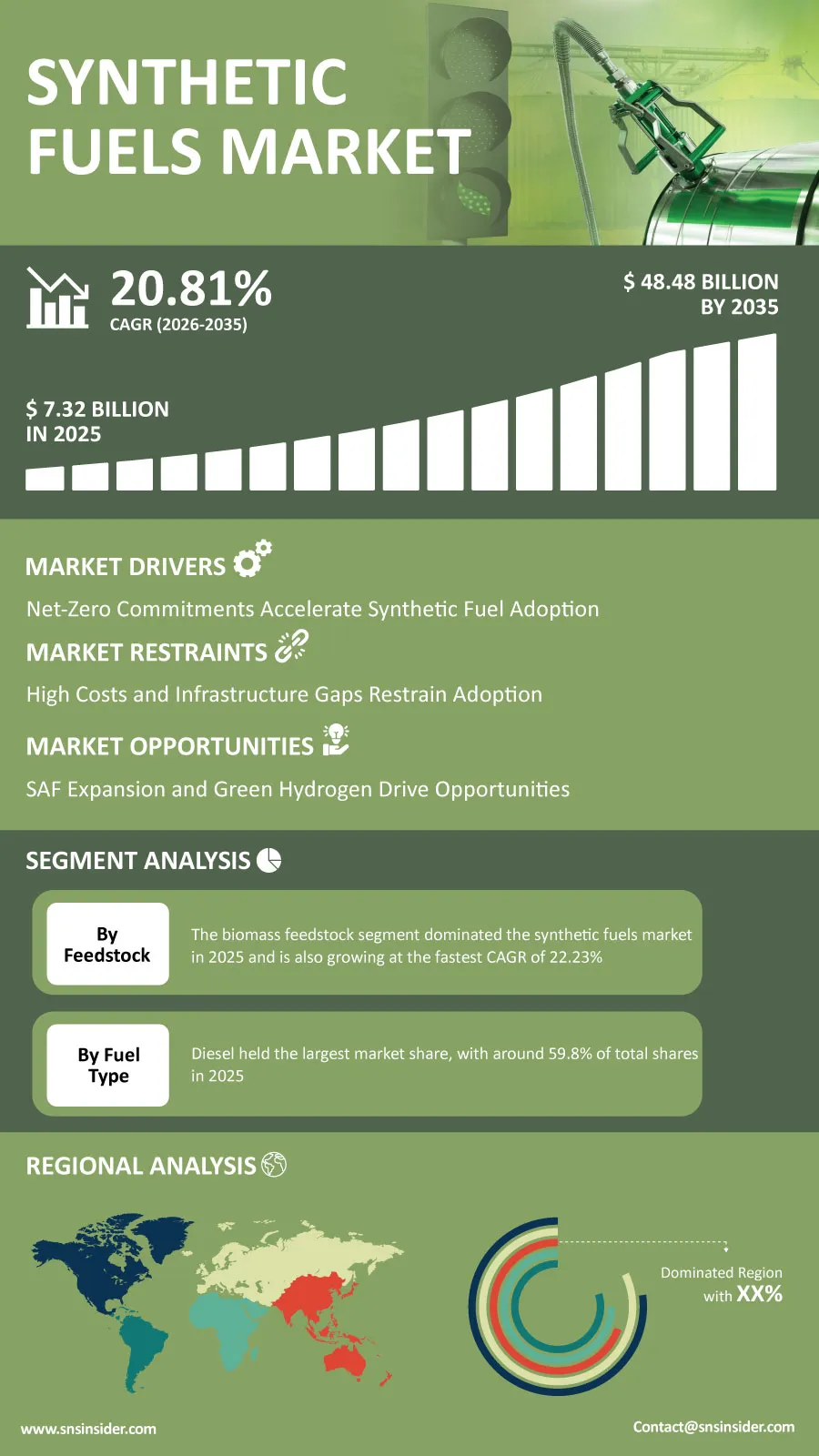
The global market for synthetic fuels is experiencing commercialization as there are increased investments by various governments, energy firms, and industrial segments in low carbon fuels to fulfill their objectives. “According to a recent study by SNS Insider, the global Synthetic Fuels Market size valued at USD 7.32 Billion in 2025, is anticipated to grow to USD 48.48 Billion by 2035, registering a CAGR of 20.81% over the 2026–2035 forecast period.”
The increasing pressure on hard-to-electrify sectors from aviation and shipping to heavy-duty transportation and industrial manufacturing has rapidly elevated synthetic fuels in demand. Recent progress in the production of renewable hydrogen and companies introducing carbon capture technologies and new Power-to-Liquid (PtL) processes means production efficiency is increasing while attractive pathways to net-zero through commercialising emission-free liquid fuels are being developed.
The industry players have also received support through the government policies for incentives, clean fuel mandate and growing renewable energy resources. Over time as the costs of production fall through technological advances, synthetic fuels will play a larger role in leading the global energy transition.
To Get Detailed Insights on the Synthetic Fuels Market – Request a Sample Report
Green Hydrogen and Sustainable Aviation Investments Unlock Long-Term Growth Opportunities
The dictum is the momentum across the synthetic fuels value chain is picking up pace with cleaner energy projects being pursued both by public and private investors. By harnessing renewable electricity and captured carbon dioxide, e-fuels are now set for mass production to substitute conventional fossil fuels in a way which does not necessitate substantial changes to current engines or fuelincurring infrastructure.
Within the aviation sector, this opportunity area continues to be one of the most robust as airlines seek practical ways to reduce lifecycle emissions but recovery is expected to take more time with continually tightening environmental regulations. Long-term agreements between fuel producers, airlines and technology developers are scaling sustainable aviation fuel (SAF) production.
Manufacturers are increasingly realising cost reductions from producing renewable hydrogen, deploying carbon utilization technologies and employing continuous improvements in electrolyzer efficiency, making investments commercially viable at scale across North America, Europe and Asia Pacific.
Key Market Insights Highlight Rapid Technology Adoption
The Biomass segment accounted for more than a fifth of the global biofuels market in 2025 by feedstock and will continue to grow at the fastest rate, with a CAGR of 22.23% during 2023–2035. The rising availability of agricultural residues, waste from forestry and renewable biomass resources continues to bolster production of Biomass-to-Liquid (BTL) fuel across the globe.
Synthetic Diesel accounted for around 59.8% of the market revenue by fuel type in 2025 facilitated by compatibility with existing transportation infrastructure and diesel engines. Kerosene/Sustainable Aviation Fuel (SAF) is forecast to be the fastest growing, backed by global airline decarbonization targets and legislative blending mandates for aviation fuel.
By End use, Transportation was the largest application segment and is expected to dominate in 2025 as government and fleet operators shift towards clean alternatives for road, rail, maritime & logistic operations. Aviation is anticipated to generate the highest revenue growth, in terms of CAGR, throughout the forecast period owing to continuing international carbon reduction commitments fuelling demand for synthetic jet fuel.
Advanced Fuel Technologies Accelerate Industry Transformation
Innovation is still at the heart of how synthetic fuels develop. Companies are serving to merge renewable hydrogen production with carbon capture and utilisation (CCU) systems to produce low-carbon liquid fuels that could allow them to supply their present transportation networks.
However, technological improvements in Fischer-Tropsch synthesis and Power-to-Liquid conversion processes, as well as advanced catalyst developments coupled with ongoing digital process optimization are steadily increasing efficiency of conversions at reduced production costs. Added justification is also the raising demand for sustainable transportation fuels globally as manufacturers expand pilot facilities into commercial-scale operations.
Increasing collaboration between energy companies, auto manufacturers, aviation interests and research institutions will hasten commercialization while enhancing long-term supply chain resilience.
North America Leads Fastest Growth as Asia Pacific and Europe Accelerate Global E-Fuels Market Expansion Through 2035
Based on region, the market in North America is expected to witness the highest CAGR during 2023-2030 due to increasing clean fuel production incentives along with growing renewable hydrogen projects and government-supported sustainable aviation fuel (SAF) initiatives. The continuous investment augmentation in the defense, transportation, and industrial domains further fuels the regional market expansion.
Asia Pacific is experiencing significant development as China, Japan, South Korea and India improve payable on investments in hydrogen related resources and renewable energy sources like synthetic fuel manufacturing. Stronger long-term growth prospects across the region due to rising energy demand, favourable carbon neutrality policies and increasing industrial decarbonization efforts.
Europe retains a critical role via ambitious climate policy initiatives, green aviation legislation and significant investments in e-fuels and renewable hydrogen technologies while emerging markets around the Middle East, Africa, and Latin America are utilizing energy abundance to kick-start future supply capabilities.
Industry Participants Expand Production Capacity Through Innovation
The competition in the Global Synthetic Fuels Market is getting tougher as the top players make investments in renewable hydrogen, sustainable aviation fuel production, carbon capture, and synthetic fuel plants. Through collaboration, technology licensing, and long-term supply deals, the manufacturers are achieving commercialization of their products and improving their global production chains.
Key companies operating in the global Synthetic Fuels Market include Sasol Limited, Shell plc, ExxonMobil Corporation, TotalEnergies SE, Neste Corporation, Chevron Renewable Energy Group, BP plc, LanzaTech, Infinium, Synhelion SA, Topsoe A/S, Air Products and Chemicals, Inc., Linde Engineering, Comstock Fuels, Dakota Gasification Company, Petro SA, Synfuels China, Maire Tecnimont S.p.A., BTG Biomass Technology Group, and Carbon Engineering.
An SNS Insider analyst Himanshu Sharma commented, "Rapid progress in renewable hydrogen, carbon capture technologies, and sustainable aviation fuel production is transforming synthetic fuels from demonstration projects into commercially scalable energy solutions. Organizations investing in advanced production technologies, strategic partnerships, and integrated clean energy infrastructure are expected to gain a significant competitive advantage as global decarbonization efforts accelerate through 2035."
About the Author

Get in touch




