
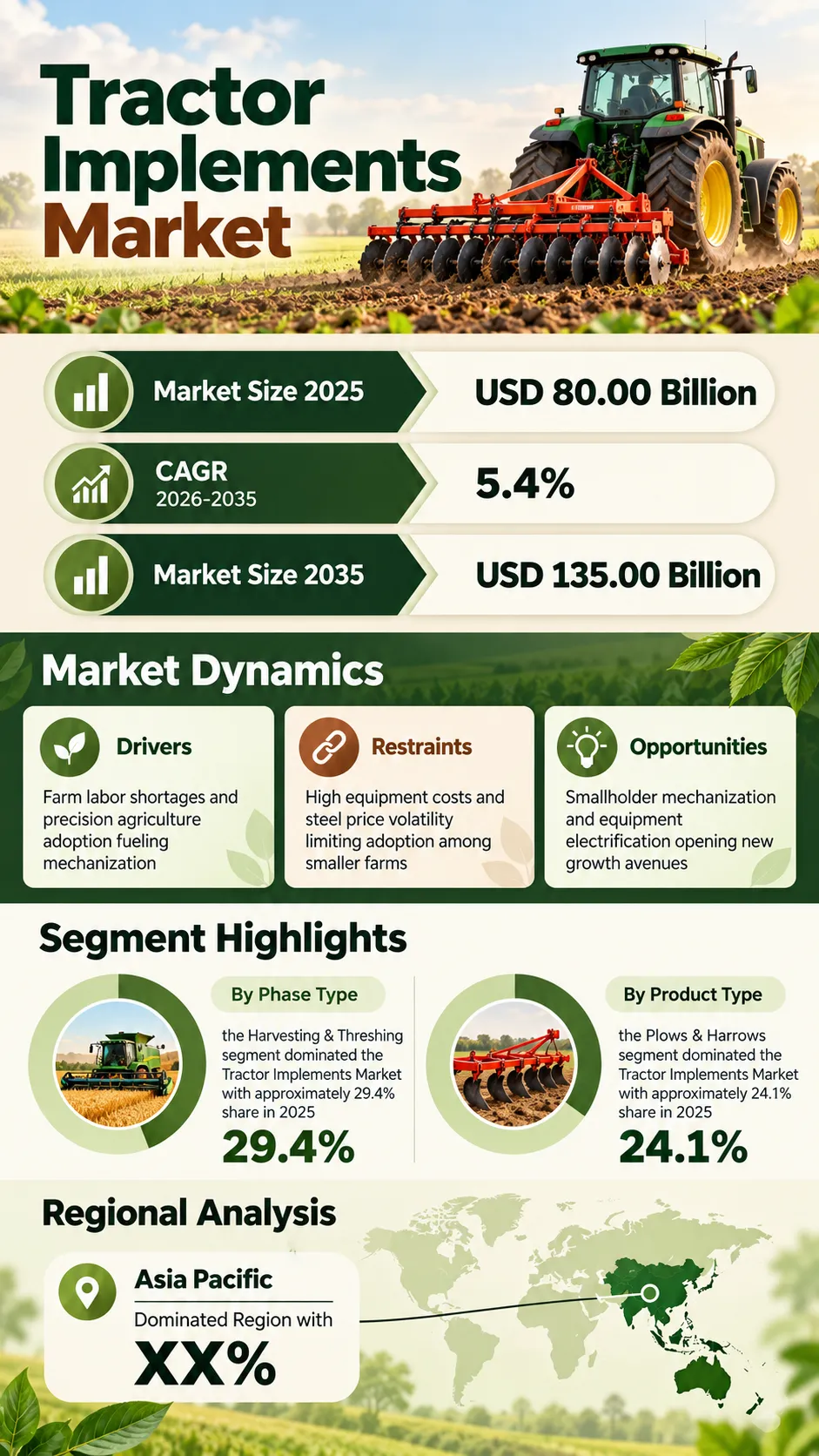
The global Tractor Implements Market is set for steady expansion as farms of every size lean further into mechanized, precision-equipped equipment to manage labor shortages and improve yield. “According to a recent study by SNS Insider, the global Tractor Implements Market size valued at USD 80.00 billion in 2025, is anticipated to grow to USD 135.00 billion by 2035, registering a CAGR of 5.4% over the 2026-2035 forecast period.”
There have been steady changes within implement engineering and precision-agriculture technology over time, due to which many manufacturers aiming at improved yield outcomes and labor-cost reduction can take advantage of this trend. This includes the need for more sensor-integrated, software-connected equipment that gives farmers confidence in yield and input-cost improvements across a wide range of farm sizes. This applies in situations where tractor implements are used across land development, sowing, harvesting, and crop protection applications.
Manufacturers are constantly working to improve equipment precision and durability in order to meet various needs of commercial and smallholder farmers worldwide.
To Get Detailed Insights on the Tractor Implements Market – Request a Sample Report
Precision Agriculture and Smallholder Mechanization Ecosystems Create New Demand
The tractor implements market has evolved from basic mechanical attachments into a broader mix of sensor-integrated, software-connected equipment built for precision farming. The growing investment in GPS guidance, variable-rate application technology, and multi-format equipment development has required the development of more efficient and reliable production systems.
New precision technology and electrification approaches can improve yield outcomes, reduce input waste, and expand the range of farm sizes implements can serve efficiently. This gives manufacturers the possibility to be more effective when reaching commercial and smallholder farmers and strengthening claims around productivity and resource efficiency.
Equipment manufacturers, agricultural technology firms, and farm dealers are increasingly cooperating due to the growing interest in developing future solutions for precise, labor-efficient farm mechanization.
Key Market Findings Highlight High-Growth Segments
The harvesting & threshing segment dominated all categories in the tractor implements market share with a market revenue share of approximately 29.4% in 2025 due to the equipment-intensive nature of the harvest stage of production.
The fastest growing category is expected to be the sowing & planting segment, which will grow at a CAGR of approximately 6.9% through 2035. This will be possible owing to increasing accessibility of precision seeding technology to mid-size and smaller farms.
By product type, plows & harrows held the largest share of total market revenue at approximately 24.1% in 2025 due to their foundational role in soil preparation. The seeders & planters segment will see the fastest growth in revenue generation at a CAGR of approximately 7.2%.
Regional trends show Asia Pacific leading with approximately 38.6% revenue share in 2025, driven by India and China's scale as global tractor markets, while also registering the fastest growth trajectory through the forecast period.
Precision Technology, Equipment Durability, and Application Diversification Gain Importance
In this regard, manufacturers have been looking at tractor implement products that would make their equipment more precision-capable, longer-lasting under varied field conditions, and more application-diverse.
Innovation in GPS guidance, variable-rate technology, and multi-format development has been making it possible for companies to come up with products that can meet increasingly demanding farmer and regulatory expectations. In addition to that, increasing emphasis on equipment electrification is also making it possible for companies to find solutions that optimize fuel and resource efficiency.
Such trends are likely to become even more prominent in the future.
Asia Pacific Leads Amid Large-Scale Smallholder Mechanization
Asia Pacific represented approximately 38.6% share of global market revenue in 2025 and was the largest regional market, owing to India and China's position as two of the largest tractor markets in the world by unit volume alongside government subsidy programs supporting farm mechanization. The region is also expected to register a fast growth trajectory during the forecast period, propelled by continued smallholder mechanization across the region's fast-growing agricultural economies.
On the other hand, North America represented a meaningful share of global market revenue in 2025, aided by large-scale commercial row-crop farming and strong adoption of precision-agriculture-equipped implements.
Leading Companies Drive Innovation and Competition
The environment continues to stay very dynamic since players continue innovating on precision technology and equipment engineering as well as forming partnerships in order to enhance their position in the industry.
Some of the major companies that operate in the global tractor implements market are Deere & Company, CNH Industrial N.V., AGCO Corporation, Kubota Corporation, CLAAS KGaA mbH, Mahindra & Mahindra Ltd., SDF Group, Kverneland Group, Krone Group, and Amazonen-Werke H. Dreyer SE & Co. KG.
An SNS Insider Analyst Himanshu Sharma commented, “The steady shift toward precision-equipped, sensor-integrated implements alongside continued smallholder mechanization is creating consistent demand across both commercial and first-time farm buyers. Manufacturers that successfully combine precision technology innovation, equipment electrification, distribution network strength, and affordable entry-level offerings will be best positioned to capitalize on emerging opportunities across land development, planting, harvesting, and crop protection applications.”
About the Author

Get in touch




