
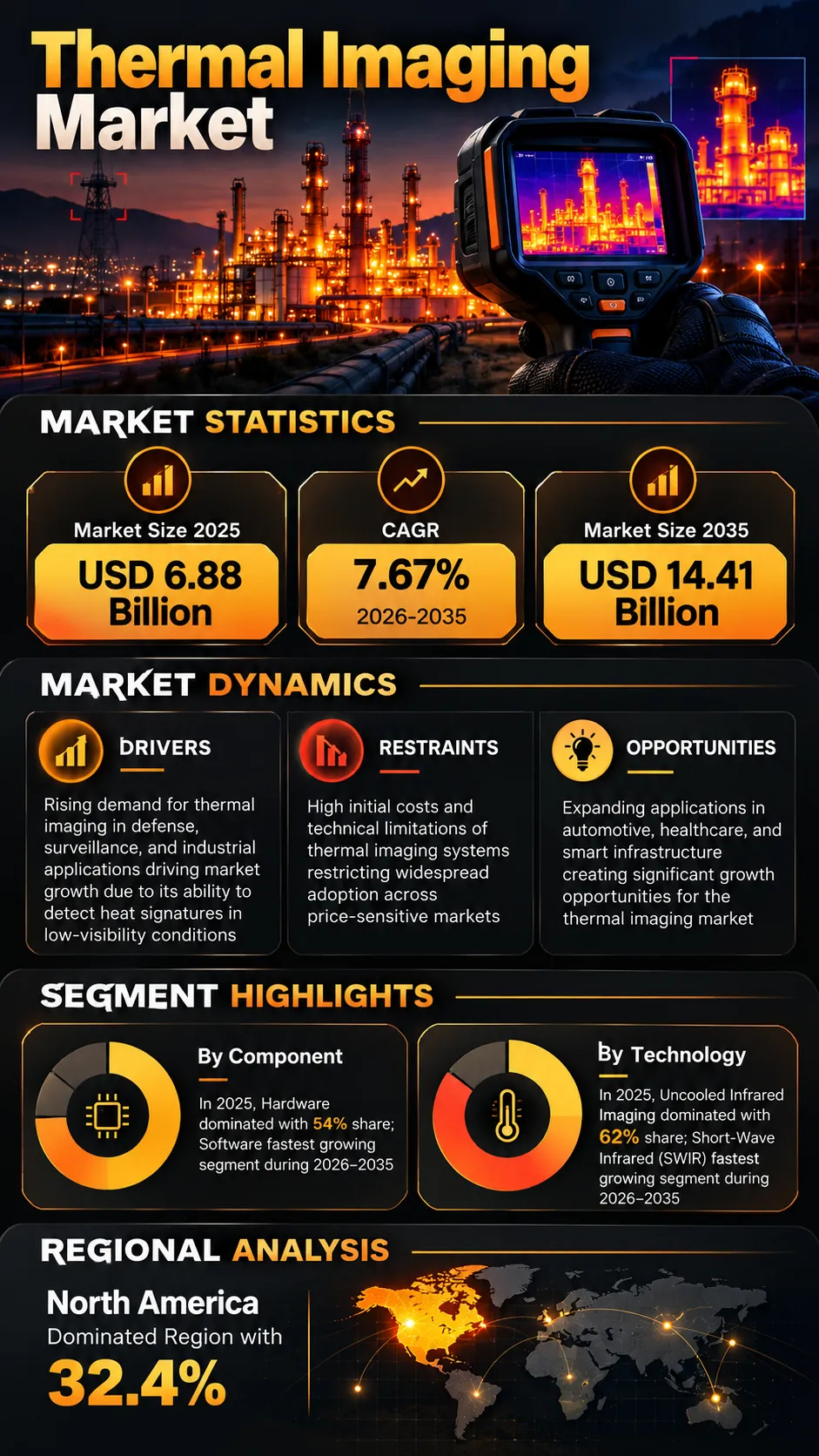
The Thermal Imaging Market is witnessing a period of steady growth due to the increasing investments being made by companies in various industries, including the defense, industrial, automotive, health care, and infrastructural segments. "According to a recent study by SNS Insider, the global Thermal Imaging Market size valued at USD 6.88 billion in 2025, is anticipated to grow to USD 14.41 billion by 2035, registering a CAGR of 7.67% over the 2026–2035 forecast period."
The technology has been gaining more commercial significance as thermal sensors have moved on from their traditional role of military and security functions to more applications. Thermal imaging is now being used by industries to detect equipment defects and monitor the condition of machines.
In addition, automotive industries are looking at thermal imaging technology to be used in future autonomous cars. In the meantime, infrared technology is opening up new frontiers in building management, fire-fighting, healthcare, and consumer electronics fields.
To Get Detailed Insights on the Thermal Imaging Market – Request a Sample Report
Expanding Applications Create New Growth Opportunities
With increased spending on critical infrastructure security and public safety, the demand for thermal imaging cameras that are able to work in conditions of darkness, smokes, and other reduced visibility remains high. The defense and law enforcement sectors keep utilizing infrared technologies for their surveillance, border control, and situational awareness activities.
The industry sector is yet another area that brings significant demand for infrared cameras since companies need continuous monitoring systems that are capable of spotting irregularities in the temperature of various devices. In addition to growing implementation of connected monitoring systems, thermal imagery also finds applications in the maintenance and automation processes.
Meanwhile, improvements in sensor miniaturization, image processing, and artificial intelligence are helping manufacturers deliver more capable devices in smaller and increasingly accessible form factors.
Key Market Insights Highlight Shifting Demand Patterns
By component, hardware segment held 54% of global market revenue in 2025, supported by continued deployment of thermal cameras, infrared sensors, and imaging modules across security and industrial applications. Software is projected to register the fastest growth through 2035 as demand rises for AI-based analytics, automated image interpretation, and real-time thermal data processing.
Based on technology, uncooled infrared imaging segment was estimated to hold 62% of market revenue in 2025. Its relatively compact design, lower operating complexity, and suitability for portable and commercial systems are supporting broad adoption. Short-Wave Infrared (SWIR) technology is forecast to be the fastest-growing segment as advanced industrial inspection, surveillance, semiconductor applications, and specialized imaging requirements expand.
By application, surveillance and security held around 38% of market revenue in 2025, reflecting continued use across defense, border protection, public safety, and critical infrastructure. Healthcare and medical applications are projected to grow at the fastest rate through 2035 as thermal imaging gains traction in non-invasive screening, temperature monitoring, and selected diagnostic applications.
By end user, defense and military segment held 41% of market revenue in 2025. Commercial and residential users are expected to record the fastest growth as thermal technologies increasingly enter smart buildings, energy management, home security, and compact inspection devices.
AI and Sensor Miniaturization Reshape Thermal Imaging Applications
The application of AI into thermal imaging has opened up some new opportunities for automated anomaly detection and maintenance as well as intelligent surveillance. Some advanced algorithms can assist users in recognizing any temperature differences and identifying possible equipment or security events without having to manually interpret the images.
Another emerging trend with thermal imaging is the connectivity of thermal cameras to smart infrastructure systems. This fusion enables users to incorporate thermal data into other data collected through sensors.
North America Captures 32.4% Market Revenue as Asia Pacific Accelerates at 8.5% CAGR
In North America, 32.4% share of market revenue is anticipated to be held in 2025 due to high defense spending, technology vendors, and broad usage of infrared sensors in various applications. Investments in surveillance solutions, predictive maintenance systems, and smart infrastructure will further drive regional demand.
Asia Pacific is anticipated to register the highest growth with CAGR of 8.5% in 2026-2035 owing to high spending on defense, rapid industrialization, infrastructure development, and smart city investments in China, India, Japan, and South Korea.
Europe continues to benefit from industrial automation, workplace safety requirements, energy-efficiency initiatives, and thermal imaging adoption across automotive and aerospace operations.
Industry Participants Focus on Intelligent Imaging Innovation
Competition remains active as technology companies expand infrared sensor capabilities, improve image quality, and integrate analytics into thermal imaging platforms. Manufacturers are emphasizing AI-enabled processing, compact designs, enhanced sensitivity, and solutions tailored to defense, industrial, automotive, and commercial applications.
Key companies operating in the global Thermal Imaging Market include FLIR Systems, Teledyne Technologies, Raytheon Technologies, Leonardo DRS, L3 Technologies, Seek Thermal, Opgal, Hikvision, Axis Communications, FLIR OEM Solutions, Bosch Security Systems, Northrop Grumman, Dahua Technology, Cisco Systems, Honeywell, Thales Group, PerkinElmer, Siemens, GE Measurement & Control, and Advances Thermal Imaging Co.
An SNS Insider analyst Sushant Kadam commented, “Thermal imaging is transitioning from a specialized sensing technology into a broader intelligence platform for security, industrial monitoring, mobility, and infrastructure applications. Continued advances in infrared sensors, artificial intelligence, and miniaturization are expected to expand the technology’s commercial reach and create new opportunities across emerging use cases.”
About the Author

Get in touch




