
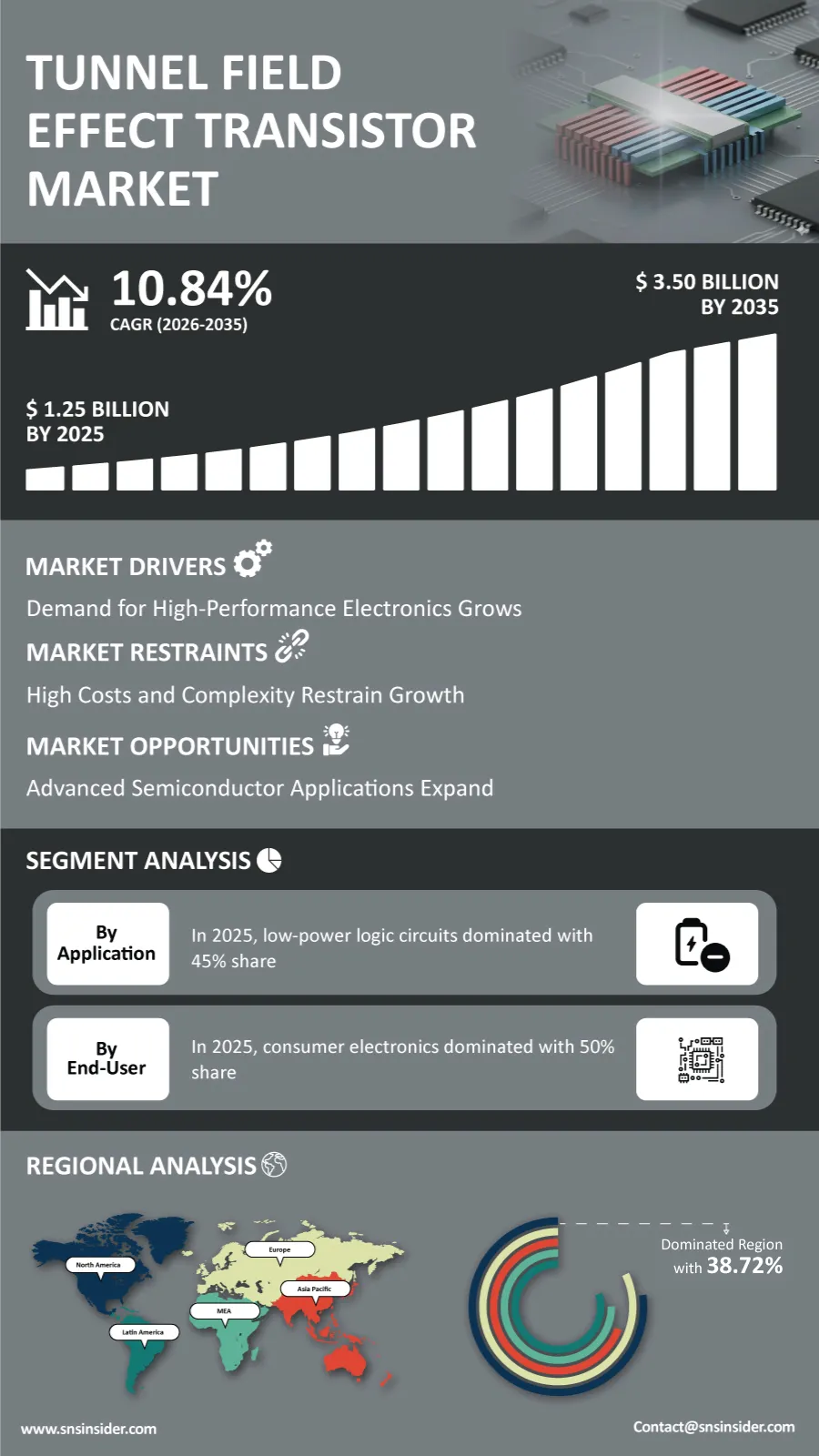
The global Tunnel Field-effect Transistor (TFET) Market is poised for robust expansion over the coming decade owing to the fact that the semiconductor industry is witnessing accelerated research into ultra-low-power electronics. According to a recent study by SNS Insider, the global Tunnel Field-effect Transistor (TFET) Market size valued at USD 1.25 billion in 2025, is anticipated to grow to USD 3.50 billion by 2035, registering a CAGR of 10.84% over the 2026–2035 forecast period.
Increasing energy efficiency requirements of electronics in consumer devices, artificial intelligence, Internet of Things, and edge computing systems are prompting semiconductor companies to investigate transistor technologies that can provide better performance while consuming much less energy. With physical limitations of semiconductor technology coming into effect, Tunnel FET (TFETs) transistors seem to be one of the viable options in the future.
Continued advancements in sophisticated materials, nanofabrication processes, and hybrid semiconductor structures will help enhance the performance, scaling capability, and economic feasibility of TFETs. Future developments in semiconductor R&D and production will likely hasten commercial adoption for a variety of applications.
To Get Detailed Insights on the Tunnel Field-effect Transistor Market – Request a Sample Report
Next-Generation Semiconductor Innovation Opens New Growth Opportunities
The semiconductor industry is concentrating more on the development of technologies that can provide computing and wearable technologies through artificial intelligence (AI), sensors, and connectivity in an efficient manner in terms of energy consumption. The TFET has some advantages due to its ability to allow low-voltage operations and minimize leakage currents.
There are increasing investments in semiconductor manufacturing, R&D collaborations, and pilot productions that provide good environments for the wider use of the technology in the market. Moreover, the manufacturers are utilizing innovative materials and hybrid CMOS-TFET designs in order to increase the reliability of their products while reducing their size.
Through the investments made by the governments and private companies in semiconductors, it is expected that the technologies related to TFET will be commercially successful in the future.
Key Market Insights Highlight Shifting Demand Patterns
By device type, planar TFET is estimated to hold a 50% share of global market revenue in 2025 since it is compatible with traditional CMOS fabrication process and used widely in low power logic circuits and memories. Nanowire TFET is expected to register the fastest growth rate till 2035 as semiconductor vendors try to achieve high scalability and electrostatic performance.
Based on material type, silicon-based TFET segment held 55% of market revenue in 2025 as the material has well developed fabrication process and a solid semiconductor ecosystem. 2D-material-based TFET will be the fastest growing as more and more researches are being conducted related to graphene and molybdenum disulfide which have better switching characteristics and energy efficiency than silicon.
In terms of application, low power logic circuit application segment generated 45% of global revenue in 2025 as the demand for energy efficient integrated circuits rises rapidly in consumer electronics and portable devices. The sensors and IoT applications will become the fastest growing segments as more and more connected products are being implemented in different industries and infrastructures.
By end user, consumer electronics dominated with a 50% share of market revenue in 2025 due to increased production of smartphones, wearables, tablets, and portable computing devices. Automotive & industrial electronics application segments will show the fastest growth till 2035 as intelligent vehicles, factory automation and artificial intelligence in industrial facilities require efficient semiconductors.
AI and Edge Computing Continue to Drive Technology Adoption
The quick rise of artificial intelligence, edge computing, and intelligent devices is changing the way semiconductors are designed. Semiconductor manufacturers are currently focused on designing transistors that can provide high performance computing while using the least amount of power, especially in battery-operated and always connected devices.
The TFET technology has received increasing interest owing to its potential to facilitate very efficient computation in AI accelerators, IoT sensors, wearables, and advanced communication systems. It is expected that continuous improvement in nanotechnology, materials science, and semiconductor integration will improve the commercial viability of this technology in future years.
North America Leads with 38.72% Revenue Share in 2025; Asia Pacific Emerges as the Fastest-Growing Region at 13.20% CAGR
North America captured a market revenue share of about 38.72% in 2025 on the basis of leading semiconductor producers, substantial research operations, and investments in artificial intelligence, high-end computing, and energy-saving electronics. Collaboration between technology firms and research institutes continues to enhance North America's position as an innovator of semiconductors.
Asia Pacific is likely to witness the highest growth rate at a CAGR of 13.20% from 2021 to 2035. Growth is attributed to the expansion of semiconductor manufacturing capacity, increased production of consumer electronics, increasing penetration of IoT, and favorable government policies.
As global investments in semiconductor self-sufficiency and next-generation electronics continue to increase, demand for advanced low-power transistor technologies is expected to accelerate across both developed and emerging markets.
Industry Participants Focus on Advanced Semiconductor Innovation
The competitive landscape remains highly dynamic since semiconductor firms are still investing in transistor designs, new material technology, and energy-efficient computing systems. Innovation in products, collaboration in research, and manufacturing are key in the competitive strategy.
Key companies operating in the global Tunnel Field-effect Transistor (TFET) Market include Intel Corporation, Samsung Electronics Co. Ltd., Taiwan Semiconductor Manufacturing Company (TSMC), GlobalFoundries Inc., Infineon Technologies AG, STMicroelectronics N.V., Texas Instruments Incorporated, NXP Semiconductors N.V., ON Semiconductor Corporation, Qualcomm Incorporated, Broadcom Inc., Micron Technology Inc., Renesas Electronics Corporation, SK Hynix Inc., Analog Devices Inc., Qorvo Inc., Advanced Linear Devices Inc., Axcera Inc., Focus Microwaves Inc., and Fairchild Semiconductor.
An SNS Insider analyst Sushant Kadam commented, “The growing transition toward ultra-low-power semiconductor technologies is creating significant opportunities for Tunnel Field Effect Transistors across AI, IoT, and advanced computing applications. Companies investing in materials innovation, scalable manufacturing, and next-generation transistor architectures will be well positioned to benefit from the industry's continued evolution.”
About the Author

Get in touch




