
Tunnel Field Effect Transistor Market Size Analysis:
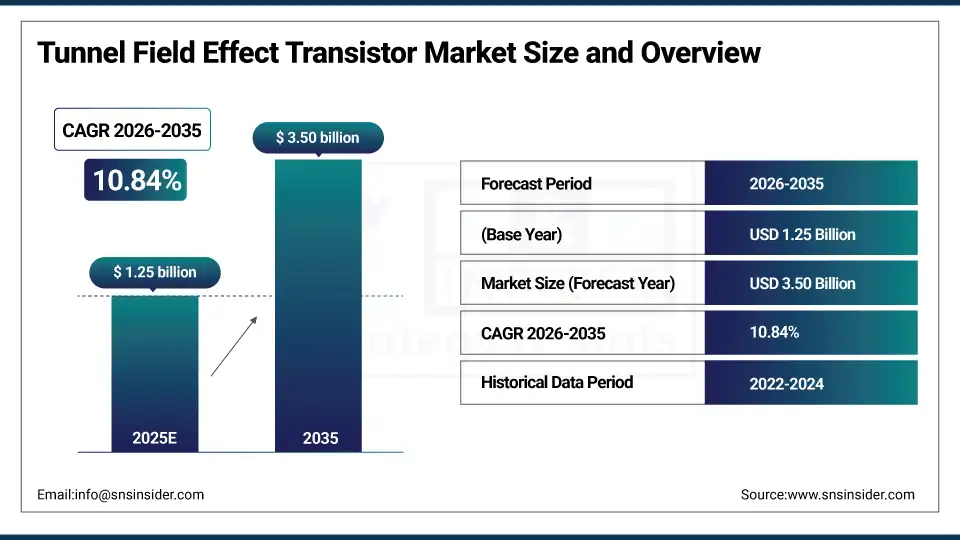
The Tunnel Field Effect Transistor Market size is valued at USD 1.25 Billion in 2025 and is expected to reach USD 3.50 Billion by 2035 and grow at a CAGR of 10.84% over the forecast period 2026-2035.
The growth of the Tunnel Field Effect Transistor Market is fueled by the rising demand for low-power and high-performing electronics in consumer electronics, IoT, and mobile. Increased use of AI, high-performance computing and power-efficient technologies are touted as the main market drivers for implementation of TFETs in future semiconductor devices. Materials technology, nanoscale device technology and hybrid CMOS-TFET architecture are improving the performance scalability and reliability. Furthermore, increasing semiconductor investments towards R&D coupled with industry support & initiatives and increase in demand for energy-efficient electronics in smart devices and industrial purposes are promoting market acceptance across the globe leading to substantial market growth over the forecast period.
According to industry studies, over 45% of Tunnel FET (TFET) demand is driven by ultra-low-power and high-performance electronics, fueled by rapid adoption in IoT devices, AI-enabled computing, and energy-efficient mobile and consumer electronics applications.
To Get more information On Tunnel Field Effect Transistor Market - Request Free Sample Report
Tunnel Field Effect Transistor Market Trends:
-
Shift Toward Ultra-Low-Power Electronics: Increasing demand for energy-efficient devices in IoT, wearables, and mobile computing is driving TFET adoption.
-
Advanced Material Integration: Growing use of III–V compounds, 2D materials, and hybrid CMOS-TFET architectures is enhancing device performance and enabling next-generation semiconductor applications.
-
AI and Edge Computing Adoption: Rising deployment of TFETs in AI accelerators, edge devices, and low-power computing platforms is fueling market growth.
-
Scaling Beyond Silicon Limits: TFETs are gaining traction as an alternative to traditional CMOS for sub-10nm nodes, offering steeper subthreshold slopes and lower power consumption.
-
Increased R&D and Investment: Significant investments by semiconductor manufacturers in TFET research, prototyping, and pilot production are accelerating commercialization.
U.S. Specialty Tunnel Field Effect Transistor Market Size Outlook:
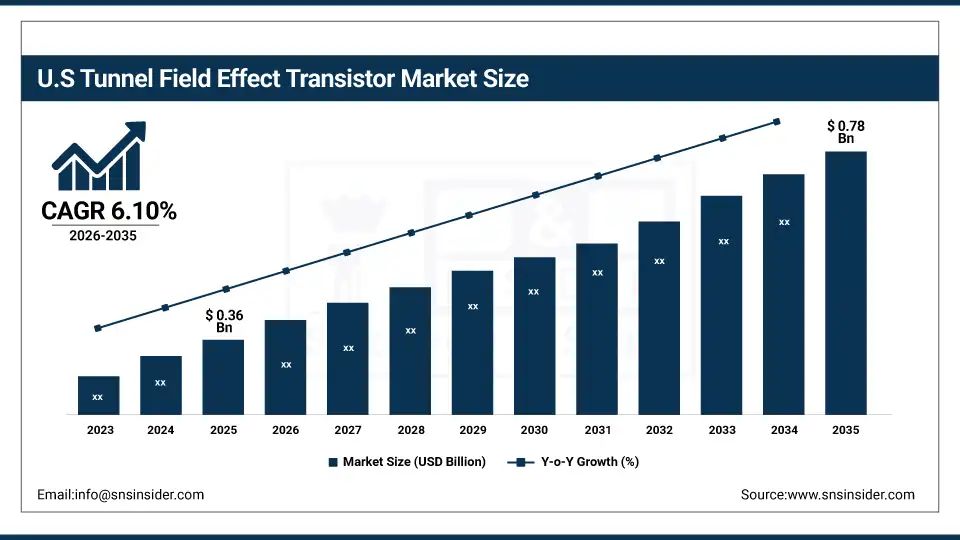
The U.S. Tunnel Field Effect Transistor (TFET) Market size is USD 0.36 Billion in 2025 and is expected to reach USD 0.78 Billion by 2035, growing at a CAGR of 6.10% over the forecast period of 2026-2035. High demand for TFETs in the U.S. can be attributed to growing adoption of ultra-low-power and high-performance electronics in AI-based computing, IoT devices, and mobile applications. Emerging Materials, Nanoscale Device Architectures and Hybrid CMOS-TFET Technology Drive Performance, Scalability and Reliability; Growing Semiconductor R&D Investments, Industry Support & Rising Demand for Energy-Efficient Electronics also Accelerate Market Adoption.
Tunnel Field Effect Transistor Market Growth Drivers:
-
Rising Demand for Ultra-Low-Power and High-Performance Electronics
Market Dynamics The market for Tunnel FET (TFET) is predominantly driven by the increasing demand for energy-efficient & high-performance electronics in IoT, AI-enabled computing, mobile devices and consumer electronics among others. Firm are more and more employing TFETs in order to lower the power dissipation, bring about device performances improvement simultaneously of forward looking semiconductor apps. As the industry studies show, more than 45% of demand will be ultra-low-power electronics so as to control market acceptance. Furthermore, growing demand for energy-efficient computing and mobile solutions is also driving the market growth.
Tunnel Field Effect Transistor Market Growth Restraints:
-
High Manufacturing Complexity and Cost Challenges
Market growth is restricted due to complexities associated with TFET manufacturing, material integrations and emerging nanosize device designs. Mature application, however, is retarded by high costs of production process deviations and also low mass-manufacture experience. Reports suggest that close to 35% of TFET pilot projects get delayed because of fabrication issues, which in turn restricts its rapid proliferation. The lack of standard manufacturing platform, and the expensive R&D facilities also drive away large-scale use.
Tunnel Field Effect Transistor Market Growth Opportunities:
-
Integration in Advanced Semiconductor, AI, and IoT Applications
There are great potentials of TFETs in future computing systems, AI accelerators, edge devices and IoT environments. Increasing spending on semiconductor research & development, hybrid CMOS-TFET designs and integration of smart devices lead to lesser power consumption with improved efficiency and performance. Industry research indicates that the adoption of TFET in power-efficient electronics and AI computing solutions is growing at well over 15% per annum, reflecting robust future growth. Rise in demand for sustainable, low-power semiconductors in developed and developing regions offers long-term market potential.
Tunnel Field Effect Transistor Market Segment:
-
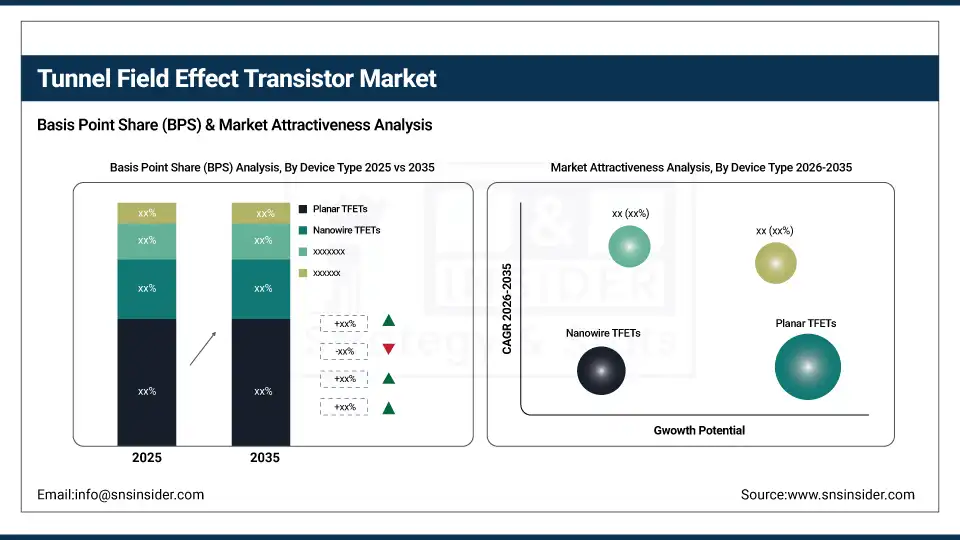
By Device Type: In 2025, planar TFETs dominated with 50% share; nanowire TFETs are the fastest-growing segment during 2026–2035.
-
By Material Type: In 2025, silicon-based TFETs dominated with 55% share; 2D-material-based TFETs are the fastest-growing segment during 2026–2035.
-
By Application: In 2025, low-power logic circuits dominated with 45% share; sensors & IoT devices are the fastest-growing segment during 2026–2035.
-
By End User: In 2025, consumer electronics dominated with 50% share; automotive & industrial electronics are the fastest-growing segment during 2026–2035.
By Device Type: Planar TFETs Lead as Nanowire TFETs Expand Rapidly
Planar TFETs are the key competitors in Tunnel Field Effect Transistor Market and they have been well established with standard technology [1] of high reliability, employing them widely for low-power logic circuits, memory devices and consumer electronic applications. Due to their compatibility with the standard CMOS process and demonstrated performance, they have been chosen for general purpose IC applications.
Nanowire TFETs are gaining significant momentum due to high electrostatic control, improved subthreshold swing and excellent scaling at nanoscale regime. In particular, nanowire TFETs are being developed and scaled with new fabrication methods, integrated into next generation devices, and increasingly proposed in AI accelerators, IoT sensors and HPC causing its proliferation especially for novel semiconductor-related applications.
By Material Type: Silicon-Based TFETs Lead as 2D-Material-Based TFETs Gain Momentum.
Currently, silicon-based TFETs are dominant in the market because of their mature manufacturing technology as opposed to III–V materials, cost-effectiveness and wide use in mainstream electronics and mobile phones. Silicon and its well-established supply chains will remain dominant in logic, memory, and IoT applications thanks to wide availability.
2D-material-based TFETs are being propelled to the spotlight with a surge of research and pilot production. Ultra low-power, enhanced switching performance and scalability for the future of semiconductors: From MoS2 to graphene! Leading to rapid penetration of 2D-materials based TFETs, increasing investment in R&D, hybrid CMOS-TFET integration and newer energy-efficient applications are the primary enablers.
By Application: Low-Power Logic Circuits Lead as Sensors & IoT Devices Expand.
Low-power logic gates are currently dominating the market demand for TFETs, as these find critical applications in energy-efficient computing, consumer electronics and mobile technology. They are necessitated by the desire to reduce power consumption in high density integrated circuits and also to keep device reliability across performance-critical applications.
Sensors & IoT devices market is growing rapidly due the proliferation of connected devices, smart sensors and IOT deployments. TFETs support ultra-low-power operation in battery operated applications, Improving sensor life and performance. Overall, the trend for smart or IoT home/industrial and wearables growth drives more in this segment.
By End User: Consumer Electronics Lead as Automotive & Industrial Electronics Expands.
The TFET market is dominated by Consumer Electronics Product Segments owing to the high demand for low-power smartphones, tablets, wearables and portable computing devices. Integration of TFET enables manufacturers to enhance battery life, device performance, and overall power savings; which in turn is the predominant end-user segment.
Automotive & Industrial Electronics The automotive and industrial electronics end-markets are growing, propelled by the increasing demand for low-power, high performance semiconductors in electric vehicles (EVs), autonomy and industrial automation. Increasing use of energy-saving electronics for automotive and industrial compact devices, along with the spread of AI and smart systems are driving the rapid adoption of TFET in automotive and industrial applications.
Tunnel Field Effect Transistor Market Regional Analysis:
North America Tunnel Field Effect Transistor Market Insights:
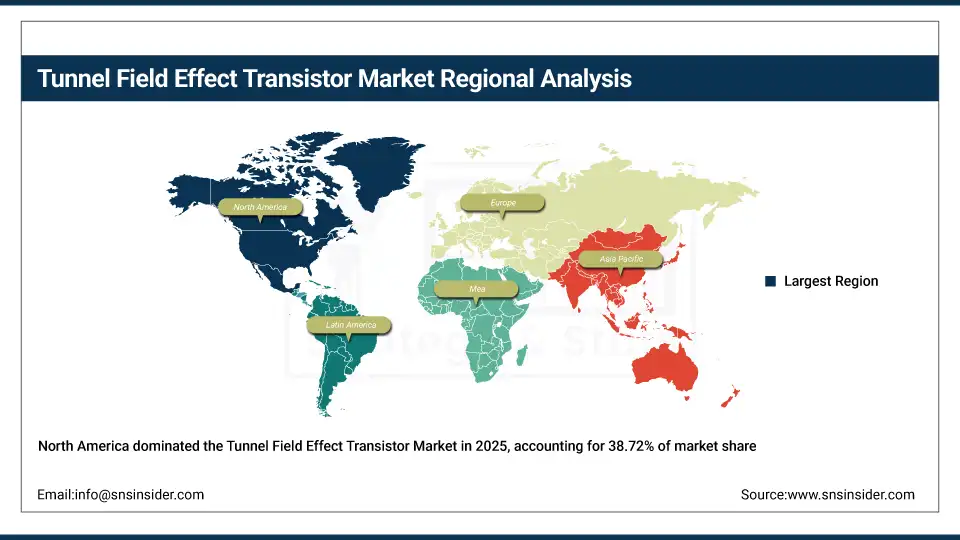
In 2025, North America’s Tunnel Field Effect Transistor Market accounting for the highest regional revenue share of approximately 38.72% in 2025. North America’s domination is majorly due to the presence of large semiconductor companies, significant R&D investments, and robust demand for energy-efficient, and high-level performance electronics in consumer, IT, and industry use cases. TFET integration in large scales was enabled by the availability of mature technology infrastructure like AI, Internet of Things (IoT), and next-generation computing platforms. In addition, momentum around industry initiatives and collaborative research programs combined with increasing demand for ultra-low power technologies in mobile, AI and IOT further drove market growth in the region.
Get Customized Report as per Your Business Requirement - Enquiry Now
Asia Pacific Tunnel Field Effect Transistor Market Insights:
Asia Pacific represents a high-growth region for the Tunnel Field Effect Transistor Market, registering a CAGR of 13.20% during 2026–2035. This high growth is driven by rapid expansion of consumer electronics, increasing adoption of IoT devices, and rising investments in advanced semiconductor manufacturing. The region’s large technology ecosystem, growing urbanization, and strong demand for energy-efficient and high-performance electronics have created significant opportunities for TFET deployment. Additionally, supportive government initiatives, smart electronics programs, and advancements in materials, nanoscale device engineering, and hybrid CMOS-TFET integration have accelerated R&D, pilot projects, and commercial adoption, boosting market growth during 2026–2035.
Europe Tunnel Field Effect Transistor Market Insights:
Strong demand for low-power electronic devices in Europe, rising usage of, and investment in, IoT device market and significant investment by manufacturers in technological innovations are fueling construction progress of tunnel FET (TFET). Favorable government initiatives, collaborative research efforts and smart electronics programs have boosted pilot projects and commercial deployments. Increasing preference for AI, low power computing, and hybrid CMOS-TFET architectures, in addition to the rising penetration across consumer electronic goods, industrial, and automotive electronics is further accelerating market growth in leading European economies.
Latin America Tunnel Field Effect Transistor Market Insights:
The Tunnel Field Effect Transistor Market in Latin America is driven by growing innovations in consumer electronics, industrial automation, and mobile computing. Increasing investment in semiconductor R&D, IoT infrastructure and energy efficient electronics driving pilot programs and early commercialization. Moreover, the growing penetration of connected devices including digitalization in urbanized areas is prompted manufacturers to opt for TFETs and as a result hold significant potential that can be leveraged from across Brazil, Mexico and other developing economies.
Middle East and Africa Tunnel Field Effect Transistor Market Insights:
Middle East & Africa Tunnel Field Effect Transistor Market is due to increasing the use of IoT devices, smart electronics and low power computing. Investments in semiconductor infrastructure, R&D, and AI-based technologies are driving pilot projects as well as commercial roll-outs. Moreover, with increasing demand for energy-efficient components in consumer electronics and industrial application along with the telecommunication thus driving TFETs market growth across the region.
Tunnel Field Effect Transistor (TFET) Market Competitive Landscape:
Intel Corporation is a leading Tunnel FET (TFET) company known for its advanced semiconductor R&D and development of ultra-low-power transistor technologies. Intel focuses on integrating TFETs into high-performance computing, AI accelerators, and next-generation mobile and IoT devices. The company is recognized for its strong innovation pipeline, extensive fabrication capabilities, and strategic partnerships with global semiconductor and electronics manufacturers.
-
In 2025, Intel Corporation announced successful TFET pilot production for low-power AI chips, targeting integration into edge computing and wearable devices by 2026.
Samsung Electronics Co. Ltd are a large manufacturer of TFETs, harnessing their semiconductor manufacturing know-how to produce energy efficient and high performance transistors for consumer electronics, mobile devices and memory. Samsung focuses on scalable TFET architectures, hybrid CMOS integration, and materials innovation to increase device performance while addressing power consumption.
-
March 2025, Samsung Electronics unveiled a new TFET-based prototype chip for AI-enabled smartphones and IoT devices, with plans for mass adoption in 2026 across mobile and consumer electronics segments.
Taiwan Semiconductor Manufacturing Company (TSMC) is a leading TFET manufacturer and foundry partner, focusing on next-generation semiconductor fabrication and low-power transistor technologies. TSMC collaborates with global semiconductor innovators to enable TFET integration in high-performance, energy-efficient computing and IoT applications. The company is recognized for its advanced process nodes, reliability, and strong ecosystem partnerships.
-
July 2025, TSMC announced a strategic collaboration with several AI chip designers to implement TFETs in sub-10nm nodes, targeting commercial deployment in 2026 for low-power computing and IoT platforms.
Tunnel Field Effect Transistor Companies are:
-
Samsung Electronics Co. Ltd.
-
Taiwan Semiconductor Manufacturing Company (TSMC)
-
GlobalFoundries Inc
-
STMicroelectronics N.V.
-
Texas Instruments Incorporated
-
NXP Semiconductors N.V.
-
ON Semiconductor Corporation
-
Qualcomm Incorporated
-
Broadcom Inc.
-
Renesas Electronics Corporation
-
SK Hynix Inc.
-
Analog Devices Inc.
-
Qorvo Inc.
-
Advanced Linear Devices Inc.
-
Axcera Inc.
-
Focus Microwaves Inc.
-
Fairchild Semiconductor
| Report Attributes | Details |
|---|---|
| Market Size in 2025 | USD 1.25 Billion |
| Market Size by 2035 | USD 3.50 Billion |
| CAGR | CAGR of 10.84% From 2026 to 2035 |
| Base Year | 2025 |
| Forecast Period | 2026-2035 |
| Historical Data | 2022-2024 |
| Report Scope & Coverage | Market Size, Segments Analysis, Competitive Landscape, Regional Analysis, DROC & SWOT Analysis, Forecast Outlook |
| Key Segments | • By Device Type: (Planar TFETs, Nanowire TFETs, Heterojunction TFETs) • By Material Type: (Silicon-based TFETs, III–V compound semiconductor TFETs, 2D-material-based TFETs) • By Application: (Low-power logic circuits, Memory devices, Sensors & IoT devices) • By End User: (Consumer electronics, IT & telecommunications, Automotive & industrial electronics) |
| Regional Analysis/Coverage | North America (US, Canada), Europe (Germany, UK, France, Italy, Spain, Russia, Poland, Rest of Europe), Asia Pacific (China, India, Japan, South Korea, Australia, ASEAN Countries, Rest of Asia Pacific), Middle East & Africa (UAE, Saudi Arabia, Qatar, South Africa, Rest of Middle East & Africa), Latin America (Brazil, Argentina, Mexico, Colombia, Rest of Latin America). |
| Company Profiles | Intel Corporation, Samsung Electronics Co. Ltd., Taiwan Semiconductor Manufacturing Company (TSMC), GlobalFoundries Inc., Infineon Technologies AG, STMicroelectronics N.V., Texas Instruments Incorporated, NXP Semiconductors N.V., ON Semiconductor Corporation, Qualcomm Incorporated, Broadcom Inc., Micron Technology Inc., Renesas Electronics Corporation, SK Hynix Inc., Analog Devices Inc., Qorvo Inc., Advanced Linear Devices Inc., Axcera Inc., Focus Microwaves Inc., Fairchild Semiconductor. |

Frequently Asked Questions
The Tunnel Field Effect Transistor Market is expected to grow at a CAGR of 10.84% during 2026-2035.
The market was valued at USD 1.25 Billion in 2025 and is projected to reach USD 3.50 Billion by 2035.
The key drivers of the Tunnel Field Effect Transistor Market are the rising demand for ultra-low-power electronics, increasing adoption in AI and advanced computing, scaling beyond silicon limits, and growing applications in IoT and mobile devices.
The Silicon-based TFETs segment dominated the Tunnel Field Effect Transistor Market, driven by established manufacturing processes, high reliability, and widespread adoption in low-power and IoT applications.
North-America dominated the Tunnel Field Effect Transistor Market in 2025.
