
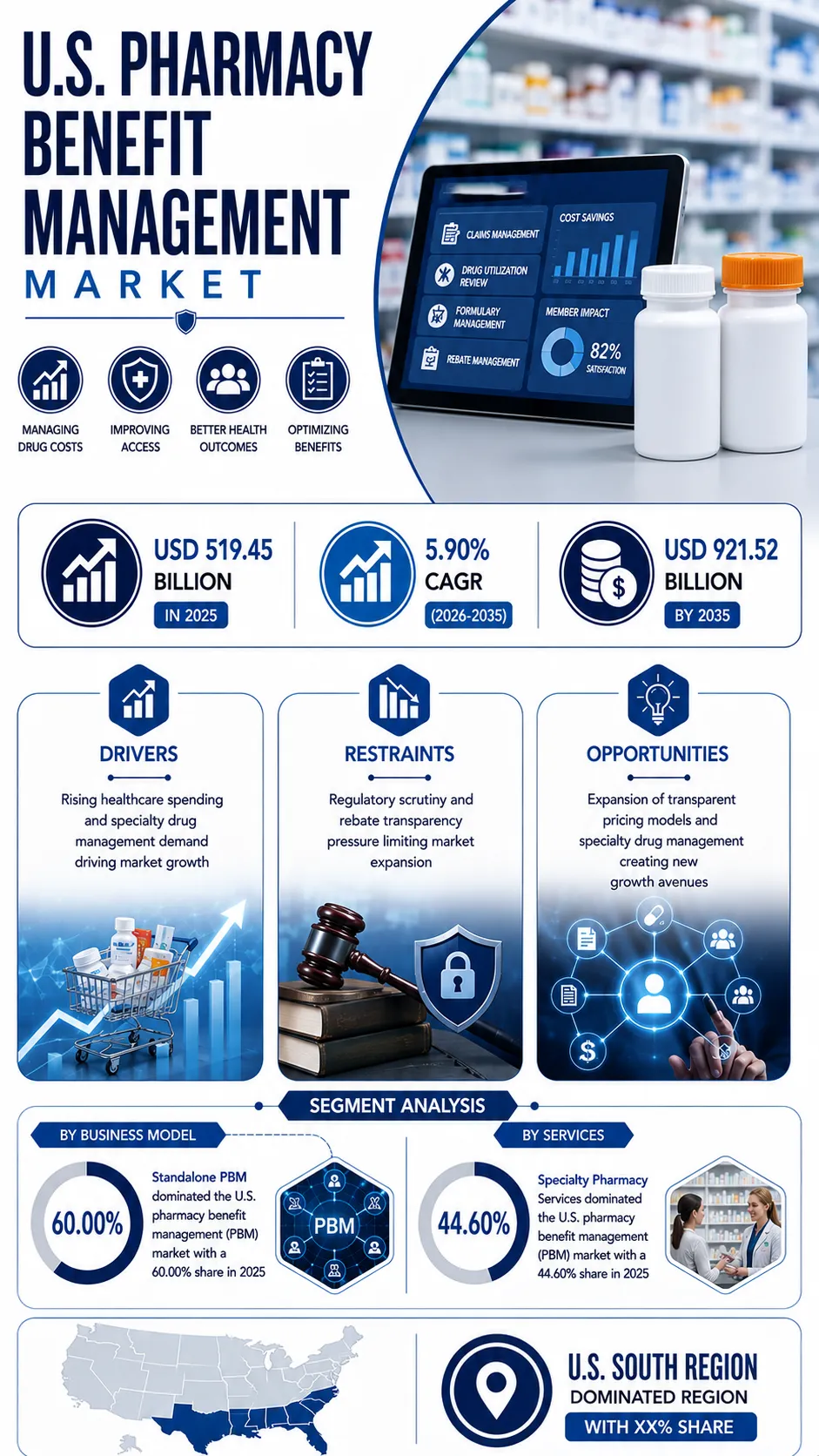
The U.S. Pharmacy Benefit Management Market is set for steady expansion as healthcare spending growth and specialty drug management demand continue to reshape prescription drug program administration nationwide. “According to a recent study by SNS Insider, the U.S. Pharmacy Benefit Management Market size valued at USD 519.45 billion in 2025, is anticipated to grow to USD 921.52 billion by 2035, registering a CAGR of 5.90% over the 2026–2035 forecast period.”
There have been notable changes within prescription drug program administration over time, due to which many payers who aim at improving cost management can take advantage of this trend. This includes the need for more transparent, data-driven formulary and rebate management approaches that will provide health plans with the ability to control rapidly growing specialty drug spending. This applies in situations where PBMs support commercial, Medicare, and Medicaid health plan clients. Payers are constantly working hard to ensure that their pharmacy benefit management arrangements perform better than before in order to meet various cost containment and regulatory transparency requirements.
To Get Detailed Insights on the U.S. Pharmacy Benefit Management Market – Request a Sample Report
Specialty Drug Spending Creates New Demand
The pharmacy benefit management market has evolved from basic claims processing administration to increasingly sophisticated, clinically integrated cost management platforms. The growing investment in AI-powered cost analytics, specialty drug utilization management, and transparent pricing models across PBM organizations of all sizes has required the development of more comprehensive and data-driven pharmacy benefit solutions.
New cost management and formulary technologies can increase pricing transparency, improve specialty drug utilization control, and allow for expansion into increasingly complex Medicare and Medicaid managed care arrangements. This gives health plans and employers the possibility to control rapidly growing pharmacy spending while maintaining member access to increasingly expensive specialty and biologic therapeutics.
PBM organizations, health plans, and digital health platforms are increasingly cooperating thanks to the growing interest in developing future solutions for transparent, data-driven pharmacy benefit management.
Key Market Findings Highlight High-Growth Segments
The standalone PBM business model dominated all categories in the U.S. pharmacy benefit management market share with the largest market share of 60.00% in 2025 due to established scale advantages in rebate negotiation. The fastest growing category is expected to be the healthcare insurance provider model which will grow at an estimated CAGR of 7.20% through 2035, owing to growing integration of PBM functions directly within insurers.
By services, specialty pharmacy services held the largest share of total market revenue in 2025 due to the rapidly growing share of pharmacy spend attributable to high-cost specialty medications. Retail pharmacy networks will see significant growth in revenue generation, driven by growing consumer demand for broader network access and flexibility.
Based on end-user, federal and government programs are expected to dominate the market during the anticipated forecast period, driven by substantial and growing federal health insurance program enrollment. On the other hand, the commercial segment demonstrated the highest market growth in 2025, supported by rising commercial insurance enrollment.
Distributive health plan trends are changing as well. Commercial health plans accounted for the largest revenue share in 2025 owing to the substantial scale of employer-sponsored insurance coverage. But Medicare plans will turn out to be the fastest-growing health plan category through 2035, on the back of growing Medicare Advantage and Part D enrollment tied to the aging population.
Transparency, Cost Control, and Specialty Drug Management Gain Importance
In this regard, health plans and employers have been looking at PBM arrangements that would deliver more transparent, predictable pricing while requiring less exposure to rebate-related cost uncertainty.
Innovation in AI-powered cost analytics, transparent pass-through pricing models, and specialty drug utilization management has been making it possible for PBM organizations to come up with solutions that appeal to increasingly cost-conscious and regulatory-aware health plan clients. In addition to that, increasing emphasis on value-based care integration is also making it possible for PBMs to find solutions that tie reimbursement to patient outcomes. Such trends are likely to become even more prominent in the future.
South Region Emerges as the Largest Market Amid Rising Commercial Insurance Enrollment
The South region represented the largest share of U.S. market revenue in 2025, owing to the region's substantial population base and growing employer-sponsored insurance enrollment across major metropolitan markets. On the other hand, the West region is expected to be the fastest-growing market during the forecast period through 2035, propelled by the region's substantial technology sector employer base and growing consumer demand for transparent, technology-enabled PBM solutions.
Leading Companies Drive Innovation and Competition
The environment continues to stay very dynamic since players continue innovating on transparent pricing models and specialty drug management as well as forming partnerships in order to enhance their position in the industry. Some of the major companies that operate in the U.S. pharmacy benefit management market are CVS Health, The Cigna Group, UnitedHealth Group, Humana, Prime Therapeutics, MedImpact Healthcare Systems, Elixir Rx Solutions, Navitus Health Solutions, EmpiRx Health, and Capital Rx.
An SNS Insider analyst Parry Kardani commented, "The growing regulatory scrutiny and consumer demand for pricing transparency is creating unprecedented pressure on traditional rebate-driven PBM business models. Organizations that successfully combine transparent pricing, AI-driven cost analytics, and specialty drug management expertise will be best positioned to capitalize on emerging opportunities across commercial, Medicare, and Medicaid health plan segments."
About the Author

Get in touch




