
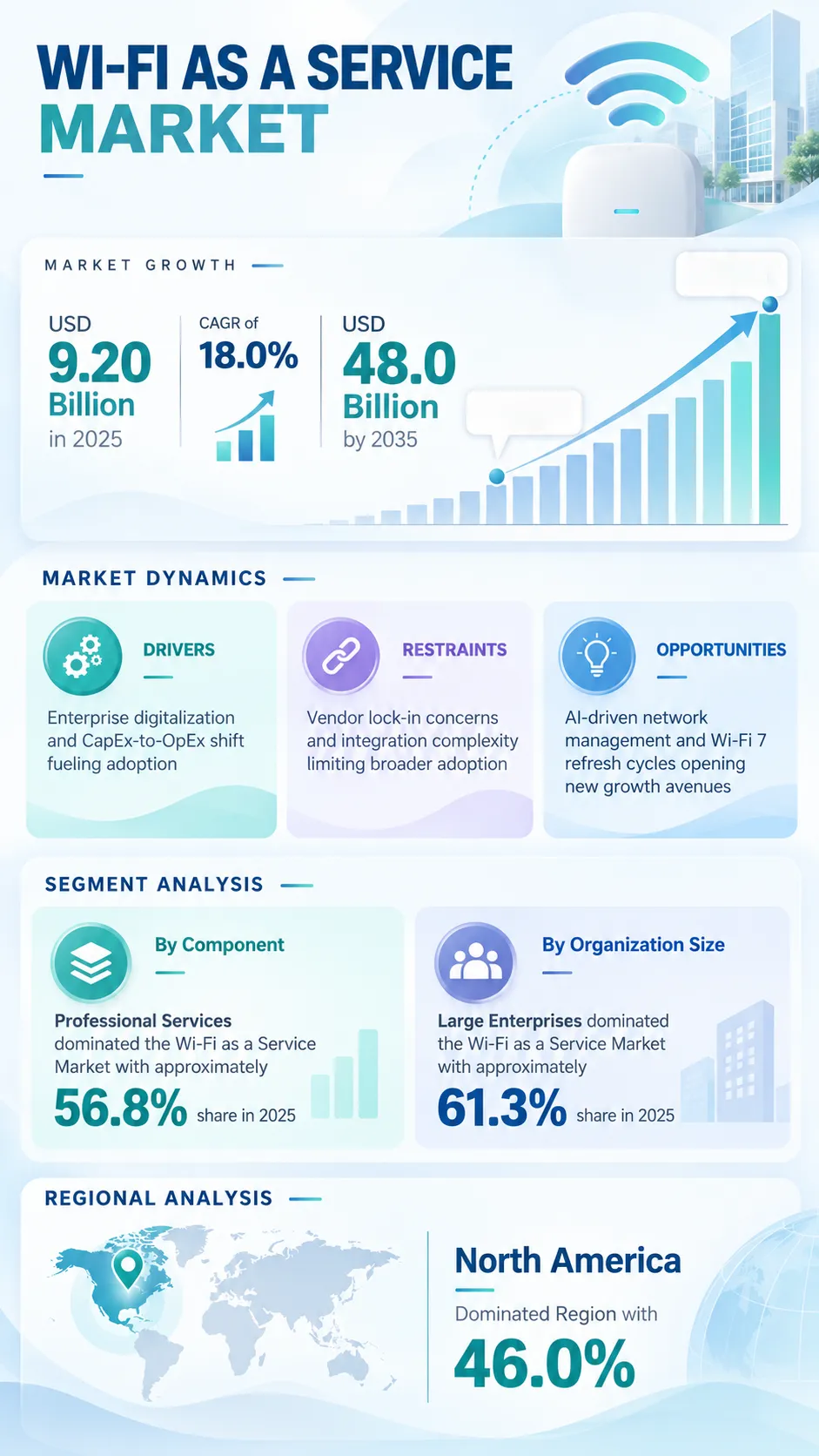
The global Wi-Fi as a Service Market is set for rapid expansion as enterprises lean further into subscription-based, cloud-managed wireless connectivity. “According to a recent study by SNS Insider, the global Wi-Fi as a Service Market size valued at USD 9.20 billion in 2025, is anticipated to grow to USD 48.0 billion by 2035, registering a CAGR of 18.0% over the 2026-2035 forecast period.”
There have been rapid changes within cloud management and AI-driven networking technology over time, due to which many providers aiming at improved reliability and operational efficiency can take advantage of this trend. This includes the need for more automated, self-healing network management platforms that give enterprise buyers confidence in connectivity reliability, across a wide range of applications from retail guest Wi-Fi to healthcare device connectivity. This applies in situations where Wi-Fi as a Service is used across retail, healthcare, education, and hospitality applications.
Providers are constantly working to improve network reliability and management automation in order to meet various needs of multi-location enterprises worldwide.
To Get Detailed Insights on the Wi-Fi as a Service Market – Request a Sample Report
Enterprise Digitalization and Subscription Model Ecosystems Create New Demand
The Wi-Fi as a Service market has evolved from basic managed access point offerings into a broader mix of AI-driven, cloud-native network management platforms. The growing investment in automated network operations, Wi-Fi 7 hardware, and multi-vertical service development has required the development of more efficient and reliable operating systems.
New management and hardware approaches can improve network reliability, reduce operational overhead, and expand the range of verticals Wi-Fi as a Service can serve. This gives providers the possibility to be more effective when reaching multi-location enterprises and strengthening claims around scalability and reliability.
Networking technology vendors, managed service providers, and enterprise IT buyers are increasingly cooperating due to the growing interest in developing future solutions for reliable, subscription-based wireless connectivity.
Key Market Findings Highlight High-Growth Segments
The professional services segment dominated all categories in the Wi-Fi as a Service market share with a market revenue share of approximately 56.8% in 2025 due to the advisory and deployment expertise multi-location rollouts require.
The fastest growing category is expected to be the managed services segment, which will grow at a CAGR of approximately 20.4% through 2035. This will be possible owing to rising enterprise preference for ongoing, subscription-based network monitoring and optimization.
By organization size, large enterprises held the largest share of total market revenue at approximately 61.3% in 2025 due to the scale advantages centralized, cloud-managed Wi-Fi offers multi-location businesses. The small & medium enterprises segment will see the fastest growth in revenue generation at a CAGR of approximately 21.8%.
Regional trends show North America leading with approximately 46.0% revenue share in 2025, while Asia Pacific is expected to register a fast growth trajectory driven by rapid enterprise digitalization across China, India, and Japan.
Cloud Management, AI-Driven Automation, and Vertical Diversification Gain Importance
In this regard, providers have been looking at Wi-Fi as a Service platforms that would make their management more cloud-native, their operations more AI-automated, and their applications more vertical-diverse.
Innovation in AI-driven network management, Wi-Fi 7 hardware, and multi-vertical development has been making it possible for companies to come up with platforms that can meet increasingly demanding enterprise and regulatory expectations. In addition to that, increasing emphasis on cross-platform hardware compatibility is also making it possible for companies to find solutions that reduce vendor lock-in concerns.
Such trends are likely to become even more prominent in the future.
North America Leads Amid Deep Enterprise Base and Vendor Concentration
North America led the Wi-Fi as a Service Market in 2025, accounting for a 46.0% share, supported by the United States’ large base of multi-location enterprises and concentration of leading networking technology vendors. Strong enterprise digitalization across retail, healthcare, hospitality, education, and IT is accelerating managed Wi-Fi adoption. Growing cloud migration, IoT deployments, cybersecurity requirements, and demand for scalable connectivity are further supporting market expansion. The region’s mature technology ecosystem and vendor proximity continue strengthening its leadership in adoption and innovation.
On the other hand, Europe represented a meaningful share of global market revenue in 2025, aided by strong enterprise digitalization across retail, healthcare, and hospitality sectors anchored by the United Kingdom.
Leading Companies Drive Innovation and Competition
The environment continues to stay very dynamic since players continue innovating on cloud management and AI-driven networking technology as well as forming partnerships in order to enhance their position in the industry.
Some of the major companies that operate in the global Wi-Fi as a Service market are Cisco Systems, Inc., Hewlett Packard Enterprise (HPE Aruba), Juniper Networks, Inc., Extreme Networks, Inc., Huawei Technologies Co., Ltd., Fortinet, Inc., CommScope Holding Company, Inc., Arista Networks, Inc., Ubiquiti Inc., TP-Link Corporation Limited, D-Link Corporation, Cambium Networks Corporation.
An SNS Insider Analyst Sakshi Kale commented, “The steady shift toward subscription-based, AI-managed wireless connectivity is creating consistent demand across enterprises of every size. Providers that successfully combine cloud-native management, AI-driven automation, Wi-Fi 7 hardware readiness, and reliable multi-vertical service delivery will be best positioned to capitalize on emerging opportunities across retail, healthcare, education, and hospitality applications.”
About the Author

Get in touch




