
As per the SNS Insider report titled, Cell and Gene Therapy CDMO Market Size, Share & Segmentation By Therapy Type, Service Type, Vector Type, End User, and Region | Global Forecast 2026–2035 “The global Cell and Gene Therapy CDMO Market was valued at USD 5.23 Billion in 2025 and is expected to reach USD 29.49 Billion by 2035, growing at a CAGR of 18.90% during the forecast period of 2026-2035.”
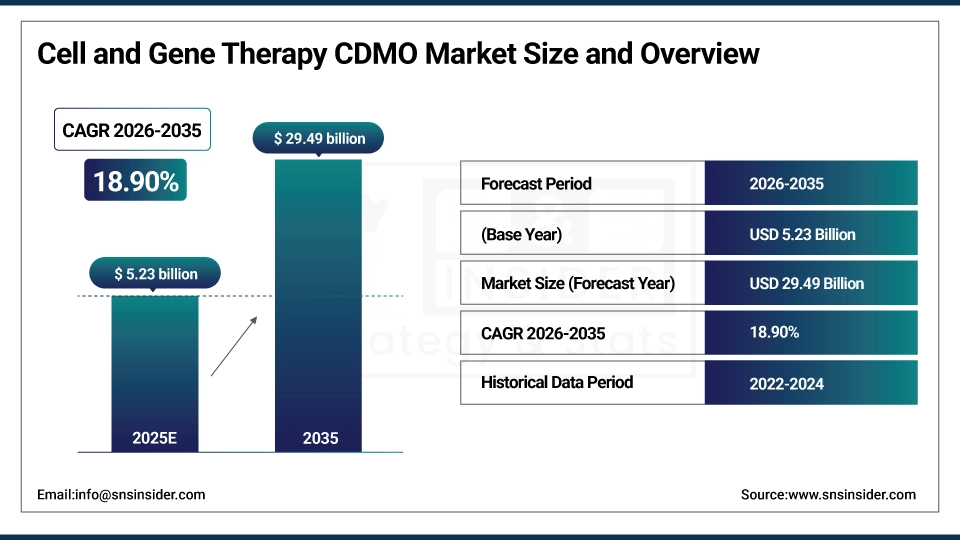
According to recent industry analysis, the growing commercialization of novel advanced therapies, increased pipeline activity, and outsourced demand by biopharmaceutical companies is driving market growth at a fast pace globally.
The Cell and Gene Therapy CDMO Industry is undergoing significant transformation, with more and more pharmaceuticals and biotech companies opting for contract manufacturing organizations that help with the manufacture of complex biological drugs. Manufacturing cell and gene therapies involves the need for sophisticated equipment, facilities for producing viral vectors, and the need to possess scalable commercial manufacturing capability.
Rising Clinical Pipeline Expansion and Commercialization of Advanced Therapies Accelerate Market Growth Globally
Increasing number of approved cell and gene therapies and robust clinical pipeline in late-stage phases are key growth drivers for specialized CDMO services globally. As per data from Alliance for Regenerative Medicine (ARM), more than 2,700 clinical trials for regenerative medicine & advanced therapy were being actively conducted globally in 2025, with cancer, rare genetic conditions, hematological disorders, and autoimmune diseases comprising the major therapeutic applications. Increasing approvals by US Food and Drug Administration (FDA) and European Medicines Agency (EMA) continues to fuel commercialization activities and outsourcing of manufacturing facilities.
Rapid adoption of viral vector-based therapies such as adeno-associated viruses (AAV), lentiviral vectors, and retroviruses, is resulting in significant demand for large-scale GMP compliant manufacturing capabilities. Many of the leading biopharma companies are partnering with CDMOs to address manufacturing constraints and expedite product development and marketing. In 2025, for instance, Thermo Fisher Scientific increased its manufacturing capabilities for viral vectors in the United States, to address rising demand for commercial scale gene therapies, while Lonza Group expanded its capacities in Europe and North America for autologous and allogeneic cell therapy manufacturing services.
Furthermore, increasing investments made by various stakeholders across the regenerative medicine manufacturing ecosystem will positively drive market growth. Industry investment funding data provided by ARM and BioPlan Associates reveals that investments made for cell and gene therapy manufacturing infrastructure exceeded USD 25 Billion globally between 2023-2025, owing to the need for improved manufacturing efficiency, scalable vector manufacturing, cryopreservation solutions, and automated bioprocessing.
However, increasing manufacturing costs, strict regulations, complexities involved in logistics, and manufacturing scalability issues continue to be key limiting factors for market growth. The necessity for specialized clean rooms, highly trained labor, and rigorous quality control standards results in high operational costs for manufacturers as well as CDMOs.
Key Report Highlights
- By Therapy Type, Cell Therapy dominated the market with a 49% revenue share in 2025, owing to increasing adoption of CAR-T therapies, stem cell therapies, and expanding oncology applications, while Gene Therapy is projected to be the fastest-growing segment during 2026-2035 due to rising approvals for rare disease treatments and growing viral vector demand.
- By Service Type, Manufacturing accounted for the largest market share of 57% in 2025, supported by rising commercial-scale production outsourcing, whereas Process & Analytical Development is expected to witness the fastest growth during the forecast period owing to increasing demand for process optimization and regulatory compliance support.
- By Vector Type, Viral Vectors held a dominant 69% market share in 2025, driven by strong adoption of lentiviral and AAV vector technologies across gene therapy applications, while Non-Viral Vectors are anticipated to register the fastest growth through 2035 due to advancements in lipid nanoparticles and plasmid DNA delivery systems.
- By End User, Biopharmaceutical Companies dominated the market with a 61% revenue share in 2025, supported by increasing outsourcing strategies and pipeline expansion activities, while Startups are projected to emerge as the fastest-growing segment during 2026-2035 due to rising venture capital investments and increasing innovation in regenerative medicine.
- Regionally, North America dominated the global Cell and Gene Therapy CDMO market, accounting for approximately 45% of total market revenue in 2025, while Asia-Pacific is expected to be the fastest-growing regional market, registering a CAGR of 23.05% during 2026-2035.
Regional Outlook:
North America accounted for nearly 45% of the share of the Cell and Gene Therapy CDMO Market in 2025 due to high biotechnology innovation ecosystems, increasing approval of new products by the FDA, clinical trials, and biologics manufacturing infrastructure. North America has been receiving significant growth due to a presence of large number of leading CDMOs, robust funding opportunities, and rise in personalized medicines.
The United States holds the highest share in North America market due to substantial spending on viral vectors, CAR-T therapy, and regenerative medicine products. North America continues its dominance during 2025 due to facility expansions by leading players involved in cell therapy manufacturing services to cater to late stage clinical and commercial manufacturing demands.
Asia-Pacific is likely to become the fastest-growing regional market during 2026 to 2035, with a high CAGR of 23.05%. The growth in the APAC region is attributed to rising innovation in biotechnology industry in countries like China, South Korea, Japan, Singapore, and India coupled with increased investments in biologics manufacturing facilities in the region. The countries in APAC have taken initiatives to manufacture innovative cell and gene therapies to curb their reliance on imports.
China has emerged as an important player in cell and gene therapy manufacturing due to government support, rising clinical pipelines, and increasing investments by local biopharmaceutical companies. South Korea's cell and gene therapy market is growing significantly with the help of global expansion by Samsung Biologics and rising contract manufacturing needs in APAC markets.
Recent Industry Developments
- In March 2025, Lonza Group expanded its cell and gene therapy manufacturing capabilities in Europe to support increasing commercial demand for autologous cell therapies and viral vector production.
- In June 2025, Thermo Fisher Scientific announced additional investments in viral vector manufacturing infrastructure in the United States to strengthen large-scale gene therapy production capacity.
- In February 2025, Samsung Biologics expanded advanced biologics production capabilities targeting regenerative medicine manufacturing services for global biopharmaceutical clients.
- In April 2025, WuXi Advanced Therapies introduced enhanced integrated development and manufacturing solutions for cell therapy developers to accelerate clinical-to-commercial transition timelines.
Leading Companies in the Cell and Gene Therapy CDMO Market
- AGC Biologics
- Bayer Cell Therapy Manufacturing
- Brammer Bio
- Catalent, Inc.
- Cell and Gene Therapy Catapult Manufacturing Innovation Centre
- Charles River Laboratories
- Cobra Biologics
- Fujifilm Diosynth Biotechnologies
- KBI Biopharma
- Kite Pharma Manufacturing
- Lonza Group
- Novasep
- Oxford Biomedica
- Porton Advanced Solutions
- Resilience
- Samsung Biologics
- Thermo Fisher Scientific
- Viralgen Vector Core
- WuXi Advanced Therapies
- Yposkesi
About the Author

Get in touch




