
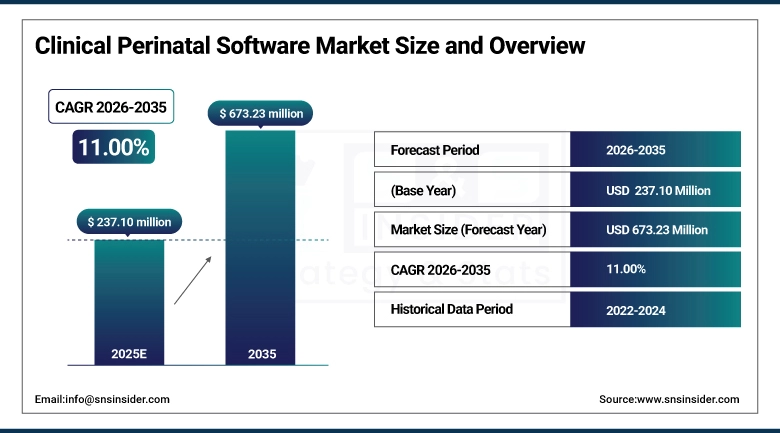
As per the SNS Insider Report titled, Clinical Perinatal Software Market Size, Share & Segmentation, By Deployment Mode, By Product Type, By Application, By End-User, By Region, And Global Forecast 2026–2035, “The global Clinical Perinatal Software Market size was valued at USD 237.10 million in 2025 and is anticipated to grow to USD 673.23 million by 2035, registering a CAGR of 11.00% over the 2026–2035 forecast period.”
Key Takeaways
- Cloud-Based / Web-Based deployment accounted for the leading 61.5% revenue share in 2025, supported by increasing adoption of scalable digital healthcare infrastructure.
- On-Premise deployment is projected to witness the fastest growth through 2035, expanding at a CAGR of 15.2% due to rising demand for enhanced data control and hospital-based integration systems.
- Electronic Fetal Monitoring Software dominated the market with a 35.8% share in 2025 owing to increasing emphasis on continuous fetal monitoring and real-time maternal health assessment.
- Analytics & Reporting Tools emerged as the fastest-growing product category, expected to expand at a CAGR of 16.4% during the forecast period.
- Maternal Care applications held the largest market share of 42.7% in 2025 due to increasing digitization of prenatal and postnatal healthcare workflows.
- High-Risk Pregnancy Management is anticipated to register the fastest CAGR of 15.8% through 2035, driven by growing incidences of pregnancy-related complications globally.
- Hospitals represented the leading end-user segment with a 48.3% market share in 2025 as large healthcare facilities continue to invest in integrated obstetric monitoring systems.
- North America dominated the Clinical Perinatal Software Market with a 52.0% share in 2025, while Asia Pacific is projected to record the fastest CAGR of approximately 13.98% between 2026 and 2035.
Why Clinical Perinatal Software Market is Growing?
The market for Clinical Perinatal Software is expected to see robust growth on account of increased emphasis on health outcomes for mothers and neonates, widespread use of electronic health record technology and greater integration of artificial intelligence based clinical decision support tools in obstetric care. Perinatal software systems have been implemented by various healthcare facilities to increase workflow efficiency, lower errors rates and ensure more accurate monitoring of the baby during labor and delivery.
The rise in high-risk pregnancies among older women along with other diseases such as diabetes and hypertension is contributing positively towards growth. In addition to that, various government programs aimed at digitization of the healthcare sector along with investment in smart hospitals are also aiding the adoption of cloud-based perinatal management solutions.
There is an increasing demand for enhanced interoperability among healthcare IT systems and easy access to real time information that is likely to motivate the adoption of updated obstetric management systems. Integration of predictive analysis, remote monitoring systems and alert functions would lead to many opportunities for software developers in the future.
Clinical Perinatal Software Market Statistics
- Globally, an estimated 295,000 deaths per year occur in women due to pregnancy and delivery complications, increasing the need for maternal care technology solutions.
- Nearly 15 percent of pregnant women face pregnancy complications necessitating specialized medical treatment, and their monitoring becomes essential in today's world.
- The proportion of hospitals using Electronic Health Records in developed economies exceeds 90%, facilitating a favorable ecosystem for introducing perinatal technologies.
- An average of over 130 million births take place around the world annually, underscoring the need for improved obstetric technology solutions.
- The annual investment in digital health solutions across the globe exceeds USD 20 billion, and funding for maternal-neonatal solutions grows steadily.
- Clinicians rely more frequently on AI-based tools to minimize adverse outcomes and improve the efficiency of delivery process management.
- Digitization of healthcare facilities in developing countries facilitates greater availability of maternal care technologies and cloud-based clinical solutions.
- Growing demand for remote patient monitoring drives the use of telehealth-based prenatal and postnatal management solutions.
Emerging Trends
There have been significant developments in technology within the Clinical Perinatal Software Market as a result of advancements in areas like artificial intelligence, predictive analytics, and interoperability in healthcare. There are also new AI-powered fetal monitoring tools available in the market which can help detect fetal complications early. In addition, vendors have introduced advanced analytics dashboards for better understanding of various clinical metrics regarding both the mother and the fetus.
In recent years, cloud-based solutions have become popular because of the ease of access and low costs involved in setting up such systems. Mobile apps are also making waves in the clinical perinatal software segment, as they provide a convenient way for patients to engage with doctors and monitor their pregnancy progress.
Other key trends in the industry include the development of centralized data management solutions that help healthcare facilities improve their delivery processes. Cybersecurity and data privacy measures are also being prioritized in light of greater digitalization.
Top 10 Companies
- Koninklijke Philips N.V.
- GE HealthCare
- Oracle Health
- PeriGen Inc.
- Cerner Corporation
- K2 Medical Systems
- Huntleigh Healthcare Limited
- Clinical Computer Systems, Inc.
- Edan Instruments Inc.
- Spacelabs Healthcare Inc.
About the Author

Get in touch




