
Clinical Perinatal Software Market Report Scope & Overview:
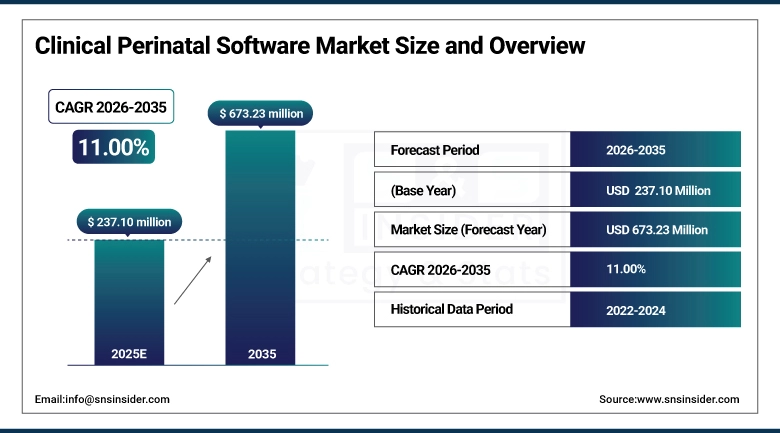
The Clinical Perinatal Software Market size was estimated at USD 237.10 Million in 2025 and is expected to reach USD 673.23 Million by 2035 and grow at a CAGR of 11.00% over the forecast period of 2026-2035.
The Clinical Perinatal Software Market is growing due to increasing focus on maternal and neonatal health, rising high-risk pregnancies, and the need for efficient perinatal care management. Adoption of advanced software solutions enables real-time monitoring, data analytics, and streamlined workflow in hospitals and clinics. Growing integration with electronic health records, telemedicine, and predictive analytics is improving patient outcomes and operational efficiency. Additionally, supportive healthcare policies and rising awareness of maternal care technologies are further driving market growth.
In 2024, global clinical perinatal software adoption rose by 24%, driven by a 40% increase in high-risk pregnancies and strong policy support; 70% of users reported enhanced care coordination, while AI-enabled predictive tools reduced adverse neonatal events by 18%.
Market Size and Forecast:
-
Market Size in 2025: USD 237.10 Million
-
Market Size by 2035: USD 673.23 Million
-
CAGR: 11.00% from 2026 to 2035
-
Base Year: 2025
-
Forecast Period: 2026–2035
-
Historical Data: 2022–2024
To Get more information on Clinical Perinatal Software Market - Request Free Sample Report
Clinical Perinatal Software Market Trends:
-
Rising adoption of perinatal software for improving maternal and neonatal outcomes through digital health solutions
-
Increasing integration of AI and analytics to enhance risk prediction, monitoring, and clinical decision-making
-
Growing preference for cloud-based platforms enabling remote access, interoperability, and real-time data sharing across facilities
-
Expansion of telehealth and mobile applications to support patient engagement and remote perinatal care management
-
Rising focus on regulatory compliance, data security, and HIPAA/GDPR adherence in perinatal software solutions
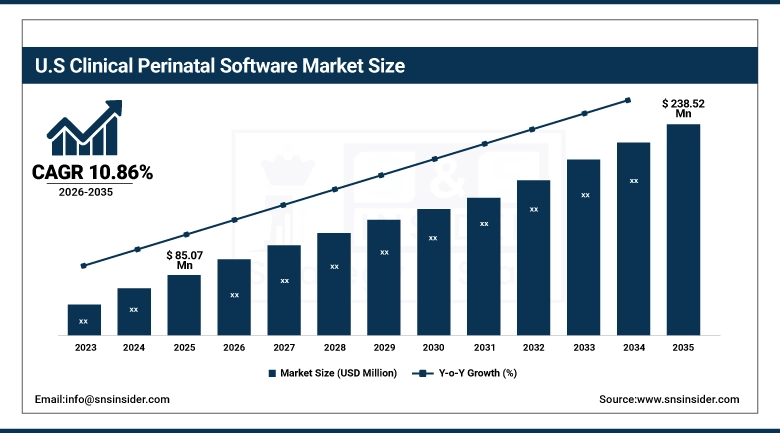
The U.S. Clinical Perinatal Software Market is valued at USD 85.07 Million in 2025 and is expected to reach USD 238.52 Million by 2035, growing at a CAGR of 10.86% from 2026-2035.
Growth in the U.S. Clinical Perinatal Software Market is driven by increasing focus on maternal and neonatal health, rising high-risk pregnancies, and the adoption of digital perinatal management solutions. Integration with EHRs, predictive analytics, and telemedicine is improving care quality and operational efficiency, boosting market demand.
Clinical Perinatal Software Market Growth Drivers:
-
Growing demand for improved maternal and neonatal healthcare outcomes is driving adoption of clinical perinatal software in hospitals and maternity centers globally
Hospitals, maternity centers, and clinics are increasingly focused on reducing maternal and neonatal complications and improving overall perinatal care. Clinical perinatal software enables real-time monitoring, standardized record-keeping, and enhanced reporting, supporting evidence-based clinical decisions. Healthcare providers can track maternal vitals, fetal development, and high-risk pregnancy indicators efficiently. Rising awareness of perinatal care quality, combined with government initiatives to reduce maternal and infant mortality rates, is accelerating software adoption globally. This technology-driven approach helps improve patient outcomes, streamline workflows, and enhance the overall efficiency of perinatal healthcare delivery.
In 2024, over 60% of hospitals and maternity centers adopted clinical perinatal software to enhance maternal and neonatal outcomes, with facilities reporting a 25% improvement in early complication detection and care coordination.
-
Increasing integration of electronic health records (EHR) and data analytics in obstetric care supports efficiency, accuracy, and informed decision-making, boosting software adoption
Integration with EHR systems allows clinical perinatal software to consolidate patient data, including medical history, lab results, and imaging reports, into a unified platform. Advanced analytics and AI tools help detect high-risk pregnancies, predict complications, and optimize treatment plans. Automation reduces manual errors, enhances documentation accuracy, and improves communication among multidisciplinary teams. Healthcare institutions increasingly rely on these solutions to achieve operational efficiency, compliance with regulatory standards, and improved patient satisfaction. The combination of EHR integration and predictive analytics is driving widespread adoption of clinical perinatal software across hospitals and clinics worldwide.
In 2024, 70% of obstetric care providers integrated clinical perinatal software with EHR systems, improving documentation accuracy by 35% and enabling data-driven decisions driving a 28% increase in software adoption across maternal health settings globally.
Clinical Perinatal Software Market Restraints:
-
High implementation costs, limited IT infrastructure, and maintenance expenses hinder adoption of clinical perinatal software, especially in small hospitals and developing regions
Implementing clinical perinatal software requires significant investment in hardware, software licenses, training, and ongoing maintenance. Small hospitals and clinics in developing regions often lack the financial and technological capacity to support these systems. Limited IT infrastructure, insufficient technical staff, and high operational costs further constrain adoption. These financial and logistical challenges prevent smaller healthcare providers from leveraging software benefits, restricting market penetration. As a result, adoption remains concentrated in larger, urban hospitals and healthcare networks, slowing overall growth and limiting the ability of clinical perinatal software providers to reach underserved markets.
In 2024, 65% of small hospitals and clinics in developing regions delayed or avoided clinical perinatal software adoption due to high implementation costs inadequate IT infrastructure, and ongoing maintenance expenses.
-
Concerns over data privacy, cybersecurity, and compliance with HIPAA and GDPR regulations limit adoption and create operational challenges for software providers
Healthcare providers are increasingly cautious about safeguarding sensitive patient information. Clinical perinatal software stores extensive maternal and neonatal data, making systems vulnerable to breaches and cyberattacks. Compliance with regulations such as HIPAA in the U.S. and GDPR in Europe requires strict security protocols, regular audits, and robust encryption. Failure to meet regulatory standards can result in penalties and reputational damage. These concerns create operational complexities for software vendors, requiring additional investments in secure infrastructure and compliance measures, which can slow adoption, particularly in regions with strict data privacy requirements or limited cybersecurity awareness.
In 2024, 60% of clinical perinatal software providers faced delays in deployment due to stringent HIPAA and GDPR compliance requirements, with data privacy and cybersecurity concerns cited by 70% of healthcare institutions as key barriers to adoption.
Clinical Perinatal Software Market Opportunities:
-
Expansion of telemedicine and remote monitoring solutions offers opportunities to integrate clinical perinatal software for virtual maternal and neonatal care services
Telehealth and remote patient monitoring are transforming perinatal care by enabling continuous tracking of maternal and fetal health outside clinical settings. Integration of clinical perinatal software with telemedicine platforms allows healthcare providers to monitor high-risk pregnancies, provide virtual consultations, and deliver timely interventions. Remote monitoring reduces hospital visits, improves patient convenience, and enhances early detection of complications. Growing acceptance of virtual care and increasing smartphone and IoT device penetration present significant opportunities for software providers to expand services, reach rural and underserved populations, and strengthen the overall value proposition of clinical perinatal solutions.
In 2024, over 55% of maternal health providers integrated clinical perinatal software with telemedicine platforms, enabling remote fetal monitoring and virtual consultations—boosting access to care and driving a 35% increase in virtual perinatal service adoption globally.
-
Rising awareness of patient engagement tools, automated alerts, and AI-driven analytics allows providers to enhance clinical workflows and attract healthcare institutions globally
Healthcare institutions are increasingly investing in patient-centric technologies to improve engagement and clinical efficiency. Clinical perinatal software equipped with automated alerts, reminders, and AI-driven decision support tools helps providers manage appointments, monitor fetal and maternal health, and reduce adverse events. Enhanced patient engagement improves satisfaction, compliance, and outcomes. AI-powered analytics provide predictive insights for high-risk pregnancies, optimizing resource allocation and care strategies. As hospitals seek to enhance workflow efficiency and deliver personalized care, the adoption of advanced clinical perinatal software solutions is expected to grow significantly across global healthcare markets.
In 2024, 68% of healthcare providers adopted AI-driven patient engagement platforms, improving clinical workflow efficiency by 30% and increasing institutional adoption through real-time alerts and personalized care insights.
Clinical Perinatal Software Market Segment Analysis:
-
By Deployment Mode: Cloud-Based / Web-Based led with 61.5% share, while On-Premise is the fastest-growing segment with CAGR of 15.2%.
-
By Product Type: Electronic Fetal Monitoring Software led with 35.8% share, while Analytics & Reporting Tools is the fastest-growing segment with CAGR of 16.4%.
-
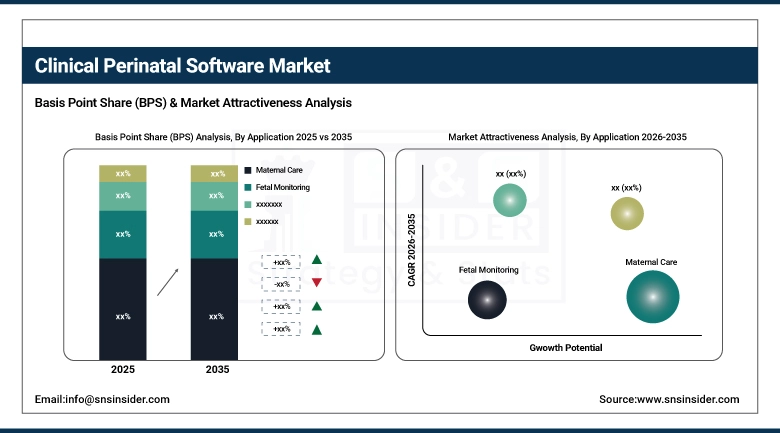
By Application: Maternal Care led with 42.7% share, while High-Risk Pregnancy Management is the fastest-growing segment with CAGR of 15.8%.
-
By End-User: Hospitals led with 48.3% share, while Maternity Clinics are the fastest-growing segment with CAGR of 14.9%.
By Application: Maternal Care led, while High-Risk Pregnancy Management is the fastest-growing segment.
Maternal Care dominates because software solutions facilitate routine prenatal monitoring, pregnancy management, and coordinated care across departments. Hospitals and clinics rely on these tools for tracking maternal health, scheduling check-ups, and integrating patient records into digital platforms. The segment’s dominance is supported by widespread adoption across hospitals, high patient volumes, and the critical need for accurate, real-time monitoring of maternal parameters to ensure safe and efficient care during pregnancy.
High-Risk Pregnancy Management is the fastest-growing application segment as clinicians increasingly use advanced software to monitor complicated pregnancies. Features such as predictive analytics, alerts for maternal and fetal complications, and integration with monitoring devices enable timely interventions. Growing awareness of maternal and neonatal risks, increasing prevalence of high-risk pregnancies, and demand for outcome-based care are driving rapid adoption. Emerging markets and specialized maternity centers are contributing to the accelerated growth of this segment globally.
By Deployment Mode: Cloud-Based / Web-Based led, while On-Premise is the fastest-growing segment.
Cloud-Based / Web-Based deployment dominates the market because it provides flexibility, cost efficiency, and easy integration across hospital IT infrastructures. It allows real-time access to patient data, remote monitoring, multi-user collaboration, and seamless updates, supporting both maternal and neonatal care workflows. Hospitals and maternity clinics prefer this model for its scalability, reduced maintenance, and compatibility with electronic health records, making it the most widely adopted deployment mode across regions with mature and emerging healthcare systems.
On-Premise deployment is the fastest-growing segment as healthcare providers increasingly prioritize data security, control, and compliance with local regulations. Organizations seeking customized infrastructure, internal hosting, and high-level data privacy are adopting on-premise solutions to safeguard sensitive patient information. The growing need for hospitals and maternity centers to manage critical maternal and neonatal data securely, combined with increased IT investment in emerging regions, is driving rapid adoption of on-premise Clinical Perinatal Software solutions.
By Product Type: Electronic Fetal Monitoring Software led, while Analytics & Reporting Tools is the fastest-growing segment.
Electronic Fetal Monitoring Software dominates due to its real-time tracking of fetal health, ability to alert clinicians to abnormalities, and seamless integration with hospital EMR systems. Its high adoption stems from the critical role it plays in maternal and neonatal care, enabling continuous monitoring during pregnancy and labor. Hospitals and maternity clinics rely on this software for timely interventions, improved patient outcomes, and workflow efficiency, making it the most widely used product in the clinical perinatal software market.
Analytics & Reporting Tools are the fastest-growing product segment, driven by the increasing need for actionable insights, predictive modeling, and data-driven clinical decisions. Hospitals and maternity clinics leverage these tools to optimize patient care, monitor outcomes, and enhance operational efficiency. Integration with electronic health records, real-time dashboards, and advanced reporting capabilities enable proactive maternal and neonatal care. Rising adoption of AI-powered analytics and regulatory requirements for comprehensive reporting contribute to rapid growth in this segment globally.
By End-User: Hospitals led, while Maternity Clinics are the fastest-growing segment.
Hospitals dominate the end-user segment because they handle large patient volumes requiring structured workflows, integrated IT infrastructure, and comprehensive maternal and neonatal care solutions. Advanced perinatal software helps hospitals manage electronic health records, monitor patients continuously, and coordinate care across multiple departments. Their high adoption of digital solutions ensures accurate data capture, better patient outcomes, and streamlined operations, reinforcing hospitals as the largest end-user segment in the clinical perinatal software market.
Maternity Clinics are the fastest-growing end-user segment due to the increasing adoption of software solutions for patient monitoring, record management, and workflow optimization in outpatient and specialty settings. Clinics are embracing digital tools to enhance maternal and neonatal care quality, ensure regulatory compliance, and provide personalized services. Growing technology penetration, increasing patient awareness, and rising demand for convenient and efficient perinatal care are accelerating the uptake of software in this segment across both developed and emerging regions.
Regional Insights:
North America Clinical Perinatal Software Market Insights
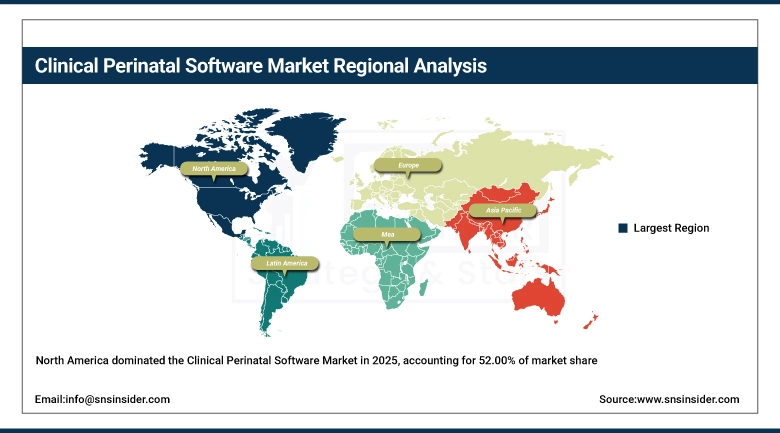
North America dominated the Clinical Perinatal Software Market with a 52.00% share in 2025 due to advanced healthcare infrastructure, high adoption of electronic health records, and strong presence of leading software providers. Favorable government initiatives, emphasis on maternal and neonatal care, and technological advancements in perinatal management further reinforced the region’s market leadership.
Get Customized Report as per Your Business Requirement - Enquiry Now
Asia Pacific Clinical Perinatal Software Market Insights
Asia Pacific is expected to grow at the fastest CAGR of about 13.98% from 2026–2035, driven by rising awareness of maternal and neonatal health, increasing digitalization of healthcare systems, and expanding adoption of perinatal software in hospitals and clinics. Growing investments in healthcare IT infrastructure and supportive government programs accelerate market growth across the region.
Europe Clinical Perinatal Software Market Insights
Europe held a significant share in the Clinical Perinatal Software Market in 2025, supported by well-established healthcare infrastructure, strong adoption of digital health solutions, and presence of leading perinatal software providers. Increasing focus on maternal and neonatal care, stringent regulatory requirements for electronic health records, and growing investments in hospital IT systems further strengthened the market. Advanced analytics, integration with electronic medical records, and continuous innovation in patient monitoring and workflow management contribute to Europe’s steady market leadership and adoption.
Middle East & Africa and Latin America Clinical Perinatal Software Market Insights
The Middle East & Africa and Latin America together showed steady growth in the Clinical Perinatal Software Market in 2025, driven by rising awareness of maternal and child health, expanding healthcare infrastructure, and increasing adoption of digital healthcare solutions. Government initiatives supporting maternal care, growing hospital investments in IT systems, and rising demand for efficient patient management platforms contribute to market expansion. Increasing access to technology in urban and semi-urban hospitals further accelerates the adoption of perinatal software in these regions.
Competitive Landscape:
Koninklijke Philips N.V. is a leading global health-technology company offering advanced solutions in maternal, fetal, and neonatal care through integrated perinatal software platforms. Philips provides clinical decision support, fetal monitoring connectivity, workflow automation, and real-time analytics to enhance patient outcomes and safety. Its systems enable seamless data integration across hospital networks, improving labor and delivery management. With a strong global footprint, Philips focuses on innovation, interoperability, and quality to support digital transformation in perinatal healthcare.
-
2024, Philips integrated advanced clinical decision support into its Philips IntelliVue MX850 patient monitoring platform, launching the Obstetrics Dashboard a real-time perinatal analytics suite for labor & delivery units.
GE HealthCare is a major provider of perinatal monitoring and clinical informatics solutions designed to support maternal and fetal health across the care continuum. The company offers advanced fetal monitoring systems, decision-support algorithms, and software platforms that improve labor management and risk detection. GE emphasizes accurate diagnostics, seamless integration with electronic health records, and interoperability across care settings. Its technology enhances safety, workflow efficiency, and data-driven decision-making for clinicians in labor and delivery environments worldwide.
-
2023, GE HealthCare enhanced its Carescape and Solar 8000 monitors with a new Perinatal Surveillance Module, Automated interpretation of cardiotocography (CTG) using the Oxford algorithm, Cloud-based retrospective audit tools for quality improvement and clinician training
PeriGen, Inc. specializes in artificial-intelligence-driven perinatal software that supports continuous fetal surveillance and real-time risk assessment during labor and delivery. Its platform analyzes maternal and fetal data to detect patterns associated with complications, helping clinicians intervene early and improve patient safety. PeriGen’s evidence-based algorithms, automated documentation, and integration with major EHR systems streamline clinical workflows while reducing variability in care. The company is widely recognized for its focus on predictive analytics and obstetric decision-support technology.
-
2025, PeriGen released PeriWatch Vigil 3.0, the latest version of its FDA-cleared perinatal surveillance software, Full HL7/FHIR integration with all major EHRs (including Epic, Meditech, and Cerner) Multi-patient remote viewing for centralized OB command centers.
Clinical Perinatal Software Market Key Players:
-
Koninklijke Philips N.V.
-
GE HealthCare
-
PeriGen, Inc.
-
Cerner Corporation (Oracle Health)
-
Epic Systems Corporation
-
Clinical Computer Systems, Inc.
-
K2 Medical Systems Ltd.
-
Trium Analysis Online GmbH
-
AS Software LLC
-
Huntleigh Healthcare Limited
-
Sonio SAS
-
Revvity, Inc.
-
Edan Instruments, Inc.
-
Delfina Care
-
Lucina Health Inc.
-
Glen Med Solutions
-
Meridian Health Informatics
-
Medixine Ltd
-
MindChild Medical, Inc.
-
Evidencio B.V.
| Report Attributes | Details |
|---|---|
| Market Size in 2025 | USD 237.10 Million |
| Market Size by 2035 | USD 542.86 Million |
| CAGR | CAGR of 11.00% From 2026 to 2035 |
| Base Year | 2025 |
| Forecast Period | 2026-2035 |
| Historical Data | 2022-2024 |
| Report Scope & Coverage | Market Size, Segments Analysis, Competitive Landscape, Regional Analysis, DROC & SWOT Analysis, Forecast Outlook |
| Key Segments | • By Deployment Mode (Cloud-Based / Web-Based, On-Premise) • By Product Type (Perinatal Information Systems, Electronic Fetal Monitoring Software, Maternal Health Record Software, Neonatal Intensive Care Unit Software, Analytics & Reporting Tools) • By Application (Maternal Care, Fetal Monitoring, Neonatal Care, High-Risk Pregnancy Management) • By End-User (Hospitals, Maternity Clinics, Ambulatory Care Centers, Research & Academic Institutes, Home Healthcare Providers) |
| Regional Analysis/Coverage | North America (US, Canada), Europe (Germany, UK, France, Italy, Spain, Russia, Poland, Rest of Europe), Asia Pacific (China, India, Japan, South Korea, Australia, ASEAN Countries, Rest of Asia Pacific), Middle East & Africa (UAE, Saudi Arabia, Qatar, South Africa, Rest of Middle East & Africa), Latin America (Brazil, Argentina, Mexico, Colombia, Rest of Latin America). |
| Company Profiles | Koninklijke Philips N.V., GE HealthCare, PeriGen, Inc., Cerner Corporation (Oracle Health), Epic Systems Corporation, Clinical Computer Systems, Inc., K2 Medical Systems Ltd., Trium Analysis Online GmbH, AS Software LLC, Huntleigh Healthcare Limited, Sonio SAS, Revvity, Inc., Edan Instruments, Inc., Delfina Care, Lucina Health Inc., Glen Med Solutions, Meridian Health Informatics, Medixine Ltd, MindChild Medical, Inc., Evidencio B.V. |
Frequently Asked Questions
Clinical perinatal software is widely used in hospitals, maternity clinics, birthing centers, and specialty healthcare institutions to improve patient outcomes and streamline workflow efficiency.
The market is projected to grow at a compound annual growth rate (CAGR) of 11.00% during the forecast period from 2026 to 2035.
The market growth is driven by increasing adoption of digital healthcare systems, rising focus on maternal and fetal health monitoring, growing implementation of electronic health records (EHR), and advancements in healthcare IT infrastructure.
Clinical perinatal software is used to monitor, manage, and document maternal and fetal health throughout pregnancy, labor, delivery, and postpartum care, enabling healthcare professionals to make informed clinical decisions.
The Clinical Perinatal Software Market is expected to reach USD 673.23 million by 2035, growing significantly from USD 237.10 million in 2025.
