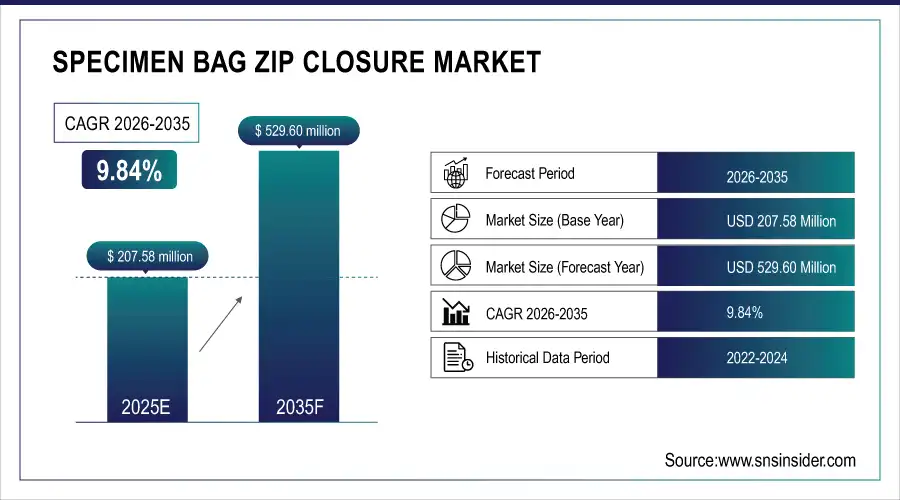
As per the SNS Insider Report titled, Specimen Bag Zip Closure Market by Material Type, by Product Configuration, by Closure Feature/Security, by Application/Usage, by End-User Industry, by Region, And Global Forecast 2026–2035, “The global Specimen Bag Zip Closure Market size valued at USD 207.58 Million in 2025, is anticipated to grow to USD 529.60 Million by 2035, registering a CAGR of 9.84% over the 2026–2035 forecast period.”
Key Takeaways
-
LDPE emerged as the leading material type segment, accounting for 38.46% of the market share in 2025 owing to its durability, flexibility, and cost-effectiveness in specimen handling applications.
-
Biodegradable specimen bags are projected to witness the fastest growth, registering a CAGR of 14.25% during 2026–2035 as sustainability initiatives gain momentum across healthcare and laboratory sectors.
-
Standard Flat bags dominated the product configuration segment with a 45.32% share in 2025 due to their widespread use in hospitals, diagnostic laboratories, and specimen transportation.
-
Multi-Compartment bags are expected to expand at the fastest CAGR of 13.14% through the forecast period, driven by increasing demand for organized and contamination-free specimen storage.
-
Standard Resealable bags accounted for the largest share of 50.45% in 2025, supported by their ease of use and reliable specimen protection capabilities.
-
Security-Sealed bags with QR/Barcode features are anticipated to record the fastest CAGR of 13.89% during 2026–2035 as healthcare providers increasingly prioritize specimen traceability and chain-of-custody management.
-
Medical Specimens represented the largest application segment with a 41.78% market share in 2025, while Forensic Evidence applications are expected to grow at the fastest CAGR of 13.67% over the forecast period.
-
North America dominated the global market with a 38.72% share in 2025, while Asia-Pacific is expected to emerge as the fastest-growing region with a CAGR of 12.40% through 2035.
Why Specimen Bag Zip Closure Market is Growing?
There is considerable growth being witnessed in the Specimen Bag Zip Closure Market owing to an increase in diagnostic tests, lab processes, and specimen transportation globally. Due to the rise in cases of contagious diseases, chronic diseases, and regular health check-ups, there will be a high demand for specimen bags that ensure safety during transportation.
Another major driver for growth in the Specimen Bag Zip Closure Market is the rising focus on disease prevention and protection. Advanced specimen bags have now started being used by various labs and institutions, which can ensure that the process is safe, free from leakage, and cannot be tampered with. There is an increase in chain-of-custody requirements, especially for medical and forensic samples, which has further boosted demand.
Moreover, developments in the healthcare industry, rising investment in diagnostic labs, and usage of eco-friendly packaging materials are some other drivers that are promoting growth in the market. The advent of biodegradable specimen bags and digital tracking of packages is projected to provide huge opportunities to players in the market going forward.
Specimen Bag Zip Closure Market Statistics
-
More than 14 billion laboratory tests are conducted annually worldwide, highlighting the growing need for reliable specimen transportation and storage solutions.
-
Hospitals and diagnostic laboratories collectively process millions of biological samples every day, requiring secure and contamination-resistant packaging products.
-
Global healthcare expenditure surpassed USD 10 trillion in recent years, supporting investments in laboratory infrastructure and specimen management systems.
-
The number of diagnostic laboratories worldwide continues to expand rapidly due to increasing demand for preventive healthcare and disease screening services.
-
Clinical diagnostics account for a significant proportion of healthcare decision-making, with laboratory testing influencing approximately 70% of medical diagnoses.
-
Forensic laboratories across numerous countries are increasing investments in evidence management systems to ensure secure handling and traceability of biological samples.
-
Sustainable healthcare packaging adoption is rising as medical institutions seek environmentally responsible alternatives to conventional plastic-based products.
-
The global volume of pathology and microbiology testing has increased substantially over the past decade due to advancements in diagnostic technologies.
Emerging Trends
The first significant trend in the Specimen Bag Zip Closure Market includes the use of eco-friendly and sustainable specimen bags. The healthcare industry is working towards making their packaging eco-friendly and sustainable to eliminate plastic medical waste from the environment.
The second trend in this market involves the use of technologies like barcodes and QR codes in specimen bags. Such technologies make it easier to track the specimens and avoid labeling mistakes and improve efficiency.
Moreover, manufacturers are paying attention to multi-compartment specimen bags, where users can place different documents including requisition forms inside a single bag along with the specimen. This feature will help streamline the entire process.
Lastly, there is growing demand for tamper-resistant and chain-of-custody-compliant specimen bags in forensics and diagnostics.
Top 10 Companies
-
Thermo Fisher Scientific Inc.
-
Cardinal Health, Inc.
-
Merck KGaA
-
Heathrow Scientific LLC
-
Minigrip LLC
-
Simport Scientific Inc.
-
LK Packaging
-
VWR International LLC
-
Medline Industries, LP
-
Dynarex Corporation
About the Author

Get in touch