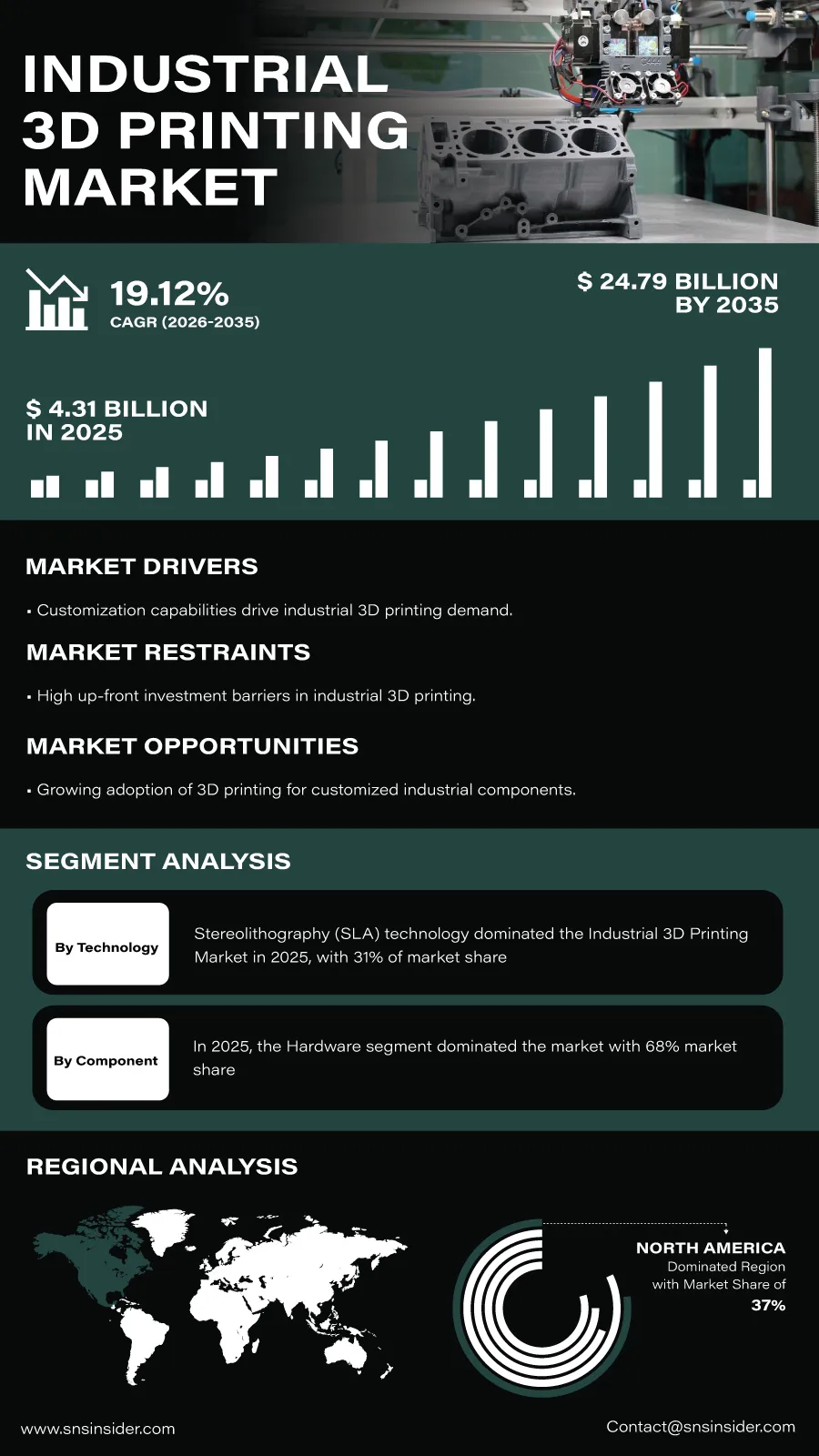
The global Industrial 3D Printing Market is witnessing substantial growth due to the growing use of additive manufacturing in order to enhance production efficiency and facilitate custom part manufacturing while minimizing waste. “According to a recent study by SNS Insider, the global Industrial 3D Printing Market size, valued at USD 4.31 billion in 2025, is anticipated to reach USD 24.79 billion by 2035, registering a CAGR of 19.12% over the forecast period 2026–2035.”
The rising use of 3D printing in industry sectors such as aerospace, automotive, healthcare, and manufacturing is driving an increase in demand for highly specialized solutions in terms of additive manufacturing machinery, materials, and software tools. 3D printing technologies are more and more being used by manufacturers to create complicated parts and shapes, light products, custom medical devices, and high-precision prototypes.
As various industries shift from conventional manufacturing to digital manufacturing, there is a move towards industrial 3D printing being utilized for more than just prototype creation and toward being used for end parts as well. This is due to developments in stereolithography, metal additive manufacturing, multi-material printing, and artificial intelligence-enabled design software. The government is also backing such initiatives.
To Get Detailed Insights on the Industrial 3D Printing Market – Request a Sample Report
Customized Manufacturing and Sustainable Production Create New Growth Opportunities
The increasing need for custom parts and intricate industrial designs has led to increased use of 3D printing technology by manufacturers. Additive manufacturing allows businesses to make specialized parts without needing expensive tooling, which makes it ideal for low-volume manufacturing and complex design parts. The aerospace industry is using additive manufacturing technology to make light-weight parts while the automotive industry is using additive manufacturing for prototypes, tooling, and certain parts of production.
Increasing emphasis on sustainable manufacturing is opening up new possibilities for industrial 3D printing services. The difference between conventional manufacturing practices and additive manufacturing practices is that additive manufacturing constructs parts in layers and therefore minimizes material wastage and improves material efficiency. There are efforts made by manufacturers to produce goods locally and maintain digital inventories in order to minimize the need for transport.
However, high capital cost needs and the shortage of skilled personnel continue to pose problems for industry-wide adoption. High-end 3D printers need high capital costs in terms of machinery, raw material, software, and manpower. Small manufacturers will find it hard to justify these costs without having a production schedule. Technology companies have been trying to address this issue by increasing the speed of printing, streamlining the production process through automation, and creating software solutions to make the process more efficient.
Key Market Insights Highlight Shifting Demand Patterns
By technology, Stereolithography (SLA) accounted for approximately 31% of global Industrial 3D Printing Market revenue in 2025 due to its ability to manufacture highly detailed components with smooth surface finishes and excellent dimensional accuracy. SLA technology continues to gain adoption across healthcare, dental manufacturing, automotive prototyping, and aerospace applications where component precision and surface quality are critical. The segment is also projected to register the fastest growth, expanding at a CAGR of approximately 30.87% from 2026 to 2035, as advancements in resin formulations, laser processing, and high-speed printing improve production efficiency and expand industrial applications.
Based on component, the Hardware segment dominated the market with approximately 68% of revenue in 2025 owing to the strong investments in industrial-grade 3D printers across aerospace, automotive, healthcare, and general manufacturing industries. Growing demand for advanced polymer and metal printing equipment is encouraging manufacturers to expand production capacity and integrate additive manufacturing into established industrial workflows. Meanwhile, the Software segment is anticipated to register the fastest growth, with a projected CAGR of approximately 29.96%, supported by increasing adoption of advanced modeling, simulation, automated build preparation, and AI-assisted design optimization solutions.
Digital Manufacturing and AI-Enabled Design Technologies Strengthen Market Demand
The increasing adoption of industrial 3D printing technology in combination with digital manufacturing systems is changing the way businesses design, prototype, and produce intricate parts. High-end 3D printers allow manufacturers to speed up the process of product development, cut down on tooling costs, and produce specialized parts near to where they will be used. Additive manufacturing technology is being extensively used by healthcare facilities for making personalized implants, prostheses, and anatomical models, while aerospace and defense firms are investigating structural components and specialized tooling.
The field of artificial intelligence (AI), as well as manufacturing software, is helping to expand the possibilities of additive manufacturing in industry. The use of AI technologies in designing can be helpful for engineers when developing complicated geometrical forms of components, optimizing the consumption of material resources, and saving time during repetitive design operations. In December 2024, Backflip, a company launched by executives who previously worked at Markforged, received a financing of USD 30 million for the development of AI-driven 3D design technologies.
North America Leads Industrial 3D Printing Market with 37% Share as Asia Pacific Registers Fastest Growth at 20.10% CAGR
North America continued to be the leading region of the global Industrial 3D Printing Market by contributing about 37% of the total revenue generated globally in 2025. The domination of the region is attributed to the presence of robust aerospace and defense sectors, well-developed research and development framework, and early adoption of advanced manufacturing technology. Rising investments in additive manufacturing machines, production of customized medical devices, and application in automotive manufacturing will drive the regional market forward. The United States was the major player in the market with the Industrial 3D Printing Market valued at around USD 1.62 billion in 2025 and forecast to grow to USD 9.30 billion by 2035. Increasing application of metal and polymer additive manufacturing and industrial innovation programs initiated by the government will fuel market growth.
Asia Pacific is expected to have the highest regional growth rate with a forecasted CAGR of around 20.10% during 2026-2035 owing to rapid industrialization, expansion of manufacturing facilities, and investments in cutting-edge production technology. China, Japan, India, and South Korea are emerging as major regions for 3D printing equipment and services in manufacturing due to their quest for flexible production methods and customized components. Government efforts aimed at encouraging domestic manufacturing and innovation further drive the adoption of 3D printing. Europe is also a major region for 3D printing with a share of about 22% in total revenue globally in 2025 owing to its presence of automotive, aerospace, and healthcare manufacturing industries.
Industry Participants Focus on High-Speed Printing and Advanced Manufacturing Innovation
Industrial 3D Printing Market Competition is becoming more focused on speed of printing, material suitability, manufacturing accuracy, and scalability. Industrial printer manufacturers are working on building systems that can provide support for bigger build volumes, improved component accuracy, and decreased production costs. The firms are also working on developing their software solutions so that they include design optimization, process automation, and quality management within their additive manufacturing offerings. Collaboration with industries like aerospace, automotive, and medical devices is aiding the technology firms in their transition from prototype manufacturing to industrial manufacturing.
In April 2025, Stratasys introduced its Neo800+ stereolithography 3D printer, designed to deliver up to 50% faster printing throughput for demanding industrial applications, including aerospace tooling, automotive prototyping, and wind tunnel testing. The development highlights increasing demand for high-speed additive manufacturing systems capable of producing accurate, large-format components. In November 2024, HP introduced additive manufacturing innovations at Formnext, including its HP 3D Build Optimizer and developments involving polymer materials and Metal Jet technology. These initiatives reflect the industry's continued focus on improving manufacturing efficiency, reducing production costs, and expanding the commercial viability of industrial 3D printing.
Key companies operating in the global Industrial 3D Printing Market include 3D Systems Corporation, Materialise NV, HP Inc., GE Additive, EOS GmbH, Nikon SLM Solutions, Desktop Metal, Formlabs Inc., Renishaw plc, UltiMaker, Carbon, Inc., Markforged, voxeljet AG, ExOne, Proto Labs, Inc., Zortrax S.A., XYZprinting, FlashForge, Raise3D, and Stratasys Ltd.
An SNS Insider analyst, Sushant Kadam, commented, “The increasing adoption of additive manufacturing across aerospace, automotive, healthcare, and industrial production is creating substantial opportunities for the global industrial 3D printing industry. As manufacturers prioritize customized production, material efficiency, and greater design flexibility, companies that deliver advanced printing technologies, intelligent manufacturing software, and cost-effective production solutions will be well positioned to benefit from the continued transition toward digitally enabled industrial manufacturing.”
About the Author

Get in touch