
Aerospace And Defense Robotic Automation Actuators Market Report Scope & Overview:
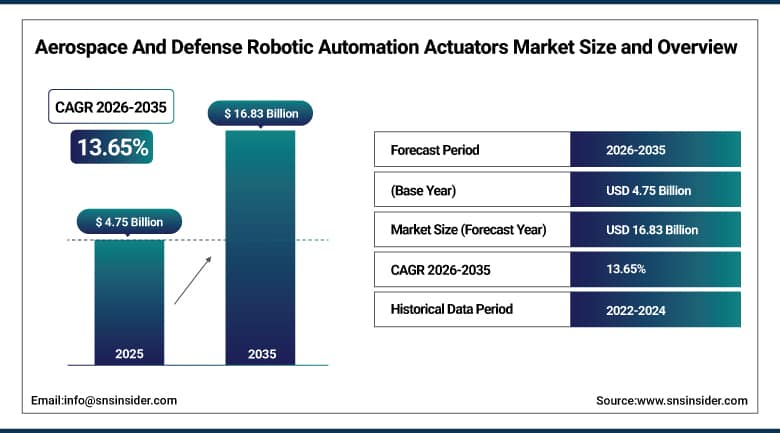
Aerospace And Defense Robotic Automation Actuators Market was valued at USD 4.75 billion in 2025 and is expected to reach USD 16.83 billion by 2035, growing at a CAGR of 13.65% from 2026-2035.
The Aerospace & Defense Robotic Automation Actuators market is witnessing significant growth due to the increasing need for high-tech automated systems that offer better precision, lightweight features, and increased efficiency. Advancements in electro-mechanical actuators, AI-powered robotics technology, and innovative flight control systems have led to enhanced capabilities in areas such as UAVs, satellite robotics, and automated defense systems. Growing expenditures on defense modernization, along with advancements in space exploration programs, are boosting the use of robotic actuators in fixed-wing aircrafts, rotary-wing aircrafts, space vehicles, and defense robotics.
Supporting this trend, the U.S. Department of Defense allocated over USD 842 billion in 2024 toward modernization programs, with a significant portion directed at advanced aerospace and defense robotics, including actuator systems. The Federal Aviation Administration (FAA) reported that more than 7,000 UAVs were registered for defense and commercial aerospace use in 2023, underscoring the rapid expansion of unmanned platforms requiring high‑precision actuators.
Meanwhile, the European Defence Fund (EDF) committed EUR 1.2 billion in 2024 to collaborative defense innovation projects, many of which integrate robotic automation actuators for next‑generation aircraft and ground defense robotics.
To Get More Information On Aerospace And Defense Robotic Automation Actuators Market - Request Free Sample Report
Aerospace And Defense Robotic Automation Actuators Market Trends
-
Shift to electro-mechanical actuators replacing hydraulics for lighter weight, higher efficiency, and reduced maintenance.
-
Integration of AI and robotics enabling autonomous flight control, UAV swarm operations, and predictive maintenance.
-
Defense modernization programs driving adoption of advanced actuator systems in next-gen aircraft and ground robotics.
-
Space exploration initiatives boosting demand for actuators in spacecraft, satellites, and launch vehicles.
-
UAV proliferation accelerating actuator demand for surveillance, combat, and logistics missions.
-
Cybersecurity and reliability focus ensuring safe integration of actuators in mission-critical aerospace platforms.
-
Regional defense spending growth in Asia-Pacific and Middle East fueling rapid market expansion.
-
Sustainability and green aviation encouraging actuator designs that reduce fuel consumption and emissions.
-
Lifecycle services and MRO creating steady aftermarket demand for actuator upgrades and replacements.
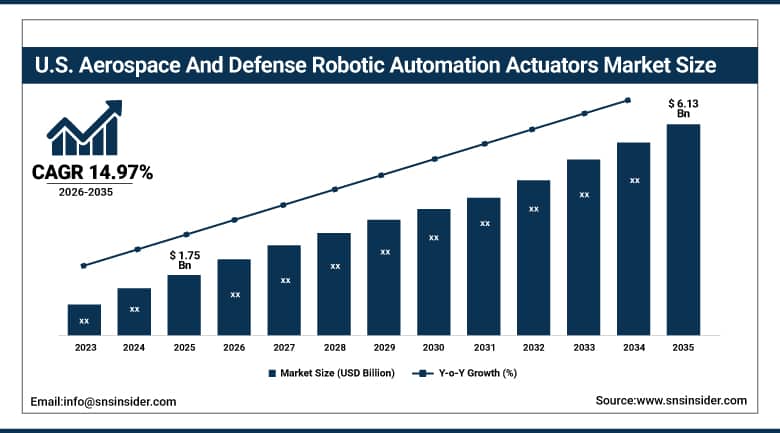
U.S. Aerospace And Defense Robotic Automation Actuators Market was valued at USD 1.75 billion in 2025 and is expected to reach USD 6.13 billion by 2035, growing at a CAGR of 14.97% from 2026-2035.
The U.S. Aerospace and Defense Robotic Automation Actuators Market is regarded as the biggest market globally due to its highly developed aerospace and defense ecosystem, significant spending by the country on defense purposes, and the presence of major technology companies such as Lockheed Martin, Raytheon Technologies, Boeing, Northrop Grumman, and Honeywell International. The Department of Defense’s favorable policies related to modernization along with FAA approvals for UAVs, automated systems, and future aircrafts play a key role in driving the usage in the market.
Supporting this trend, the U.S. Department of Defense (DoD) allocated over USD 842 billion in 2025, with a significant share directed toward modernization programs that heavily rely on advanced actuator technologies for next‑generation aircraft, UAVs, and defense robotics.
Meanwhile, the U.S. Air Force’s Next Generation Air Dominance (NGAD) program and the U.S. Navy’s carrier‑based UAV initiatives are accelerating actuator adoption in stealth aircraft and autonomous systems.
Aerospace And Defense Robotic Automation Actuators Market Segment Analysis
-
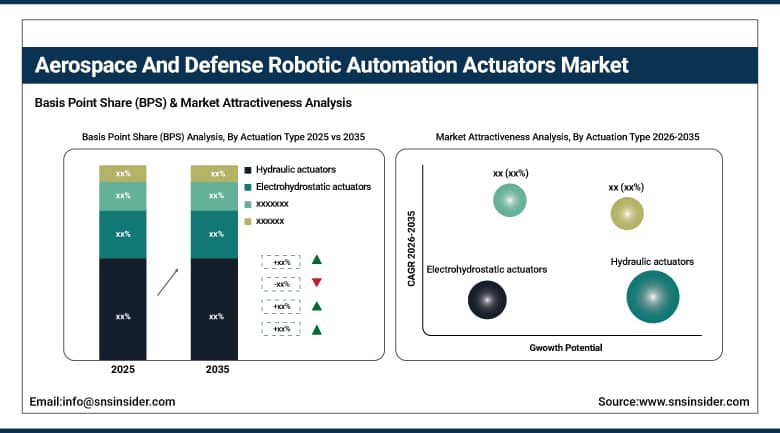
By Actuation Type, Hydraulic actuators dominated the Aerospace And Defense Robotic Automation Actuators Market with 45.28% share in 2025; Electrohydrostatic actuators fastest growing (CAGR).
-
By Application, Flight control systems dominated the Aerospace And Defense Robotic Automation Actuators Market with 37.89% share in 2025; UAV & drone actuation systems fastest growing (CAGR).
-
By Platform, Fixed-wing aircraft dominated the Aerospace And Defense Robotic Automation Actuators Market with 43.15% share in 2025; Unmanned aerial vehicles (UAVs) fastest growing (CAGR).
-
By End User, Commercial aerospace OEMs dominated the Aerospace And Defense Robotic Automation Actuators Market with 39.87% share in 2025; UAV manufacturers fastest growing (CAGR).
By Actuation Type, Hydraulic Actuators Segment Dominates the Aerospace And Defense Robotic Automation Actuators Market, Electrohydrostatic Actuators Segment Expected to Grow Fastest
The Hydraulic Actuators segment was the leading segment in the Aerospace And Defense Robotic Automation Actuators Market, with around 45.28% revenue share in 2025. Hydraulic actuators continue to be used where precision motion and force control are necessary in critical aerospace and defense applications that require extremely high power density. These actuators find widespread application in flight control surfaces, landing gear, missile guidance systems, maritime defense mechanisms, and military robotics systems.
The Electrohydrostatic Actuators (EHAs) segment is estimated to exhibit the highest CAGR during the forecast period from 2026 to 2035. The increasing trend towards electrically-powered aircraft designs, as well as advancements in autonomous defense systems, is contributing to the growth of EHA applications.
By Application, Flight Control Systems Segment Dominates the Aerospace And Defense Robotic Automation Actuators Market, UAV & Drone Actuation Systems Segment Expected to Grow Fastest
The Flight Control Systems Segment held the largest share in the Aerospace And Defense Robotic Automation Actuators Market in 2025, contributing close to 37.89% towards overall revenue generation. Flight control actuators play an integral role in the functioning of commercial airplanes, fighter aircrafts, helicopters, and air mobility, by facilitating the movement of ailerons, elevators, rudder, flaps, and spoilers.
During the forecast period from 2026-2035, the fastest CAGR will be witnessed by the UAV & Drone Actuation Systems Segment. With the growing demand for UAVs across various defense and civilian applications such as military surveillance, reconnaissance, combat missions, border security, logistics, and inspections, there will be a strong demand for light and agile actuators.
By Platform, Fixed-Wing Aircraft Segment Dominates the Aerospace And Defense Robotic Automation Actuators Market, Unmanned Aerial Vehicles (UAVs) Segment Expected to Grow Fastest
The Fixed-Wing Aircraft Segment accounted for around 43.15% of the total market in the year 2025 and had the largest share in the Aerospace and Defense Robotic Automation Actuators Market. The fixed-wing aircraft account for the largest area of actuator applications as their application ranges across commercial airplanes, fighter airplanes, transport airplanes, and special mission airplanes.
Over the forecast period of 2026 to 2035, the UAVs Segment would record the highest CAGR growth rate. The rising demand for UAVs in surveillance, reconnaissance, strikes, environmental analysis, disaster management, and inspections is creating a significant demand for robotic actuators.
By End User, Commercial Aerospace OEMs Segment Dominates the Aerospace And Defense Robotic Automation Actuators Market, UAV Manufacturers Segment Expected to Grow Fastest
In 2025, the Commercial Aerospace OEMs segment led the market in terms of share of revenue contribution, contributing to about 39.87% of the total. Aircraft manufacturers remained significant contributors of growth in terms of demand for robotic automation actuators because of the increased manufacturing of commercial aircraft, increased emphasis on energy efficiency, and increased utilization of automated flights.
During the forecast period of 2026 to 2035, the UAV Manufacturers segment will post the highest CAGR among all segments in the market. There will be a significant increase in the demand for actuators from the UAVs segment owing to an exponential rise in the number of military and commercial drone programs worldwide.
Regional Insights
|
Region |
Major Country |
Share within Region (%) |
|---|---|---|
|
North America |
United States |
42.58% |
|
Europe |
Germany |
25.14% |
|
Asia Pacific |
China |
22.26% |
|
Middle East & Africa |
UAE |
5.28% |
|
Latin America |
Brazil |
4.74% |
North America Aerospace And Defense Robotic Automation Actuators Market Insights
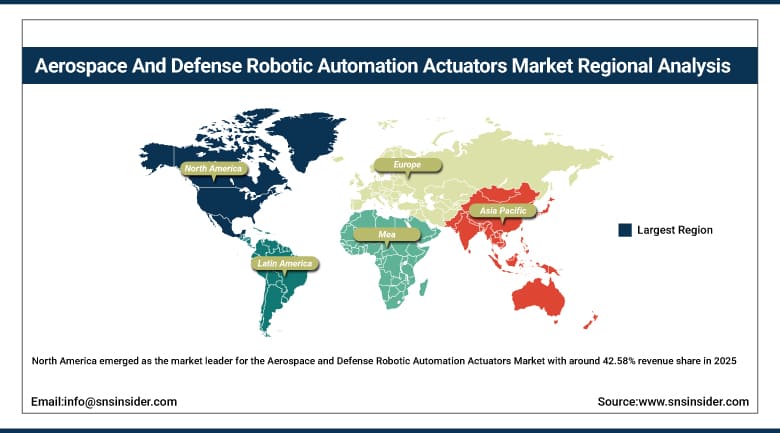
North America emerged as the market leader for the Aerospace and Defense Robotic Automation Actuators Market with around 42.58% revenue share in 2025 due to its superior aerospace and defense facilities, significant government spending on defense, and presence of major aerospace primes and actuator providers such as Boeing, Lockheed Martin, Raytheon Technologies, Northrop Grumman, Honeywell International, and Parker Hannifin. Robotic automation actuators are witnessing widespread implementation owing to robust programs for defense upgrades, fast growth in drone fleet sizes, and heavy funding toward space exploration missions.
Supporting this momentum, the U.S. Department of Defense (DoD) has recently expanded funding allocations toward next‑generation aircraft and UAV programs, with actuator technologies identified as a critical enabler of autonomous flight and advanced mission capabilities.
Additionally, major aerospace primes such as Lockheed Martin, Boeing, and Raytheon Technologies have announced new contracts and collaborations focused on integrating electro‑mechanical and electro‑hydrostatic actuators into next‑generation fighter jets, UAVs, and defense robotics systems.
Get Customized Report as Per Your Business Requirement - Enquiry Now
Asia Pacific Aerospace And Defense Robotic Automation Actuators Market Insights
The Asia-Pacific region will become one of the world’s fastest growing markets for Aerospace & Defense Robotic Automation Actuators from 2025-2035, with a CAGR of 14.92%. This growth will be attributed to significant investments in unmanned aerial vehicle formations, the expansion of space exploration in China, India, and Japan, and government-driven efforts for the modernization of their defense sectors. The region is fortunate to have an increasing number of aerospace manufacturing centers, especially in the commercial aviation industry of China and the defense robotics segment in India.
Supporting this growth, China’s Ministry of Industry and Information Technology (MIIT) has prioritized aerospace robotics and actuator technologies within its national defense modernization agenda, channeling substantial funding into UAV development, next‑generation aircraft, and space robotics programs.
The Japan Aerospace Exploration Agency (JAXA) continues to expand collaborations on spacecraft robotics and launch vehicle systems, while leading industrial players such as Mitsubishi Heavy Industries and Kawasaki Heavy Industries are driving innovation in actuator technologies for both defense and commercial aerospace platforms.
Europe Aerospace And Defense Robotic Automation Actuators Market Insights
The Europe market holds significance as an important growth region for Aerospace and Defense Robotic Automation Actuators owing to high investments made in advanced aerospace manufacturing, defense up-gradation projects, and initiatives undertaken as part of the European Defence Fund. Germany is especially well-placed for growth owing to its expertise in aerospace engineering and robotic automation with companies like Siemens, Airbus, and KUKA Robotics.
In addition, the EU’s regulatory frameworks, including the European Defence Fund and stringent aerospace certification standards, have elevated quality and safety benchmarks for actuator technologies across the continent.
Germany, in particular, has advanced its role through government‑backed aerospace innovation programs and industrial automation leadership. Companies such as Siemens, Airbus, and KUKA Robotics are spearheading the integration of electro‑mechanical and smart actuators into aircraft, UAVs, and space robotics platforms.
Middle East & Africa and Latin America Aerospace And Defense Robotic Automation Actuators Market Insights
The Middle East region has been seen to develop its programs in aerospace and defense modernization, actuator technologies having been recognized as the key technology behind UAV fleets, modern fighter jets, and even space robotics development. In Africa, the increasing use of UAV technology in the areas of surveillance, border patrol, and infrastructure inspection has led to a slow increase in actuator technology for robots due to regional collaboration and new advancements in aerospace technology. In Latin America, countries such as Brazil and Mexico have been seen to be developing their aerospace and defense industries through partnerships with global prime companies.
Supporting development in these regions, Saudi Arabia’s Ministry of Defense and Aviation has launched comprehensive aerospace and defense modernization programs that include procurement of advanced UAVs, next‑generation aircraft, and robotic automation systems, with actuator technologies positioned as a critical enabler of mission readiness.
Brazil’s aerospace sector, anchored by Embraer, is actively integrating robotic automation actuators into aircraft and defense robotics systems, while expanding collaborations with global primes to strengthen domestic capabilities.
Aerospace And Defense Robotic Automation Actuators Market Growth Drivers:
-
Rising demand for autonomous aerospace systems, including UAVs, spacecraft, and next‑generation aircraft, is driving global adoption of robotic automation actuators.
The transformation of the priorities of the defense and aerospace industries from a dependency on conventional hydraulic and manual actuators to cutting-edge electro mechanical and intelligent actuators represents the strongest structural force influencing the growth of the market. More and more defense organizations and aerospace primes look for solutions providing greater efficiency, lower maintenance, lightness, and digital fault tolerance control, thus ensuring improved performance and reliability of the mission. In response to the need to address their requirements and stay technologically ahead, defense organizations and commercial aerospace companies are developing innovative actuators.
Supporting this growth, the U.S. Department of Defense has documented a consistent multi‑year trend of rising allocations toward UAVs, next‑generation aircraft, and autonomous defense systems, with actuator technologies identified as critical enablers of modernization.
The World Economic Forum underscores that global defense and aerospace spending continues to rise sharply, driven by UAV proliferation, space exploration, and advanced aircraft programs—expanding the eligible platform base that will increasingly rely on robotic automation actuators as technology advances and mission requirements evolve.
Aerospace And Defense Robotic Automation Actuators Market Restraints:
-
High capital investment requirements for advanced aerospace and defense robotic automation actuators and sophisticated automation platforms are creating adoption barriers, particularly for smaller defense contractors and emerging aerospace markets.
The considerable financial constraints involved in purchasing, certifying, and sustaining sophisticated actuator technology pose a major constraint on market expansion, particularly for mid-range companies, regional aerospace companies, and defense agencies from poorer nations. The robotic automation technologies that are utilized in the construction of future aircraft, unmanned aerial vehicles, and space crafts demand an investment worth millions of dollars, as well as expenses incurred on proprietary parts, software upgrades, and yearly maintenance services. Such financial outlays are often accompanied by additional expenses in terms of infrastructure development, cybersecurity, and actuator testing.
Aerospace And Defense Robotic Automation Actuators Market Opportunities:
-
Accelerating integration of electro‑mechanical actuators, lightweight materials, and digital fault‑tolerant systems is creating new growth pathways for market expansion into UAV fleets, next‑generation aircraft, and space robotics platforms.
The upcoming wave of opportunities in the field of aerospace and defense actuators will be driven by the efforts to empower more people with access to sophisticated automation systems via miniaturization, affordability, and smart control mechanisms. Those firms which produce compact and modular actuator systems dedicated to UAVs, rotary wing systems, and autonomous defense systems are targeting an immense untapped market segment. The growing trend in the use of AI-based flight control, predictive maintenance, and simulation systems powered by augmented reality is expanding the scope of application of actuators to other regions and defense entities.
Recent Developments:
2026: ABB advanced its aerospace and defense automation portfolio by expanding electro‑mechanical actuator solutions for UAVs and next‑generation aircraft. The company reported growing adoption across North American and European defense programs, while continuing collaborations to integrate smart actuator technologies into autonomous flight systems.
2025: Rockwell Automation strengthened its aerospace robotics footprint by launching new digital motion‑control platforms designed for actuator integration in defense robotics and advanced aircraft. The company expanded partnerships with U.S. defense contractors, supporting modernization initiatives and enhancing cyber‑secure automation capabilities.
2025: Moog Inc. announced significant progress in actuator technologies for space exploration and defense aviation, including integration into NASA spacecraft systems and next‑generation fighter jets. The company’s electro‑hydrostatic actuators gained traction globally, reinforcing Moog’s leadership in precision aerospace motion control.
2025: Curtiss‑Wright completed strategic expansions of its aerospace actuator portfolio, focusing on electro‑mechanical and smart actuator systems for UAVs and rotary‑wing aircraft. The company strengthened its defense robotics offerings through new contracts with European and U.S. defense agencies, positioning itself as a key supplier in advanced aerospace automation.
Aerospace And Defense Robotic Automation Actuators Market Key Players
-
ABB
-
Rockwell Automation
-
Moog Inc.
-
Curtiss-Wright
-
Altra Industrial Motion
-
SMC Corporation
-
MISUMI
-
Honeywell International
-
Parker Hannifin
-
Safran Group
-
BAE Systems
-
Raytheon Technologies
-
Northrop Grumman
-
Lockheed Martin
-
Siemens
-
KUKA Robotics
-
Thales Group
-
Airbus Defence & Space
-
General Electric Aviation
-
Boeing
Aerospace And Defense Robotic Automation Actuators Market Report Scope:
| Report Attributes | Details |
|---|---|
| Market Size in 2025 | USD 4.75 Billion |
| Market Size by 2035 | USD 16.83 Billion |
| CAGR | CAGR of 13.65% From 2026 to 2035 |
| Base Year | 2025 |
| Forecast Period | 2026-2035 |
| Historical Data | 2022-2024 |
| Report Scope & Coverage | Market Size, Segments Analysis, Competitive Landscape, Regional Analysis, DROC & SWOT Analysis, Forecast Outlook |
| Key Segments | • By Actuation Type (Hydraulic Actuators, Electromechanical Actuators, Electrohydrostatic Actuators, Pneumatic Actuators, Others) • By Application (Flight Control Systems, Landing Gear Systems, UAV & Drone Actuation Systems, Satellite & Space Robotics Systems, Others) • By Platform (Fixed-Wing Aircraft, Rotary-Wing Aircraft, Unmanned Aerial Vehicles (UAVs), Spacecraft & Launch Vehicles, Ground Defense Robotics Systems, Others) • By End User (Commercial Aerospace OEMs, Defense Contractors & Military Agencies, Space Agencies, UAV Manufacturers, MRO Providers, Others) |
| Regional Analysis/Coverage | North America (US, Canada), Europe (Germany, UK, France, Italy, Spain, Russia, Poland, Rest of Europe), Asia Pacific (China, India, Japan, South Korea, Australia, ASEAN Countries, Rest of Asia Pacific), Middle East & Africa (UAE, Saudi Arabia, Qatar, South Africa, Rest of Middle East & Africa), Latin America (Brazil, Argentina, Mexico, Colombia, Rest of Latin America). |
| Company Profiles | ABB, Rockwell Automation, Moog Inc., Curtiss-Wright, Altra Industrial Motion, SMC Corporation, MISUMI, Honeywell International, Parker Hannifin, Safran Group, BAE Systems, Raytheon Technologies, Northrop Grumman, Lockheed Martin, Siemens, KUKA Robotics, Thales Group, Airbus Defence & Space, General Electric Aviation, Boeing |
Frequently Asked Questions
North America dominated the Aerospace And Defense Robotic Automation Actuators Market in 2025.
The Hydraulic actuators segment dominated the Aerospace And Defense Robotic Automation Actuators Market in 2025.
The major growth factor is the rising demand for advanced automation in aerospace and defense platforms to enhance precision, reduce weight, improve fuel efficiency, and enable next‑generation capabilities such as UAVs, satellite robotics, and autonomous defense systems.
The Aerospace And Defense Robotic Automation Actuators Market was valued at USD 4.75 billion in 2025.
The Aerospace And Defense Robotic Automation Actuators Market is expected to grow at a CAGR of 13.65% from 2026 to 2035.
