
Military Biometrics Market Report Scope & Overview:
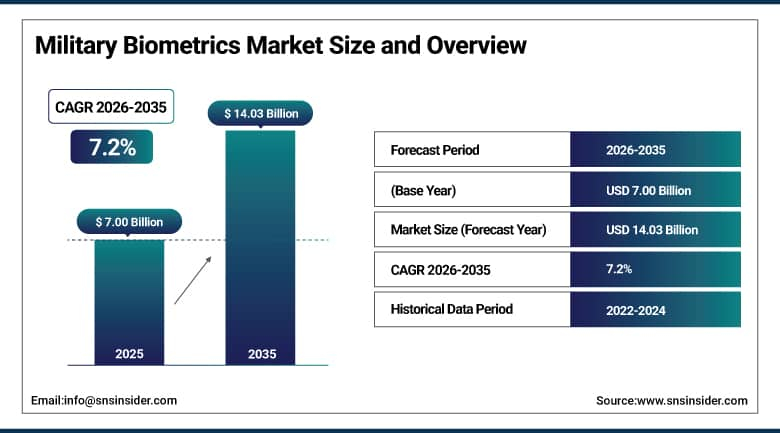
The Military Biometrics Market was valued at USD 7.00 Billion in 2025 and is expected to reach USD 14.03 Billion by 2035, growing at a CAGR of 7.2% from 2026-2035.
The Military Biometrics Market is expanding as armed forces replace paper credentials and passwords with identity systems that verify people at bases, borders and forward positions. Growth is attributed to rising defense budgets, insider threat concerns and operational demand for rapid identification of individuals in the field. Defense agencies are fielding portable multimodal collection kits, upgrading central matching repositories and moving workloads to secure cloud environments. Facial and iris recognition at a distance, together with liveness detection, is receiving increased attention. North America leads global revenue while Asia Pacific is projected to grow at the fastest pace. These factors are expected to sustain steady expansion through 2035.
⮞In April 2026, the Stockholm International Peace Research Institute reported that world military expenditure rose by 2.9% in real terms to USD 2,887 billion in 2025. Higher defense budgets provide the funding base for identity and access modernization programs.
To Get More Information On Military Biometrics Market - Request Free Sample Report
Military Biometrics Market Trends:
-
Multimodal collection kits that combine fingerprint, face and iris capture are replacing single-sensor devices.
-
Defense agencies are migrating biometric repositories and matching services to secure cloud environments.
-
Facial and iris recognition at longer distances is being specified for special operations and force protection.
-
Liveness detection and counterfeit fingerprint detection are becoming standard requirements.
-
Biometric access control is being integrated with video surveillance across military installations.
U.S. Military Biometrics Market Outlook:
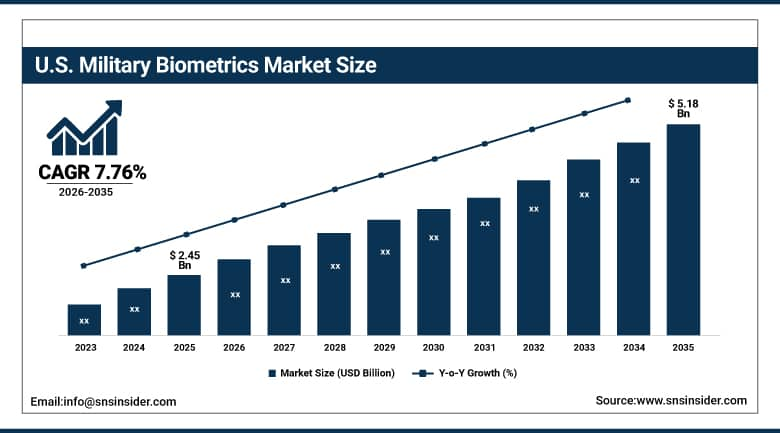
The U.S. Military Biometrics Market was valued at USD 2.45 Billion in 2025 and is expected to reach USD 5.18 Billion by 2035, growing at a CAGR of 7.76% from 2026-2035.
The U.S. Military Biometrics Market is anchored by the Department of Defense's central biometric repository, a large installed base of enrollment stations and sustained investment in tactical identity collection. The Army, Navy, Air Force, Marine Corps and Coast Guard each operate collection programs, while special operations units pursue longer range and mobile capabilities. Modernization efforts are replacing aging handheld devices and moving matching services to the cloud. Privacy and data security oversight shape procurement requirements. Budget cycles and continuing resolutions can delay awards. The market is projected to expand at a steady pace through 2035 as new collection systems are fielded across the services.
⮞In May 2026, the U.S. Army's Next Generation Biometric Collection Capability reached initial operational capability, with soldiers able to search against more than 30 million biometric encounters. The milestone marks the replacement of legacy battlefield collection devices.
Military Biometrics Market Segment Analysis:
-
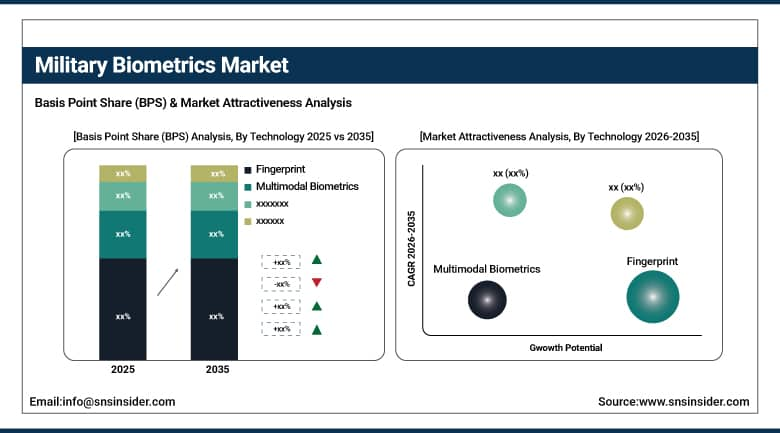
By Technology, the Fingerprint segment dominated the Military Biometrics Market with approximately 39.69% share in 2025, while the Multimodal segment is the fastest growing with a CAGR of approximately 12.76%.
-
By Solution, the Hardware segment dominated the Military Biometrics Market with approximately 51.72% share in 2025, while the Software segment is the fastest growing with a CAGR of approximately 10.37%.
-
By Deployment, the On-Premise segment dominated the Military Biometrics Market with approximately 68.50% share in 2025, while the Cloud segment is the fastest growing with a CAGR of approximately 12.66%.
-
By End User, the Defense and Military segment dominated the Military Biometrics Market with approximately 38.00% share in 2025, while the Intelligence Agencies segment is the fastest growing with a CAGR of approximately 9.56%.
By Technology, Fingerprint Dominates the Military Biometrics Market and Multimodal Grows Fastest
Fingerprint recognition remains the principal technology, characterized by decades of use in military enrollment, detainee processing and base access. Large legacy databases, mature matching algorithms and low-cost sensors support continued reliance on the modality. Rugged handheld scanners work in difficult environments where gloves, dust and poor lighting complicate other methods. Interoperability with allied and federal repositories, which are built around fingerprint templates, further reinforces its position across defense programs. Palm and latent print capabilities extend the usefulness of the modality for forensic exploitation of materials collected at sites. Training and doctrine built around fingerprint enrollment also reduce the cost of adoption.
Multimodal systems are advancing fastest as forces combine fingerprint, face and iris capture to improve accuracy and resist spoofing. A single device that records several traits lets personnel enroll individuals quickly even when one trait is damaged or unavailable. Fusion algorithms increase confidence in matches and reduce false rejections. Programs that replace single-purpose collection kits are specifying multimodal capability as a baseline requirement, which is expected to lift demand over the forecast period. Vendors are integrating contactless fingerprint capture into the same devices, which improves hygiene and throughput. Allied forces are also drawing up shared requirements for multimodal enrollment.
⮞In February 2026, the 1st Special Forces Command renewed five Clearview AI facial recognition licenses, with options that could extend the subscription through March 2030. The renewal shows special operations units sustaining investment in face-based identification tools.
By Solution, Hardware Dominates the Military Biometrics Market and Software Grows Fastest
The hardware constitutes the greatest expense since all programs start with sensors, handheld collection devices, kiosks, turnstiles and rugged tablets. The military acquires a large number of devices to equip their units and installations. Such devices need to comply with stringent environmental and security requirements. The need to replace old collection kits keeps purchases coming through regularly. Suppliers who are able to provide certified hardware with extended service agreements have a competitive edge when it comes to tenders and single-source maintenance contracts in the defense market. Accessories like docking stations, cables, power solutions and protective cases supplement unit-level purchases.
Software is the fastest-growing solution as matching engines, identity management platforms and analytics tools become the primary source of differentiation. Artificial intelligence improves match accuracy, detects presentation attacks and helps analysts link identities across different databases. Software that runs on commercial phones and tablets reduces dependence on specialized hardware. Subscription-based licensing and continuous algorithm updates support recurring revenue, while defense agencies increasingly favor modular software that can be upgraded without replacing field equipment. Access-pattern analytics that flag potential insider threats are now built into existing platforms.
⮞In March 2025, The Department of Defense stated that their Automated Biometric Identification System processed 45,000 submissions daily. This workload demonstrates the kind of processing volume that must be handled by the system’s support software.
By Deployment, On-Premise Dominates the Military Biometrics Market and Cloud Grows Fastest
On-premise installations lead because defense organizations require tight control over sensitive identity data and must operate in disconnected or classified environments. National security rules limit the use of public infrastructure for biometric records. Existing data centers and secure networks represent substantial prior investment that agencies prefer to extend. Forward-deployed units also need local matching capability when connectivity is limited, which sustains demand for self-contained systems. Some programs incorporate local matching with periodic synchronization to centralized repositories, which ensures that on-premises systems remain relevant despite the increasing availability of cloud services. The security accreditation process of cloud environments moves slowly, which forces agencies to retain core operations in their premises until accreditation is achieved.
Cloud deployment is expanding at a growing pace among defense agencies, which are using accredited government cloud environments to increase matching capacity, share information with allied nations and modernize legacy repositories. Elastic computing helps absorb large spikes in demand during operations and speeds algorithm updates. Hybrid architecture keeps sensitive data on secured networks while using cloud resources for analytics. Authorization processes for defense cloud services have matured, making it easier to implement new programs. Vendors are providing containerized applications that can be executed in both environments.
⮞In October 2026, Reporting on the modernization of the Department of Homeland Security’s biometrics stated that the life-cycle cost for the system replacement was estimated to be around USD 2.9 billion. Programs like these impact the defense departments which exchange data with homeland security systems.
By End User, Defense and Military Dominates the Military Biometrics Market and Intelligence Agencies Grows Fastest
Military forces contribute the largest demand, through use of biometrics in base access, person identification, detainee handling, and operations overseas. Service branches operate enrollment stations, tactical kits and credentialing systems. Fears of insider threats and credential misuse have increased the emphasis on strong authentication. Procurement funds and long term program architectures guarantee stable funding for vendors and sustained spending within ground, sea and air forces. Contractors working for defense agencies also need credentials, thus increasing the number of users that the military forces have to manage and consequently increased demand for scalable enrollment. Special programs for reserve components also increase the user population.
Intelligence agencies are experiencing rapid growth due to the importance of identity intelligence in counter-terrorism, force protection, and targeting. Analysts cross-reference biometric information against other information to monitor persons of interest and identify false identities. The demand is increasing for technologies that match faces and irises from imagery taken in the field and platforms that share identities between partners. Increased surveillance abilities of adversaries are also driving demand for counter-biometric solutions. Alliances with allied agencies drive demand for shared watchlists and standards-based exchanges, favoring suppliers that support international formats.
⮞In May 2026, a Congressional Research Service report quoting a former CIA technology expert, has found that there are around 30 nations which have installed biometric identification technology systems which can detect foreign military and intelligence agents. The finding underscores the growing role of identity intelligence in military and counterintelligence operations.
Regional Analysis:
|
Region |
Major Country |
Share within Region, 2025 (%) |
|---|---|---|
|
North America |
United States |
92.94 |
|
Europe |
United Kingdom |
27.18 |
|
Asia Pacific |
China |
36.54 |
|
Middle East and Africa |
Saudi Arabia |
33.45 |
|
Latin America |
Brazil |
46.07 |
North America Military Biometrics Market Insights
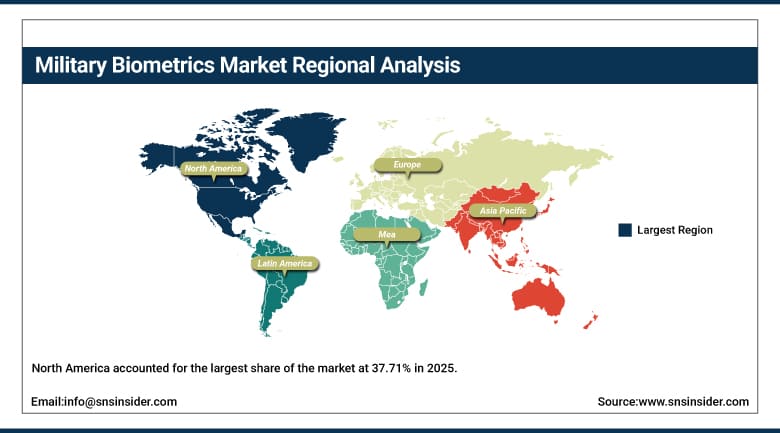
North America accounted for the largest share of the market at 37.71% in 2025. The United States operates the world's largest military biometric program, with a central repository, thousands of collection devices and active modernization contracts across the services. Canada contributes through its armed forces and border programs, while Mexico adds demand through security agencies. High defense spending, strong technology suppliers and early adoption of multimodal systems underpin the region's leadership. Industry clusters around Washington, Virginia and Maryland host many of the integrators that bid on federal biometric programs, which strengthens the regional supplier base.
Federal agencies continue to invest in cloud migration, liveness detection and tactical facial recognition. Privacy regulation, supply chain security guidelines and cybersecurity certification requirements shape which vendors can compete. Coast Guard, special operations and installation security programs provide a wide range of procurement opportunities. Budget uncertainty and long procurement cycles can delay contract awards, though the steady stream of existing programs provides reliable income for suppliers. Reserve and National Guard units are also receiving new collection systems, expanding the end-user base. Competition among integrators is intense, alongside partnerships between large prime contractors and specialist biometric companies.
⮞In September 2025, the U.S. Coast Guard entered into an indefinite delivery contract for its Biometric At Sea System, referred to as BASS 2.0. This is another example of funding directed towards marine identification systems.
Get Customized Report as Per Your Business Requirement - Enquiry Now
Europe Military Biometrics Market Insights
Europe is the second largest market segment that holds around 26.83% share of the market in 2025. In Europe, the UK, France, Germany, and Italy are at the top in terms of military expenditure on biometrics, helped by their collaboration with NATO and their expeditionary forces. Members in Eastern Europe are investing more in their defense budgets and updating their access control systems and personnel identification solutions. Military ministries in Poland and Baltic states are becoming stringent in personnel vetting process owing to their force build-up. Collaboration among NATO organizations helps in setting up common standards for identity intelligence.
Regional vendors supply fingerprint, face and iris technologies to national forces and security agencies. Border management programs, including entry and exit systems, create shared technology and a supplier base that also serves defense. Concerns about privacy, ethical use of facial recognition and regulation of artificial intelligence influence adoption timelines. Even so, heightened security tensions are leading governments to prioritize identity assurance for personnel and critical sites. Several European governments are also funding research into privacy-preserving biometrics, which may open opportunities for suppliers offering template protection and on-device matching.
⮞In March 2026, the European Commission reported that more than 45 million border crossings had been recorded in the Entry/Exit System since its launch. The scale of biometric border processing supports a deep regional supplier ecosystem.
Asia Pacific Military Biometrics Market Insights
Asia Pacific holds an estimated 22.15% of the market in 2025 and is projected to expand at a CAGR of 9.58% from 2026 to 2035, the fastest rate among regions. China, India, Japan, South Korea and Australia are expanding military budgets and modernizing personnel identity, base access and border systems. Regional tensions and large standing forces are increasing demand for secure credentialing. Local suppliers are developing fingerprint, face and iris products tailored to national requirements. Indigenous procurement preferences in India and strategic autonomy goals in other countries encourage partnerships between foreign technology owners and regional manufacturers.
India is using biometric technologies in its armed forces and defense procurements, whereas South Korea is implementing biometrics into access control and weapon security. Japan and Australia stress compatibility with allied systems. Southeast Asian countries are developing their capabilities in border and base security. Domestic development of indigenous defense technologies and advanced electronics manufacturing will be key drivers behind fast growth in the region. Unmanned systems’ fast adoption also poses new access control requirements for secure launch and maintenance bases. The local language capability and regional training programs ensure proper use of systems in theater.
⮞In August 2026, The Republic of Korea Army had reportedly been testing biometric gun cabinets in three units, with a gradual deployment throughout the force planned up to 2034. This indicates that biometrics can be applied even in weapon storage.
MEA & Latin America Military Biometrics Market Insights
The Middle East and Africa is expected to account for 8.74% of the market share in 2025. Countries such as Saudi Arabia and UAE have plans to invest in defense modernization, secure infrastructure, and integration of national identity. Both Israel and Turkey contribute their local advanced technology vendors to this region. In Africa, the armies are using biometrics for registration of soldiers due to the issue of ghost soldiers. However, financial challenges slow down the process. Exhibitions in the Gulf help vendors gain visibility and also result in government-to-government procurement deals which include biometric technology.
Latin America holds an estimated 4.57% share, with Brazil, Mexico and Colombia as the main contributors. Security forces use biometrics to support counternarcotics operations, border control and personnel vetting. Brazil is renewing facial recognition systems at airports, land borders and ports, which builds a base of technology that also serves military and police users. Budget volatility and uneven procurement capacity can slow awards across the region. Cooperation with United States and European partners provides training and equipment transfers that raise baseline capability among regional forces.
⮞In August 2026, Brazil's federal customs authority renewed its facial recognition system for five years at a cost of R$13.4 million, covering 28 locations. The renewal reflects growing reliance on biometric screening at borders and ports.
Market Dynamics:
Growth Drivers: Rising Defense Budgets, Insider Threat Concerns and Identity Intelligence Needs
Defense spending has also led to the modernization of identity systems and access systems. It means that military organizations will be able to switch their systems from traditional credentials to biometric systems in order to minimize identity-related crimes such as impersonations. Identity and access systems play an important role in the modernization of operations in different environments. Since military operations require fast identification of people and therefore, there is a necessity to use portable matching and collection tools to accomplish that. Increased number of identity fraud cases related to the defense industry also contributed to changes.
Technological innovations give additional impetus for development of biometric systems. For instance, there were many advancements in the area of AI which enhanced face and iris recognition technology. Biometric devices became more compact and more resistant to the environment. There are technologies of cloud and edge computing which ensure matching at the place where biometric information was gathered. The growing interest towards the risks related to cyber and counterintelligence issues and personal data protection encourages agencies to improve identity management and authentication. Standardized tests of biometric products give an opportunity to buyers to compare vendors.
⮞In May 2026, the U.S. House of Representatives' fiscal 2027 defense authorization bill, H.R. 8800, authorized USD 1.64 million for the Army's Family of Biometrics program. Congressional support sustains funding for the department's biometric infrastructure.
Restraints: Privacy Concerns, Data Security Risks and Budget Uncertainty
Ethical issues and privacy concerns are another significant barrier. Non-profit civil liberties groups and legislators cast doubt on the use of facial recognition technology and storage of biometric information, leading to potential limitations and the requirement for monitoring. Allied countries have different laws in relation to sharing of information, thereby limiting the use of these technologies in coalitions. Users must work through the problem of bias and inaccuracies in facial recognition technology with different demographics, leading to higher costs and tests. Ethics-related review process may delay the adoption of new capabilities. Public distrust issue can influence legislative decisions in terms of funding.
Security issues and budget constraints add additional constraints. The databases for storing biometric data can be a major target for hostile intelligence agencies and can have permanent repercussions since these features cannot be reset. Methods of spoofing and deepfakes will result in ongoing expenditures for developing liveness detection. Possible program delays and continuing resolutions can cause deferrals in procurement process. Integration with legacy systems and environmental considerations such as harsh environmental conditions for sensors are also barriers to adoption of the technology. Dependence on few algorithmic providers can create supply constraints. Shortage of cleared engineers can increase development time frames.
⮞In November 2025, the U.S. Government Accountability Office made 12 recommendations on risks to service members from publicly available digital data, and the Pentagon agreed with all but one. The findings underline the security and privacy scrutiny that surrounds defense identity information.
Opportunities: Tactical Facial Recognition, Cloud Matching and Counter-Spoofing Technologies
The area of standoff facial and iris recognition provides a large potential opportunity. Special operations and force protection units wish to identify individuals from safe standoff positions, and vendors that offer good performance in terms of lighting and weather conditions will be able to land new contracts. The testing of smartphone iris capture and wearable sensors is underway. Drones and fixed surveillance integration leads to more requirements for compact and low-power recognition modules. Collaboration between sensor vendors and software providers can help accelerate product integration. Standoff recognition test ranges are another area that can attract investment.
Cloud matching, spoofing prevention and interoperability with allies provide additional opportunities. Agencies require liveness detection that resists masks, synthetic media and presentation attacks, and vendors that have independently tested algorithms enjoy an edge. Allies are upgrading their identity systems, leading to export opportunities. Managed services such as system integration, training, maintenance and algorithm updates represent an ongoing revenue stream especially in light of the fact that defense programs are seeking managed outcomes rather than pure hardware. Training simulators based on synthetic faces and irises might become a related service offering. Technology transfer agreements between allies spur joint developments. Industry associations publish interoperability profiles.
⮞In January 2026, U.S. Special Operations Command issued a request for information seeking facial recognition solutions that can identify individuals at distances of up to 100 meters. The requirement points to demand for long-range identification tools.
Recent Developments:
-
In March 2026, BIO-key received a USD 280,000 order from a foreign defense ministry, bringing the sum of orders received in the past year from military and defense bodies to more than USD 2 million. This client has been partnering with the firm since 2017. The order points to continued interest in biometric authentication among defense bodies internationally.
-
In April 2026, Amadeus has agreed to buy IDEMIA Public Security for EUR 1.2 billion. It has a total workforce of 3,300 employees and serves more than 600 customers; it is expected to be concluded by mid-2027. This deal shows that there is consolidation among vendors of biometric and identity technology.
-
In July 2026, Parsons launched the AresNXT biometrics platform, which supports fingerprint, face and iris capture and works online or offline on iOS, Android and Windows devices. Its encryption aligns with Department of War, FBI and electronic biometric transmission standards. The platform lets units use existing devices without specialized hardware.
Military Biometrics Market Key Players:
-
Parsons
-
IDEMIA
-
HID Global
-
BIO-key
-
Thales
-
NEC
-
Leidos
-
Aware
-
M2SYS
-
Fulcrum Biometrics
-
Safran
-
Northrop Grumman
-
SAIC
-
Cognitec
-
Dermalog
-
Neurotechnology
-
BioEnable
-
Precise Biometrics
-
Crossmatch
-
Daon
Military Biometrics Market Report Scope:
| Report Attributes | Details |
|---|---|
| Market Size in 2025 | USD 7.00 Billion |
| Market Size by 2035 | USD 14.03 Billion |
| CAGR | 7.2% from 2026 to 2035 |
| Base Year | 2025 |
| Forecast Period | 2026-2035 |
| Historical Data | 2022-2024 |
| Report Scope & Coverage | Market Size, Segments Analysis, Competitive Landscape, Regional Analysis, DROC & SWOT Analysis, Forecast Outlook |
| Key Segments | • By Technology: Dominant – Fingerprint (39.69% share in 2025); Fastest-Growing – Multimodal (CAGR 12.76%) • By Solution: Dominant – Hardware (51.72% share in 2025); Fastest-Growing – Software (CAGR 10.37%) • By Deployment: Dominant – On-Premise (68.50% share in 2025); Fastest-Growing – Cloud (CAGR 12.66%) • By End User: Dominant – Defense and Military (38.00% share in 2025); Fastest-Growing – Intelligence Agencies (CAGR 9.56%) |
| Regional Analysis/Coverage | North America (US, Canada), Europe (Germany, UK, France, Italy, Spain, Russia, Poland, Rest of Europe), Asia Pacific (China, India, Japan, South Korea, Australia, ASEAN Countries, Rest of Asia Pacific), Middle East & Africa (UAE, Saudi Arabia, Qatar, South Africa, Rest of Middle East & Africa), Latin America (Brazil, Argentina, Mexico, Colombia, Rest of Latin America). |
| Company Profiles | Parsons, IDEMIA, HID Global, BIO-key, Thales, NEC, Leidos, Aware, M2SYS, Fulcrum Biometrics, Safran, Northrop Grumman, SAIC, Cognitec, Dermalog, Neurotechnology, BioEnable, Precise Biometrics, Crossmatch, Daon |

Frequently Asked Questions
The market includes Parsons, IDEMIA, HID Global, BIO-key, Thales, NEC, Leidos, Aware, M2SYS, Fulcrum Biometrics, Safran, Northrop Grumman, SAIC, Cognitec, Dermalog, Neurotechnology, BioEnable, Precise Biometrics, Crossmatch and Daon. These companies compete on matching accuracy, ruggedized collection devices, security certification, interoperability and defense contract experience.
The main opportunities lie in tactical facial and iris recognition at distance, cloud-based matching, liveness and counter-spoofing technologies, and export sales as allied forces modernize identity systems. Integration, training and algorithm update services add recurring revenue.
The key growth factor is rising defense spending directed to identity and access modernization, supported by concerns about insider threats and the need to identify individuals rapidly in operations. Advances in artificial intelligence and sensors reinforce this demand.
By technology, the Fingerprint segment dominated the market with approximately 39.69% share in 2025, supported by large legacy databases and rugged sensors. The Hardware segment led by solution and the On-Premise segment led by deployment.
North America dominated the market with approximately 37.71% share in 2025, supported by the world's largest military biometric program and high defense spending. Asia Pacific is the fastest growing region with a projected CAGR of 9.58% from 2026 to 2035.
