
AI-Powered Recycling Robot Market Report Scope & Overview:
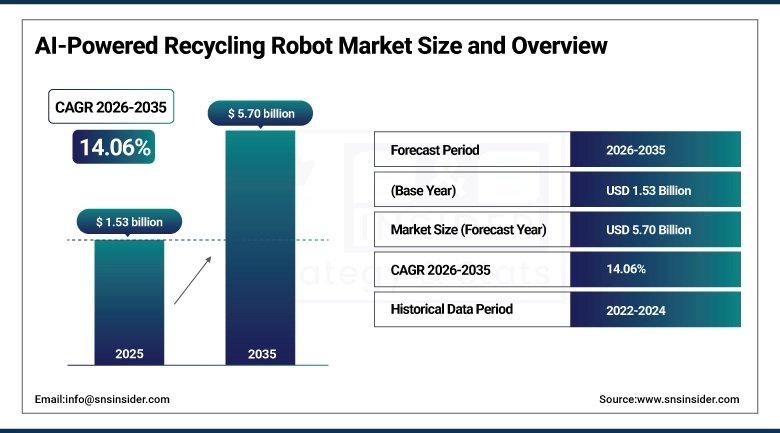
The AI-Powered Recycling Robot Market size was valued at USD 1.53 Billion in 2025 and is projected to reach USD 5.70 Billion by 2035, growing at a CAGR of 14.06% during 2026–2035.
The AI-powered recycling robot market is rapidly increasing as Waste management systems are gradually moving towards automation owing to the fact that artificial intelligence, robotics, and deep learning technologies are being developed to enhance a better and effective waste management system. They enhance material sorting, boost recycling recovery rates, and lessen dependence on manual labor by leaps and bounds. Through new innovations like vision-based recognition functionality in recycling facilities that parse and identify materials as they come in on-the-fly, connection to the cloud for constant monitoring, and real time learning algorithms, the operational efficiency of these facilities is being steadily improved. Emergent textile, plastic, and electronic waste sorting offers increased throughput and higher purity compared to conventional methods. The sustainability goals, circular economy initiatives and growing volume of waste worldwide are great tailwinds for market expansion.
On 2 April 2026, China unveiled the AI-operated mechanism, dubbed the Fastsort-Textile robot from DataBeyond, which sorts 100 kilograms (220 pounds) of used clothing in 2–3 minutes, and uses high-tech AI scanners which identify fabric composition and aim to help with textile recycling efficiency. It is now deployed in Zhangjiagang, and it represents a significant advancement in fast automatic textile waste processing over traditional manual sorting.
AI-Powered Recycling Robot Market Size and Forecast:
-
Market Size in 2025: USD 1.53 Billion
-
Market Size by 2035: USD 5.70 Billion
-
CAGR: 14.06% (from 2026 to 2035)
-
Base Year: 2025
-
Forecast Period: 2026–2035
-
Historical Data: 2022–2024
To Get more information on AI-Powered Recycling Robot Market - Request Free Sample Report
AI-Powered Recycling Robot Market Trends Highlights:
-
Rising demand for predictive maintenance is driving market adoption.
-
Growth is supported by increasing industrial automation.
-
Data center expansion is a major demand driver.
-
Liquid cooling systems are boosting sensor deployment.
-
Semiconductor manufacturing requires high-precision coolant monitoring.
-
EV battery thermal management is expanding sensor use.
-
Industrial machinery safety regulations support market growth.
U.S. AI-Powered Recycling Robot Market Size Outlook:
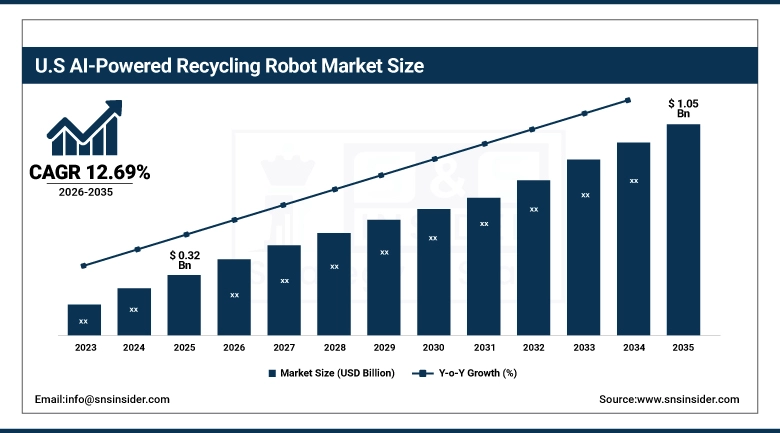
The U.S. AI-Powered Recycling Robot Market size was valued at USD 0.32 Billion in 2025 and is projected to reach USD 1.05 Billion by 2035, growing at a CAGR of 12.69% during 2026–2035, The market is driven by growing adoption of automation in the waste management industry and increasing demand for efficient material recovery systems. Advanced AI-powered robots are bolstering sorting accuracy, lowering operational costs, and increasing recycling efficiency within industrial and municipal facilities. Green initiatives and shift to circular economy practices is additionally driving the market. Ongoing development of machine learning, robotics, and sensor technologies makes it possible to detect waste at a scale and level of detail faster than before. The growing influx of investments in smart recycling infrastructure is further driving the nationwide deployment of intelligent robotic systems.
AI-Powered Recycling Robot Market Drivers:
-
Intelligent Automation Accelerating Next-Generation Recycling Transformation
Increasing demand for efficient waste management and also for better material recovery rates has led to an increasing growth in the market. With the global waste generation increasing and limitations of traditional manual sorting systems, demand for AI-equipped robotic solutions is on the rise. This type of advanced technology allows for a high level of accuracy when it comes to identifying, classifying and separating recyclable materials and minimizes recycling contamination and reliance on landfills. Deployment is being further propelled by the emerging focus on sustainability, circular economy initiatives and resource optimization. Finally, machine learning and robotics are improving the speed, precision and scalability of operations, accelerating widespread adoption by existing recycling infrastructure.
In Oct 2025 Glacier has created small recyclable robots powered with AI to recognize more than 70 kinds of recyclable things and they help a lot to improve sorting with high accuracy which results in less spread to the landfill area with their automated systems which include sorting area with conveyor, and with the help of AI can recognize all the things that can be recycled and you can save environment with this tonnes of recyclable waste can be kept away. The tech is being trialled at recycling facilities for better material recovery and to enable more sustainable waste processing operations.
AI-Powered Recycling Robot Market Restraints:
-
High Costs, Complexity, and Infrastructure Gaps Constraining AI Recycling Robot Adoption
AI-powered recycling robots market is witnessing lucrative growth, as robotic solutions with AI and ML have gradually become a reliable business mechanism; however, the market still faces few key restraints that can limit the widespread acceptance of the technology. Despite the improvements in technology and subsequent outcomes, high upfront investment in robotic systems and AI integration is a significant challenge, especially for small to mid-sized recycling facilities. It also requires the technical know-how for installation, calibration, and maintenance which is often lacking in developing regions. If the waste composition and level of contamination is not consistent, it can reduce the efficiency and accuracy of the system. Moreover, absence of uniform recycling facility and incompatibility among various technologies impede seamless implementation. Market expansion and scalability are hampered further by slow uptake in traditional recycling sectors and return on investment uncertainty.
AI-Powered Recycling Robot Market Opportunities:
-
AI-Powered Smart Recycling Infrastructure Growth Opportunity
With the growing trend of automated and intelligent waste management systems, AI-powered recycling robots have a significant opportunity in the market. The growing need for enhanced material sorting, decreased operational costs, and increased recycling precision is driving the adoption of advanced robotic solutions. With the use of artificial intelligence, waste materials can be identified, processed and classified in real time, which in turn substantially enhances recovery rates. Moreover, the growing smart city projects and circular economy practices are driving utilities for implementation of these autonomous recycling systems. The continued global focus on sustainability and reduced landfill reliance also makes AI enabled recycling infrastructure particularly appealing.
30 Sep 2025 – Taiwan-based FNG has developed an AI-powered recycling machine that automatically sorts plastic bottles by type, color, and condition to enhance recycling efficiency. The system is integrated into mobile collection units that enable smart, automated waste processing with incentive-based user participation.
AI-Powered Recycling Robot Market Segment Highlights:
-
By Type of Robot: Dominant – Autonomous Robots (72.40% in 2025 → 85.90% in 2035); Fastest Growing – Autonomous Robots (72.40% in 2025 → 85.90% in 2035)
-
By Application Area: Dominant – Industrial Waste Management (58.30% in 2025 → 65.10% in 2035); Fastest Growing – Industrial Waste Management (58.30% in 2025 → 65.10% in 2035)
-
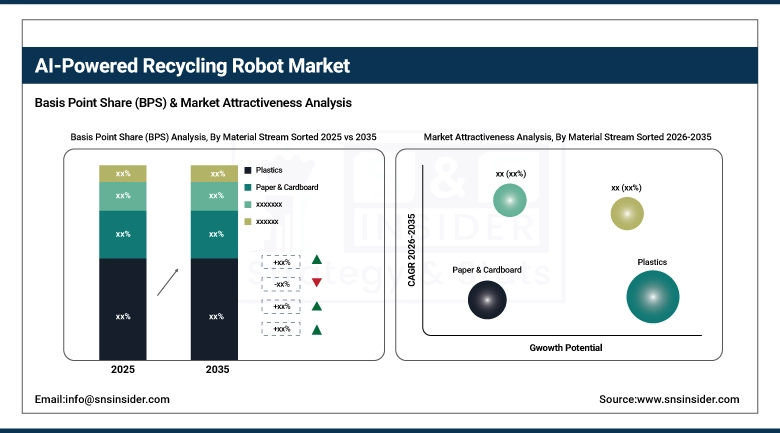
By Material Stream Sorted: Dominant – Plastics (34.80% in 2025 → 39.60% in 2035); Fastest Growing – E-Waste (15.70% in 2025 → 17.80% in 2035)
-
By End-User: Dominant – Recycling Facilities (38.50% in 2025 → 43.00% in 2035); Fastest Growing – Recycling Facilities (38.50% in 2025 → 43.00% in 2035)
By Type of Robot – Autonomous Robots (Dominant and Fastest-Growing)
The market for Autonomous Robots remains the largest, mostly due to adoption in industrial automation, logistics, manufacturing, and recycling applications where efficiency, accuracy, and minimal human intervention are required. Its deep integration with artificial intelligence, machine vision, and IoT-enabled systems further solidifies its leadership. This segment is also set to grow at the highest CAGR as the increasing deployment of fully autonomous systems in complex operational environments, a growing demand for workforce optimization, and accelerating R&D investments to advance the indigenous capacity of robotics intelligence, autonomy, and self-learning capability are expected to contribute to the overall growth.
By Application Area – Industrial Waste Management (Dominant and Fastest-Growing)
Industrial Waste Management, which has the largest market share, is the segment most widely used because of large-scale waste handling, segregation, and processing activities requiring the use of AI-powered recycling robots to operate efficiently and safely, and in accordance with regulations. When integrated with automated sorting systems and smart waste infrastructure, its leadership only grows stronger. It is also the fastest-growing segment according to new data, as industrial waste generation increases, in turn increasing the need for efficient robotic systems capable of sustainable waste processing, further propelled by stricter environmental regulations.
By Material Stream Sorted – Plastics (Dominant) and E-Waste (Fastest-Growing)
High volume plastic waste generation worldwide alongside the necessity of automated sorting solutions to advance recycling efficiency and material recovery efficiencies drives the dominant share of the Plastics segment This further helps to reinforce its top position in the market owing to compatible nature with advanced vision-based sorting technologies. On the other hand, the E-Waste segment is expanding at a faster rate owing to the increasing consumption of electronics, concerns regarding hazardous disposal of electronics, and the need for robotic sorting systems that are able to handle intricate and mixed material components.
By End-User – Recycling Facilities (Dominant and Fastest-Growing)
The Recycling Facilities segment accounted for the largest share owing to its importance in waste collection, sorting and recovery of materials, in which AI-enabled recycling robots play a major role in improving operational efficiency and throughput. The industry also leads in the utilization of automated sorting lines and intelligent systems processing waste. While the same segment is one of the fastest-growing segments, it is mainly driven by increasing investment into modern infrastructure for recycling, increasing demand for high-efficiency material recovery, and growing transition toward fully automated and smart recycling ecosystem.
AI-Powered Recycling Robot Market Regional Highlights:
-
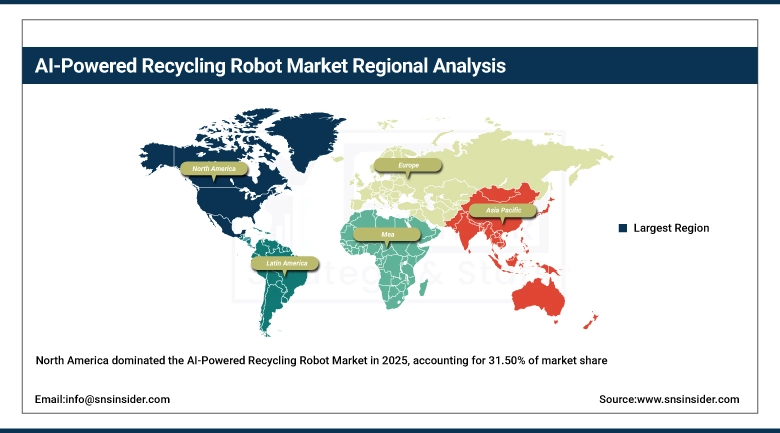
North America (Dominating – 31.50% in 2025 → 28.35% in 2035, CAGR 12.86%)
-
Asia-Pacific (Fastest Growing – 28.50% in 2025 → 33.90% in 2035, CAGR 16.04%)
-
Europe (27.00% in 2025 → 24.75% in 2035, CAGR 13.07%)
-
Latin America (7.00% in 2025 → 6.55% in 2035, CAGR 13.30%)
-
Middle East & Africa (6.00% in 2025 → 6.45% in 2035, CAGR 14.88%)
North America AI-Powered Recycling Robot Market Insights:
The analysis suggests that the region North America holds the largest share in global AI-Powered Recycling Robot market owing to high adoption of advanced automation technologies and infrastructure for effective waste management along with investment in smart recycling system. Strict environmental regulations and sustainability mandates drive effective material recovery and encourage limited landfill dependency in the region. Escalating labor costs and labor shortages are further accelerating the trend towards robotic sortation powered by Ai solutions Moreover, high technology innovation cost and high penetration & density of key robotics and AI organizations accelerates the market growth across the industrial recycling facilities.
Get Customized Report as per Your Business Requirement - Enquiry Now
U.S. AI-Powered Recycling Robot Market Insights:
The United States dominates the AI-Powered Recycling Robot market due to advanced recycling infrastructure, high adoption of AI and robotics, strong environmental regulations, and increasing demand for efficient waste sorting solutions driven by sustainability goals and labor cost pressures.
Asia-Pacific AI-Powered Recycling Robot Market Insights:
The Asia Pacific region is the fastest-growing market for AI-Powered Recycling Robots the growth can be attributed to rapid urbanization, increasing waste generation, expanded industrial and municipal recycling infrastructure. Increased environmental consciousness and favorable government measures adopted worldwide for sustainable waste management are driving the adoption at a rapid rate. Increased investment in smart manufacturing and automation technologies to drive market growth further. Besides, growing labor prices and the requirement for effective material recovery systems are also fueling demand for AI-based robotic sorting solutions across nations including China, Japan, South Korea, and India.
China AI-Powered Recycling Robot Market Insights:
China is a dominant and rapidly growing market for AI-Powered Recycling Robots due to strong government support for smart waste management, rapid industrialization, large-scale urban waste generation, and increasing adoption of automation and AI technologies to improve recycling efficiency and sustainability.
Europe AI-Powered Recycling Robot Market Insights:
Europe AI-Powered Recycling Robot Market Growth & Trends The growth of the market in Europe is expected to be steady in the next few years on account of higher environmental regulations, increased focus on circular economy initiatives, and growing sustainability targets across sectors. Launch of automation is being accelerated by rising labor costs and shortage of manual workers in sorting facilities for waste. Increasing investment in advanced recycling infrastructure and smart waste management systems further contributes to the market growth. Moreover, improved sorting precision and operational efficiency in the region is attributed the development of sensor technologies, AI, robotics and machine vision.
Germany AI-Powered Recycling Robot Market Insights:
Germany AI-Powered Recycling Robot market is evolving continuously due to strict recycling regulations, greater industrial automation, increased focus on sustainability, and the increase in adoption rate of AI based Waste Sorting technologies.
Latin America AI-Powered Recycling Robot Market Insights:
The Latin America AI-Powered Recycling Robot market is slowly gaining traction as urbanisation levels rise, waste generation increases, and the need for sustainable waste management practices is promoted. Governments in the region have been slowly tightening environmental regulations and promoting recycle programs. Scarcity of labor efficiency and infrastructure gaps is fuelling the demand for automation and AI-based sorting systems. Secondly, the rise in foreign investments and partnerships in waste management initiatives are further facilitating the adoption of advanced recycling technologies across regions, such as Brazil and Mexico.
Brazil AI-Powered Recycling Robot Market Insights:
Brazil holds the highest share in the Latin America AI-Powered Recycling Robot market owing to its large urban waste generation, increasing recycling infra, rising government attention on sustainable waste management, and adoption of automation & AI to improve operational efficiency in sorting and recovery of materials.
Middle East & Africa AI-Powered Recycling Robot Market Insights:
Growth of the Middle East & Africa AI-Powered Recycling Robot market is mainly attributed to rising urbanization and increasing waste generation in the region along with government initiatives to address sustainable waste management. Growth in smart city initiatives and innovative recycling facilities are driving the emergence of AI-based robotic sorting automation systems. Additionally, to optimize the operations & minimize the landfilling, the region is moving towards automation. Moreover, rising environmental awareness and international collaborations are promoting the use of advanced recycling technologies in significant countries.
United Arab Emirates AI-Powered Recycling Robot Market Insights:
The dominant country is the United Arab Emirates (UAE) due to its strong smart city initiative, advanced waste management establishment, and high investment into automation technologies, combined with aggressive sustainability & circular economy aims propel adoption of AI-based recycling systems.
AI-Powered Recycling Robot Market Competitive Landscape:
TOMRA Systems, established in 1972, is a global leader in sensor-based sorting and recycling solutions, specializing in AI-driven deep learning technologies and advanced material recovery systems. The company focuses on improving recycling efficiency through real-time monitoring, object recognition, and smart sorting innovations. Its key strategy includes supporting circular economy goals, enhancing sustainability, and enabling higher purity recycling streams across global waste management and packaging industries.
-
In Jan 2025 – TOMRA Systems stated that deep learning and real-time monitoring will enhance recycling efficiency through AI-based object recognition, cloud analytics, and smarter sorting systems. It also highlighted that regulations like the EU’s PPWR will drive demand for higher recycling standards, increased recycled content, and advanced sorting technologies worldwide.
AMP Robotics was founded in 2015 in the United States. It was established to transform the recycling industry using artificial intelligence, robotics, and machine learning technologies. The company has rapidly grown into a global leader in AI-powered sortation systems, enabling automated waste processing, improving recycling efficiency, and reducing environmental impact through intelligent material recovery solutions.
-
On Nov 2024, AMP Robotics announced, a partnership with Waste Connections to equip and operate a next-generation recycling facility in Commerce City, Colorado, scheduled for commissioning in early 2026, featuring its AMP ONE system processing up to 62,000 tons of single-stream recycling annually using AI-powered Smart Sortation.
AI-Powered Recycling Robot Companies are:
-
ZenRobotics
-
TOMRA Systems
-
Bulk Handling Systems
-
Waste Robotics
-
Recycleye
-
Machinex Technologies
-
Stadler Anlagenbau
-
Pellenc ST
-
CP Group (MSS Inc)
-
Greyparrot
-
Glacier
-
Bollegraaf Recycling Solutions
-
ABB Robotics
-
FANUC Corporation
-
KUKA
-
Siemens
-
Honeywell
-
Terex Corporation
| Report Attributes | Details |
|---|---|
| Market Size in 2025 | USD 1.53 Billion |
| Market Size by 2035 | USD 5.70 Billion |
| CAGR | CAGR of 14.06 % From 2026 to 2035 |
| Base Year | 2025 |
| Forecast Period | 2026-2035 |
| Historical Data | 2022-2024 |
| Report Scope & Coverage | Market Size, Segments Analysis, Competitive Landscape, Regional Analysis, DROC & SWOT Analysis, Forecast Outlook |
| Key Segments | • By Type of Robot (Flow, Temperature, Pressure and Conductivity or Other) • By Application Area (MEMS, Ultrasonic, Optical and Other) • By Material Stream Sorted (Standalone Probes, Inline Modules and Integrated Coolant Units) • By End User (Data Centers, Industrial Cooling and Battery Cooling and Others) |
| Regional Analysis/Coverage | North America (US, Canada), Europe (Germany, UK, France, Italy, Spain, Russia, Poland, Rest of Europe), Asia Pacific (China, India, Japan, South Korea, Australia, ASEAN Countries, Rest of Asia Pacific), Middle East & Africa (UAE, Saudi Arabia, Qatar, South Africa, Rest of Middle East & Africa), Latin America (Brazil, Argentina, Mexico, Colombia, Rest of Latin America). |
| Company Profiles | AMP Robotics, ZenRobotics, TOMRA Systems, Bulk Handling Systems, Waste Robotics, Recycleye, EverestLabs, Machinex Technologies, Stadler Anlagenbau, Pellenc ST, CP Group (MSS Inc), Greyparrot, Glacier, Bollegraaf Recycling Solutions, ABB Robotics, FANUC Corporation, KUKA, Siemens, Honeywell, Terex Corporation. |

Frequently Asked Questions
North America dominated the AI-Powered Recycling Robot Market in 2025.
The “Autonomous Robots” segment dominated during the projected period.
Rapid growth in waste generation and need for efficient sorting systems
The Market was valued at USD 1.53 Billion in 2025 and is projected to reach USD 5.70 Billion by 2035.
The Market is expected to grow at a CAGR of 14.06% during 2026–2035.
