
AI Recruitment Market Report Scope & Overview:
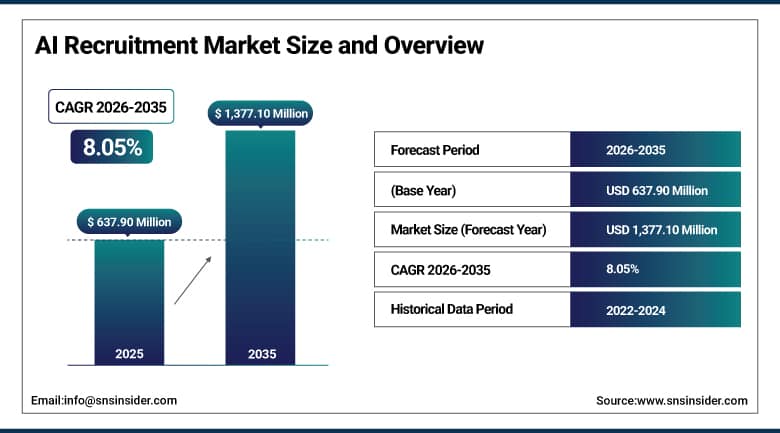
The AI Recruitment Market was valued at USD 637.90 Million in 2025 and is expected to reach USD 1,377.10 Million by 2035, growing at a CAGR of 8.05% from 2026 to 2035.
The AI Recruitment Market is undergoing a decisive shift as organizations move beyond basic resume-parsing tools toward fully agentic hiring systems capable of independently sourcing, screening, engaging and shortlisting candidates with minimal recruiter intervention. Conversational AI bots are becoming more common in talent acquisition teams to handle heavy volumes of candidate interactions, natural language search engines to convert plain English job requirements into a shortlist of candidates, and predictive analysis platforms to predict the probability of success and retention of those candidates even before making any offers to them. This transition is being fueled by persistent limitations in recruiter capacity, increasing volumes of applications due to easy application processes on job boards, and the need to minimize time to hire while enhancing the overall experience for the candidates.
In October 2025, Workday acquired Paradox, a conversational AI recruiting platform known for its Olivia assistant, in a deal valued at approximately USD 1 Million, extending Workday's hiring automation capabilities across high-volume, front-line recruiting use cases.
To Get More Information On AI Recruitment Market - Request Free Sample Report
AI Recruitment Market Trends:
-
Conversational AI agents are increasingly handling end-to-end candidate engagement for high-volume, front-line hiring.
-
Natural-language, prompt-based candidate search is replacing traditional Boolean sourcing methods.
-
Autonomous AI interviewers capable of structured, competency-based screening are gaining enterprise adoption.
-
Regulatory scrutiny is pushing vendors to embed explainability and bias-audit features directly into scoring models.
-
Skills-based talent intelligence platforms are expanding into internal mobility alongside external hiring.
U.S. AI Recruitment Market Outlook:
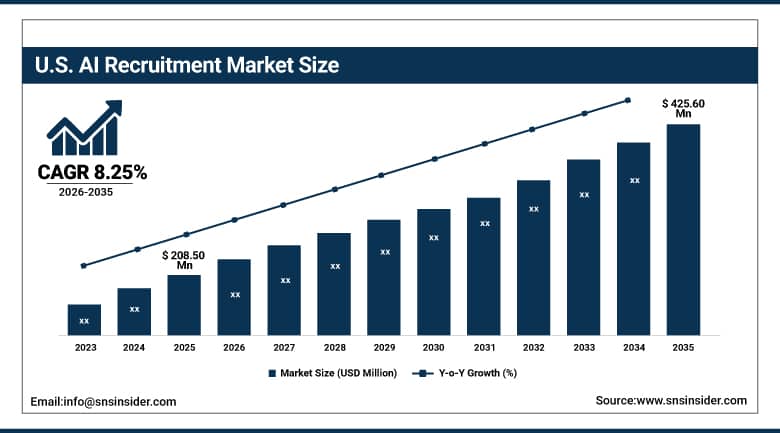
The U.S. AI Recruitment Market was valued at USD 208.50 Million in 2025 and is projected to reach USD 425.60 Million by 2035, growing at a CAGR of 8.25% during 2026–2035.
The leading position of the U.S. is also underlined by the presence of prominent HCM, ATS, and talent intelligence software providers who are based in the country, as well as the tough competition of enterprises for limited tech and specialist workers that leads to fast adoption of artificial intelligence recruitment tools. Leading American companies from such industries as technology, retail, healthcare, and logistics are actively using conversational hiring software to conduct recruiting during the peak seasons. Professional services and financial services organizations are increasingly turning to skills-based matching solutions.
In September 2025, LinkedIn's Hiring Assistant, described as the platform's first AI recruiting agent, became generally available, with charter customers reporting 62% fewer profiles reviewed and more than four hours saved per role filled.
AI Recruitment Market Segment Analysis:
-
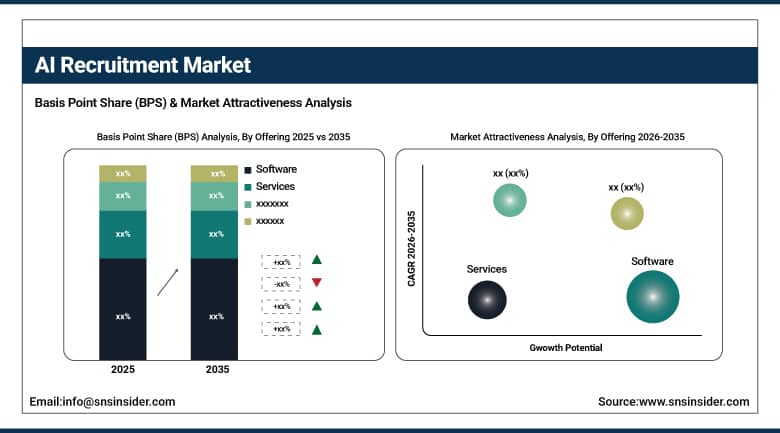
By Offering, Software dominated the AI Recruitment Market with a 68.50% share in 2025, while Services is the fastest-growing offering segment with a CAGR of 10.90% from 2026–2035.
-
By Deployment Mode, Cloud dominated the AI Recruitment Market with a 74.30% share in 2025, while Hybrid is the fastest-growing deployment segment with a CAGR of 12.40% from 2026–2035.
-
By Application, Candidate Sourcing & Screening dominated the AI Recruitment Market with a 34.20% share in 2025, while Predictive Workforce Analytics is the fastest-growing application segment with a CAGR of 13.80% from 2026–2035.
-
By End User, Corporates dominated the AI Recruitment Market with a 71.60% share in 2025, while Staffing & Recruitment Agencies is the fastest-growing end-user segment with a CAGR of 11.50% from 2026–2035.
By Offering, Software leads while Services grows fastest.
The Software segment dominated the AI Recruitment Market in 2025. The growing preference for licensed self-service AI recruiting platforms such as source, screen, and converse platforms in enterprises will persist in dominating spending. This will be owing to the need for ownership of recruiting tech stacks that are customizable according to the enterprise needs and can be integrated with the applicant tracking and HCM systems. Continuous addition of Generative AI capabilities in recruiting software solutions has driven this trend.
The Services segment is expected to grow at the fastest CAGR during 2026-2035. With the growth in adoption of AI solutions for recruitment by enterprises in various departments and regions, there will be a growing need for implementation, tuning, bias audit, and change management services related to these solutions to comply with relevant regulations.
By Deployment Mode, Cloud leads while Hybrid grows fastest.
The Cloud segment accounted for majority share of the AI Recruitment Market in 2025. Cloud-based recruiting tools help organizations in getting continuous updates in the form of language models and matching algorithms available for rapid onboarding of both large firms and limited resources mid-market players.
The Hybrid segment is set to witness the highest growth. Large companies, as well as companies that work with sensitive candidate data for the government, have started adopting hybrid strategies wherein candidate data remains within their purview, but the AI models deployed in the cloud help with sourcing and matching.
By Application, Sourcing & Screening leads while Workforce Analytics grows fastest.
The Candidate Sourcing & Screening segment led the AI Recruitment Market in 2025. This is by far the most mature application of AI in recruitment because resume parsing, automated shortlisting, and AI-enabled candidate sourcing directly deal with some of the most laborious tasks for recruiters and have quantifiable benefits that can easily be justified and measured.
The Predictive Workforce Analytics segment is forecast to witness the highest CAGR during the forecast period. The increasing interest among enterprises in predicting the success, turnover probability, and retention prospects of candidates before making the hiring decision is propelling the use of predictive analysis models, enabling organizations to extend the use of AI beyond mere candidate screening applications.
By End User, Corporates lead while Staffing Agencies grow fastest.
Corporates accounted for major share of the AI Recruitment Market in 2025. Large in-house talent acquisition operations of technology firms, retailers, healthcare providers, and financial service organizations continue to be the biggest purchasers of AI recruiting platforms due to the volume of continuous recruitment efforts and budgets allocated for HR technologies to deploy platforms companywide.
Staffing & Recruitment Agencies are projected to grow at the fastest CAGR through 2026-2035. Recruitment agencies with large volumes of candidates in their pipeline are increasingly turning to using AI-based sourcing and conversational engagement applications to distinguish themselves based on their faster placement times and superior candidate experience as their customers demand more efficiency from their outsourced recruitment process similar to that of internally-managed hiring powered by AI.
Regional Analysis:
|
Region |
Major Country |
Share within Region, 2025 (%) |
|
North America |
United States |
84.46% |
|
Europe |
United Kingdom |
27.40% |
|
Asia Pacific |
India |
29.80% |
|
Middle East & Africa |
UAE |
26.50% |
|
Latin America |
Brazil |
33.90% |
North America AI Recruitment Market Insights
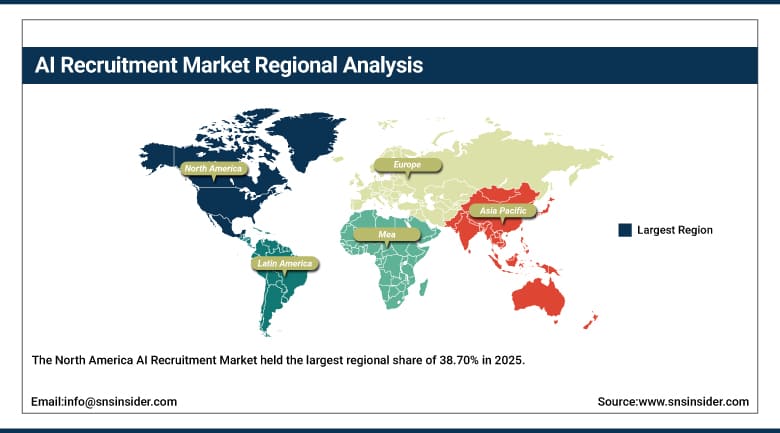
The North America AI Recruitment Market held the largest regional share of 38.70% in 2025, due to high labor market fluidity, constant struggle for skilled specialists, and the presence of the biggest players offering HCM and AI recruiting solutions within the region. Various industries, including tech, health care, retail and logistics continue to develop conversational and predictive hiring tools for managing application flow, whereas investments into AI recruitment startups in North America take up the major share.
The United States accounted majority share of the North America AI Recruitment Market in 2025, owing to the extensive adoption of applicant tracking and conversational hiring platforms among enterprises, and the rapid development of regulations at the state level forcing vendors to provide more transparent and auditable scoring systems. Canada adds to regional dynamics with the growing adoption of AI hiring technologies among mid-size companies and governmental entities.
Get Customized Report as Per Your Business Requirement - Enquiry Now
Europe AI Recruitment Market Insights
Europe continued to be a major player in the AI Recruitment Market in 2025 owing to the existence of many multinational companies and staffing agencies in Europe’s multi-linguistic fragmented labor markets. The strict laws related to data protection and transparency of hiring algorithms as per the EU AI Act and the GDPR regulations are influencing the product design for vendors within the region, making it a favorable market for vendors providing explainable scores and flexible data residency options.
The United Kingdom represented major share of the Europe AI Recruitment Market in 2025 due to presence of a highly developed industry of staffing/recruitment agencies along with high proportion of professional service firms adopting AI-driven applicant screening solutions. Additionally, Germany and France are driving growth within the region due to widespread enterprise adoption of AI-driven hiring solutions among manufacturers/financial services firms amidst stringent labor laws.
Asia Pacific AI Recruitment Market Insights
The Asia Pacific AI Recruitment Market is expected to register the fastest growth rate of approximately 10.2% globally during 2026-2035, driven by extremely high hiring volumes across the region's large outsourcing, IT-services, and manufacturing sectors, rapidly expanding cloud infrastructure, and rising employer willingness to adopt AI-powered screening to manage massive applicant pools for entry-level and campus-hiring programs. Regional technology conglomerates are also increasingly building proprietary AI recruiting tools tailored to local languages and hiring practices, further accelerating adoption.
India represented dominant share of the Asia Pacific AI Recruitment Market in 2025, supported by its vast IT-services and business-process-outsourcing hiring volumes and a fast-growing base of domestic AI recruiting start-ups. China and Japan are also significant contributors, with Chinese technology firms rapidly deploying AI-powered campus-recruiting platforms and Japanese enterprises adopting AI tools to address acute demographic-driven labor shortages.
Middle East & Africa and Latin America AI Recruitment Market Insights
Middle East and Africa, as well as Latin America regions, are increasingly adopting AI-based recruiting, as a result of the need to have standard hiring processes that are compatible with the national workforce-nationalization initiatives as well as multinationals increasing their presence in these regions.
Brazil represented majority of the Latin America AI Recruitment Market in 2025, fueled by its large outsourcing and business-process sector requiring efficient high-volume screening tools and growing domestic enterprise cloud adoption. The UAE led the Middle East & Africa region, supported by national workforce-development initiatives and growing government investment in AI-enabled public and private-sector hiring platforms.
Market Dynamics
Growth Drivers: Recruiter capacity constraints and rising applicant volumes fueling adoption
The growing disparity between the ability of recruiters to process more candidates due to one-click applications on popular recruitment portals is one of the main factors behind the AI Recruitment market. Firms rely on AI-based recruiting tools to be able to handle such volume while not increasing the number of recruiters accordingly. This way, organizations are able to keep their time-to-hire performance standards despite an increase in candidate application volume per position.
Continued advancement in large language models and structured-interview AI is also improving the quality and defensibility of automated screening decisions, encouraging broader enterprise adoption beyond early pilots. Rising employer focus on candidate experience, growing acceptance of 24/7 conversational engagement for high-volume front-line and hourly hiring, and increasing integration between AI recruiting tools and core HCM and payroll systems are further reinforcing sustained demand across the forecast period, as recruiting functions seek to operate as efficiently as other digitally transformed enterprise functions.
Restraints: Algorithmic-hiring regulation and candidate trust concerns limiting adoption
Regulations surrounding algorithmic hiring in New York City (Local Law 144), at the European Union level (AI Act high-risk designation of employment decision-making tools), and in various states across the United States are making compliance harder for AI recruiting vendors and their clients. The enterprises using these systems will have to do more third-party bias audits, retain documentation about how the algorithms work, and disclose to candidates that they are being scored – among other things.
Persistent candidate skepticism toward AI-driven screening, particularly concerns about opaque scoring criteria and the risk of qualified candidates being filtered out by automated systems, also continues to restrain adoption in certain markets and industries. Additionally, integration challenges between newer AI recruiting layers and legacy applicant-tracking systems, coupled with the need for ongoing model retraining to avoid embedding historical hiring biases, add further friction to large-scale, multi-country deployments.
Opportunities: Skills-based talent intelligence and agentic interviewing creating new growth avenues
The growing shift toward skills-based hiring, rather than credential- or pedigree-based screening, is creating substantial opportunity for AI recruiting vendors that can build defensible skills-ontology and matching capabilities extending across both external hiring and internal talent mobility. Enterprises seeking to unlock existing employee potential for internal moves, alongside external hiring, represent an expanding addressable market for talent-intelligence platforms built on unified skills data.
There is also considerable opportunity in autonomous, agentic interviewing technology capable of conducting structured, competency-based first-round conversations at scale, reducing multi-week screening cycles to same-day turnaround for high-volume roles. Continued expansion of cloud and AI infrastructure across emerging economies in Asia Pacific and Latin America, combined with rising government interest in AI-assisted public-sector hiring, will further widen the addressable market for AI recruitment vendors across organizations of all sizes.
Recent Developments:
-
2026: LinkedIn expanded Hiring Assistant through a quarterly feature update adding Microsoft Teams collaboration, AI Follow-Ups, AI Applicant Targeting, and Verified Applicant Spotlight.
-
2026: Eightfold AI launched its AI Interviewer, enabling autonomous, structured candidate interviewing designed to reduce multi-week screening cycles to same-day turnaround at enterprise scale.
AI Recruitment Market key players are:
-
Workday, Inc.
-
SAP SE
-
Ceridian HCM Holding Inc. (Dayforce)
-
HireVue, Inc.
-
iCIMS, Inc.
-
SmartRecruiters, Inc.
-
Greenhouse Software, Inc.
-
Eightfold AI, Inc.
-
Phenom People, Inc.
-
Beamery, Inc.
-
HireEZ, Inc.
-
Textkernel B.V.
-
Sense HQ, Inc.
-
ZipRecruiter, Inc.
-
Indeed, Inc.
-
LinkedIn Corporation
-
UKG Inc.
-
ADP, LLC
-
Zoho Corporation
-
JobDiva, Inc.
AI Recruitment Market Report Scope:
| Report Attributes | Details |
|---|---|
| Market Size in 2025 | USD 637.90 Million |
| Market Size by 2035 | USD 1,377.10 Million |
| CAGR | CAGR of 8.05% From 2026 to 2035 |
| Base Year | 2025 |
| Forecast Period | 2026-2035 |
| Historical Data | 2022-2024 |
| Report Scope & Coverage | Market Size, Segments Analysis, Competitive Landscape, Regional Analysis, DROC & SWOT Analysis, Forecast Outlook |
| Key Segments | • By Offering (Software, Services) • By Deployment Mode (Cloud, On-Premises, Hybrid) • By Application (Candidate Sourcing & Screening, Interview Scheduling & Assessment, Onboarding & Engagement, Predictive Workforce Analytics) • By End User (Corporates, Staffing & Recruitment Agencies) |
| Regional Analysis/Coverage | North America (US, Canada), Europe (Germany, UK, France, Italy, Spain, Russia, Poland, Rest of Europe), Asia Pacific (China, India, Japan, South Korea, Australia, ASEAN Countries, Rest of Asia Pacific), Middle East & Africa (UAE, Saudi Arabia, Qatar, South Africa, Rest of Middle East & Africa), Latin America (Brazil, Argentina, Mexico, Colombia, Rest of Latin America). |
| Company Profiles | Workday, Inc., SAP SE, Ceridian HCM Holding Inc. (Dayforce), HireVue, Inc., iCIMS, Inc., SmartRecruiters, Inc., Greenhouse Software, Inc., Eightfold AI, Inc., Phenom People, Inc., Beamery, Inc., HireEZ, Inc., Textkernel B.V., Sense HQ, Inc., ZipRecruiter, Inc., Indeed, Inc., LinkedIn Corporation, UKG Inc., ADP, LLC, Zoho Corporation, JobDiva, Inc. |

Frequently Asked Questions
The market is driven by the widening gap between recruiter capacity and rising applicant volumes, growing enterprise adoption of conversational hiring agents, and continued advancement in structured, AI-powered interviewing technology.
The Candidate Sourcing & Screening segment dominated the AI Recruitment Market in 2025, accounting for approximately 34.20% market share.
The North America region dominated the AI Recruitment Market in 2025 with a 38.70% market share, supported by the region's high labor-market mobility and concentration of leading AI recruiting vendors.
